
Published : 05 Jul 2023, 04:06 AM
Updated : 08 Jul 2023, 06:13 PM


A pre-monsoon survey conducted by the health directorate on Dhaka city has uncovered an alarming surge of Aedes aegypti mosquitoes, known carriers of the dengue virus, fuelling the worst spread of the disease in the last five years.
The survey found 55 wards in the capital's two city corporations are at high risk of dengue as the Breteau Index or BI of Aedes aegypti mosquitoes is more than 20 in these wards, the Directorate General of Health Services said at a press conference on Tuesday.
The mosquito density is chiefly measured using the BI, which counts the number of positive containers per 100 places inspected. BI exceeding 20 percent is risky, according to experts.
After the first case of dengue was reported in Bangladesh in the 1960s, the highest number of hospitalisations occurred in 2019, with 101,354 dengue patients and 179 fatalities. The majority of those affected and died were residents of Dhaka.
The pre-monsoon survey that year revealed that 21 wards in the city had a BI exceeding 20.
However, the survey revealed Tuesday showed that the average BI of the two city corporations is more than 20 – 25.52 in the Dhaka North City Corporation areas and 20.98 in Dhaka South City Corporation.
The study was carried out across 98 wards in Dhaka from Jun 18-27. The surveyors inspected 40 wards of DNCC and 58 wards of DSCC. Out of the 4,149 houses they visited in these wards, the surveyors found Aedes aegypti larvae in a total of 549 houses. Among them, 272 houses were in DNCC, and 278 were in DSCC.
In 2019, seven wards in DNCC and 14 wards in DSCC had a BI above 20, according to the DGHS report. However, in 2020, no wards in either city corporation exceeded the threshold.
In 2021, each city corporation had one ward with a BI higher than 20. In the 2022 survey, the north city had no wards with a BI above 20, while the south city had three such wards.
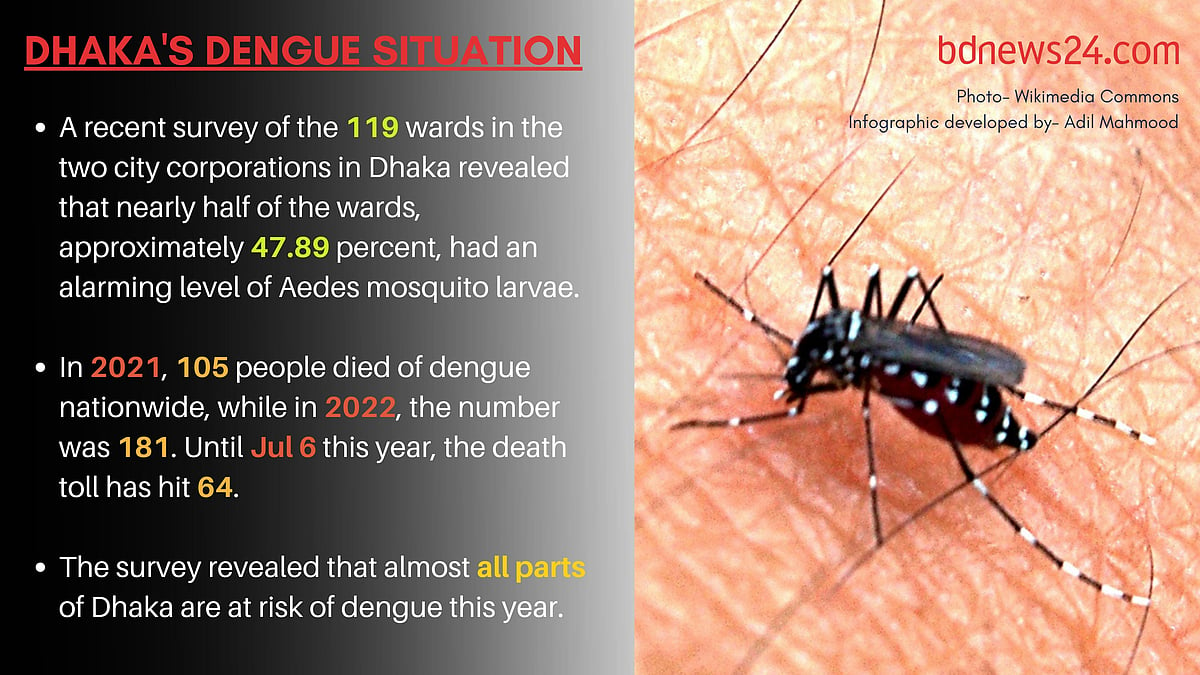
This year's survey of the 119 wards in the two city corporations revealed that nearly half of the wards in Dhaka, approximately 47.89 percent, had an alarming level of Aedes mosquito larvae, surpassing the BI threshold.
In 2020, a total of 1,405 people contracted the disease at the peak of the coronavirus pandemic, and no one died. The number of reported hospitalisations was 28,429 in 2021, with 105 deaths.
In 2022, there were 62,382 dengue hospitalisations nationwide, with 181 deaths. Dhaka alone saw 39,220 patients admitted to hospitals.
Until Jul 4 this year, the number of hospitalisations over the disease has reached 9,871, and the death toll has hit 61.
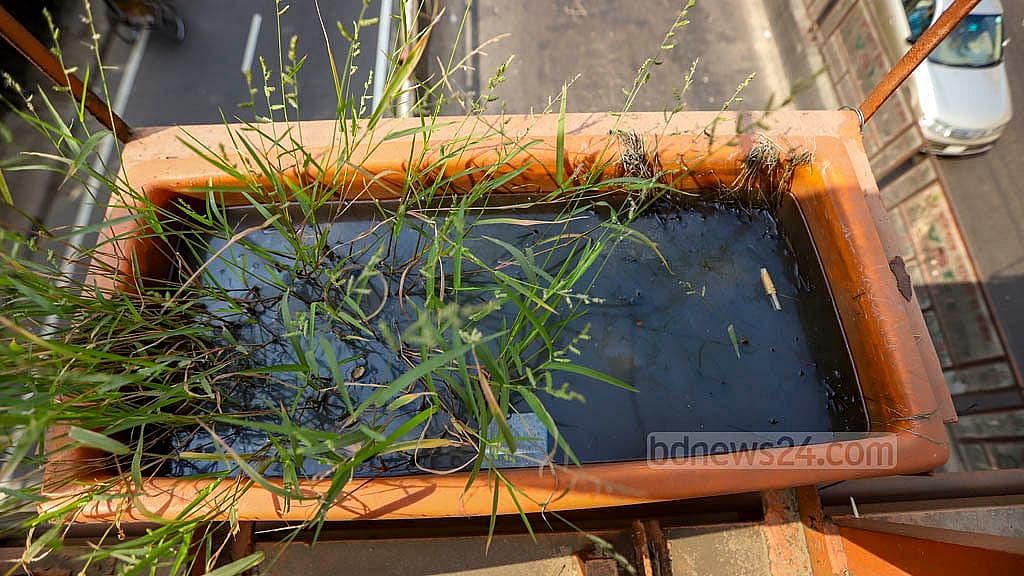
The Aedes mosquito-borne disease began spreading even before the start of the monsoon season this year. The number of cases and deaths has continued to rise since.
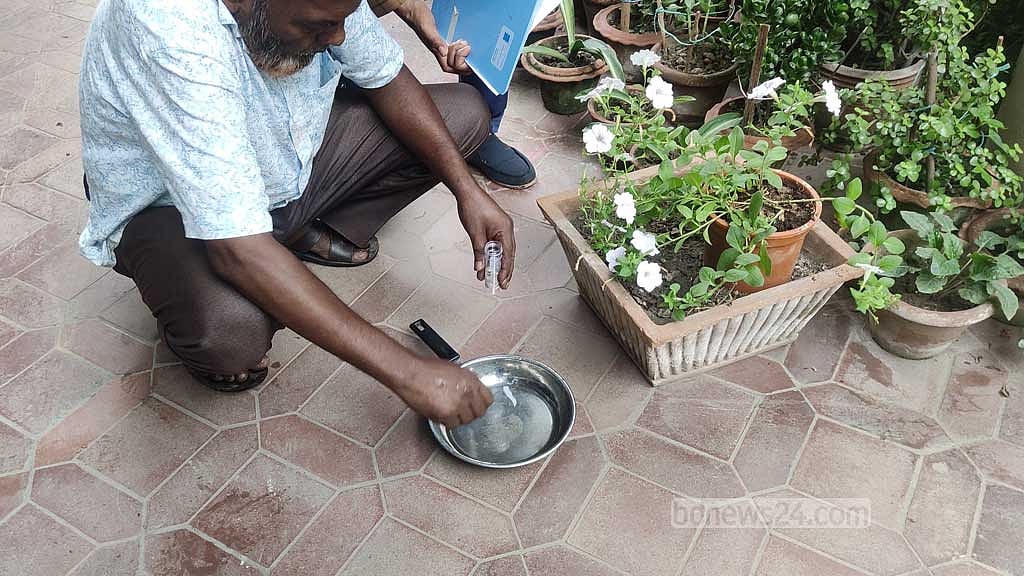
Entomologist Kabirul Bashar, a professor of zoology at Jahangirnagar University, was involved in the survey.
Monsoon already arrived in Dhaka when this year's “pre-monsoon” survey was conducted, which means the results are not fully comparable with the findings of the previous surveys, Kabirul said.
However, the latest survey results are still concerning, he said.
“We fear that the spread of dengue will be much worse this year than before. We’re finding a higher density of mosquitoes this year at the field level.”
The pre-monsoon survey, typically conducted in May, was carried out in June this year, deviating from its usual timing.
“According to our statistics, the Breteau Index and the House Index are higher in both the city corporation areas. This means that the presence of dengue-carrying Aedes mosquitoes is very high in these areas. No matter whether we live in the North or South (city corporations), we are all at risk of contracting dengue,” Professor Md Nazmul Islam, director of the DGHS’s disease control wing, said at a press conference where the survey findings were unveilled.
As part of efforts to contain the spread of the disease, DNCC has cancelled the leaves of its officials and workers to ease waterlogging and prevent Aedes aegypti mosquitoes from breeding in stagnant fresh water.
The DSCC is conducting a combing operation in the capital to eradicate the breeding grounds of dengue-carrying mosquitoes as the deadly disease is running rampant.
HIGH-RISK ZONES IN DHAKA
The DGHS survey revealed that almost all parts of the capital are at risk of dengue.
According to the DGHS, several DNCC areas, including Mirpur, Pallabi, Mazar Road, Pirer Bagh, Monipur, Shewrapara, Kafrul, Ibrahimpur, Khilkhet, Kuril, Joar Sahara, Banani, Gulshan, Baridhara, Mohakhali, Rampura, Khilgaon, Malibagh, Karwanbazar, Tejturi Bazar, Agargaon, Mohammadpur, Baitul Aman, Moghbazar, Eskaton, and Badda, are identified as vulnerable to dengue.
In DSCC, several areas such as Goran, Meradia, Basabo, Sabujbagh, Mugda, Mothertech, Fakirapool, Arambagh, Shahjahanpur, Rajarbagh, Purana Paltan, Baitul Mokarram, Dhanmondi, Rayerbazar, Neelkhet, Science Laboratory, Elephant Road, Minto Road, Kakrail, Hazaribagh, Lalbagh, Azimpur, Palashi, Bangsal, Siddikbazar, Shankhari Bazar, Ray Saheb Bazar, Wari, Sutrapur, Mill Barrack, Sayedabad, Uttar Jatrabari, Mirhajirbagh, Dholaipar, Gendaria, Jurain, and Kamrangirchar have a BI above 20.
DGHS reports that in DNCC, ward number 35 has a BI of 100, ward numbers 30 and 31 have a BI of 57, ward number 38 has a BI of 47, and ward number 13 has a BI of 41. In DSCC, ward number 34 has a BI of 60, ward number 45 has a BI of 47, ward numbers 16 and 26 have a BI of 40, ward number 22 has a BI of 43, and ward number 18 has a BI of 41.
[Writing in English by Arshi Fatiha Quazi, Editing by Osham-ul-Sufian Talukder]