Published : 17 Nov 2026, 08:25 PM
Updated : 17 Nov 2026, 08:25 PM


For years, I have been writing on social media about how religion, its rituals, symbols and emotional charge are used in Bangladesh as tools of social control rather than as guides to spirituality. Religion, particularly Islam, is deeply intertwined with politics, group identity and public morality, so there is little space for individual belief. In Bangladesh, as the government seeks political legitimacy through religion, ordinary citizens increasingly feel pressured to conform.
My discomfort with religious interference started early in my life. I was raised in a traditional rural Muslim family and was encouraged to practise Islam, but never compelled to do so. However, when someone outside the family questioned my religious practice, I felt uncomfortable. I believed that my faith was entirely my own concern.
This discomposure deepened during my time at university. Members of the Tabligh Jamaat regularly visited our student residence, inviting us to attend prayers, religious discussions at the mosque and Tablighi tours. The request was not problematic, but their actions presumed that attendance was mandatory as a Muslim. Out of social pressure, on one occasion, I participated in a three-day Tabligh tour. I felt forced; I felt embarrassed. That was a lesson I have never forgotten: forced faith is not true faith, and you should not invade someone’s religious practice.
Two Ways of Being Muslim in Bangladesh
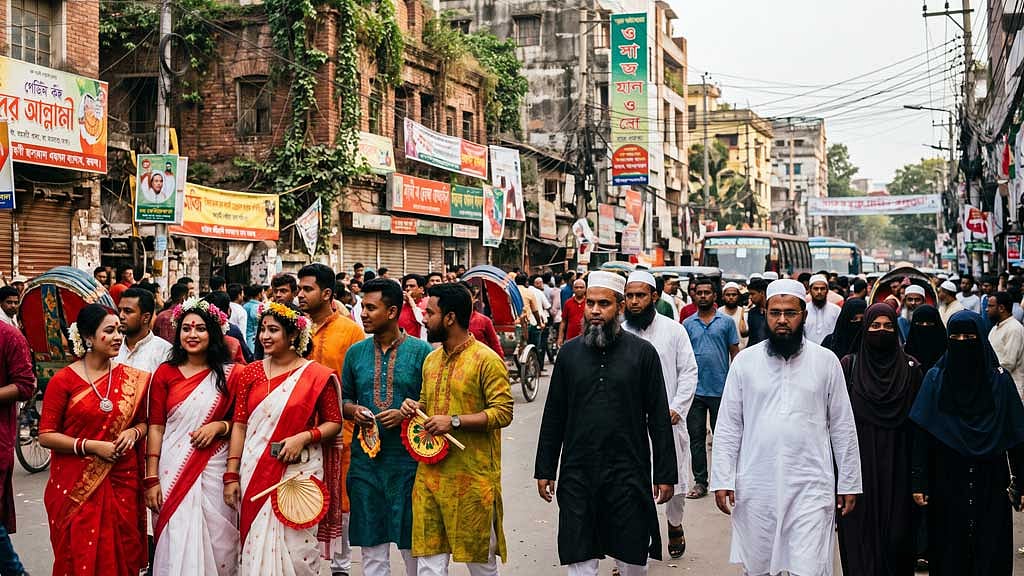
My personal experience illustrates a broader social phenomenon. Over time, Bangladeshis have gradually shifted from seeing themselves as Bangalees first, with Islam as their faith and their cultural identity rooted in an undivided Bengal, to placing their religious identity ahead of their ethnic and cultural heritage. This transformation has significant consequences.
A person who is Bangalee by culture and Muslim by faith considers religion a private affair and culture a shared experience. Someone who places Muslim identity above Bangalee heritage, on the other hand, perceives religion as a tool to shape society and will routinely reject Bangalee culture as un-Islamic. This conflict is largely present in our politics, our society and our everyday lives.
Although the distinction may seem like mere wordplay, it has a deep impact. It concerns what individuals believe they can impose their beliefs on others.
Those who see themselves as culturally Bangalee and religiously Muslim can quite happily share language, literature, songs and festivals with neighbours of any faith, as these are cultural things that do not require religious approval. Conversely, those who define themselves primarily through Islam often question whether sharing culture is permissible and frequently conclude that it is not.
An Islam that Grew by Accommodation
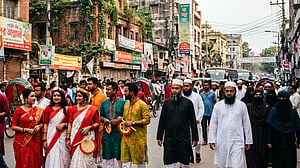
Historical evidence demonstrates that Islam in this region spread primarily through acceptance rather than coercion. Between the eighth and 13th centuries, Arab traders and Sufi saints introduced Islam through kindness, social service and spiritual appeal. Bengal embraced an eclectic form of Islam that incorporated local customs and norms. Even a few decades ago, Muslims attended Hindu fairs, sang Baul songs and participated in folk traditions.
The legacy of a Bangalee identity shaped by both culture and faith was reaffirmed in 1971. Bangladesh was not created as a state for a single faith. Its founding promise, articulated in the 1972 constitution, was that Bangalee nationhood, democracy, socialism and equal citizenship would unite people of diverse religions.
Defending Bangalee culture is not merely nostalgic; it is a defence of the foundational agreement upon which the country was built. Today, this inclusive culture is diminishing due to the rise of organised religious politics or political Islam in Bangladesh.
When Preaching Becomes a Business
The rise of the modern preacher has hastened this process. So many of the Islamic speakers one sees on television, on social media and at Waz Mahfils (sermons) disseminate distorted history, misogyny and hatred towards other religions. Their talks are full of fabricated stories, inappropriate content and incitement to attack non-Muslims and other Muslim groups. They get away with it completely. In fact, they often become more popular because religious sensationalism gets the public’s attention.
Much of this popular religious activity has become commercialised. Sermons by religious speakers generate revenue, audiences are manipulated, and religion is being treated as a commodity. When religious preaching becomes an industry, spiritual values become subordinated to the pursuit of profit. Consequently, many young men develop a distorted understanding of religion while receiving little genuine spiritual or moral guidance.
At the same time, political actors have realised that religion is an effective instrument for mobilisation, which they have used in modern politics. From the anti-Ahmadiya movement to attacks on Hindu and Buddhist temples, and from branding critics as anti-Islamic (kafir) or Islamophobic to banning cultural programmes, religion has now become a convenient tool for asserting dominance.
The state or the government often ignores these actions or, in some cases, collaborates, as religion delivers political advantages. This failure to maintain the separation between religion and state is the cause of the impunity and the social unrest that we see.
A State Cannot Have a Religion
The principle remains straightforward: a state cannot possess a religion. A state is a legal entity, not an individual. It cannot pray, fast or attend a mosque. However, it must protect the rights of all citizens equally, including Muslims, Hindus, Christians, Buddhists and atheists, as is guaranteed in the Constitution as a fundamental right. When the state chooses or favours a religion, it ends up discriminating against others.
Bangladesh’s founding promise was secularism, defined not as the absence of religion but as the state’s neutrality towards all religions. That promise has diminished. Contemporary social unrest, religious intolerance and frequent communal conflicts indicate this decline. I argue that if religion continues to be intertwined with politics, both religion and the nation will be weakened.
I say this because I was brought up in the principle of equity and compassion. I support secularism and the 1972 Constitution, not as a rejection of religion. I have seen what happens when religion is forced upon people. Any faith that relies on the police, the mob or the state to survive has already surrendered its claim to true spirituality.
The Way Forward is Personal Freedom
A viable path forward begins with restoring personal freedom. Religion should be confined to private life. Individuals should be free to pray, fast, perform Puja or attend prayer halls according to their own choice.
Parents may convey religious values to their children, but they should also instil tolerance. Until their children reach maturity, parents should shield them from external religious pressures. Once they become adults, they must have the autonomy to choose their own spiritual path. Islam itself communicates that “there is no compulsion in religion”. Coercion affects personal dignity and violates the faith it purports to defend.
Bangladesh stands at a crossroads. The nation should not continue intertwining religion with politics, which leads to division, hypocrisy and intolerance; instead, it can reclaim its tradition of pluralism and cultural richness. Maintaining a separation between religion and politics will not undermine faith; rather, it will strengthen society.
It is now the time to ask: will we be people whose Bangalee cultural roots sit comfortably alongside our Muslim faith, proud of our culture and individuality? Or will we be people whose Muslim identity takes precedence over their Bangalee heritage, whose very sense of self is defined by fear, coercion and political control?
Our future hinges on the answer.
[Dr Mahmud M Hasan is an associate professor of law at Carleton University, in Ottawa, Canada]