Published : 28 Aug 2023, 03:05 PM
Updated : 28 Aug 2023, 03:06 PM


Over the years, cases of the mosquito-borne dengue virus were typically confined to Dhaka's urban landscape. But recently, the deadly disease has spread far beyond the boundaries of the city.
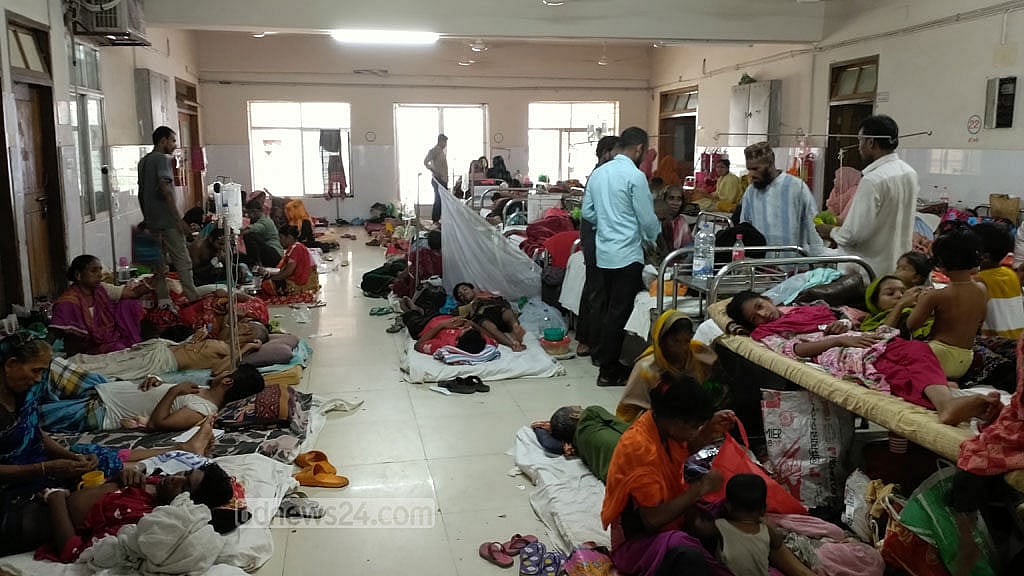
As Bangladesh grapples with the worst dengue outbreak on record, the disease is now equally as prevalent outside the capital, posing a nationwide health risk. It has also stoked fears of the healthcare system being overwhelmed.
Alarmingly, larvae of the Aedes aegypti mosquito, a known carrier of the dengue virus, were discovered in seven out of 10 houses in a village in Patuakhali’s Dumki Upazila. A survey by the health directorate also revealed the presence of Aedes larvae in 10 out of 37 containers.
In another survey conducted on Jul 11, Aedes mosquito larvae were detected in seven out of 10 houses in Pirojpur's Nesarabad Upazila. Eight out of 16 containers were also found to contain the larvae.
As cases of dengue continue to run rampant in 2023, experts have flagged the mounting health risks stemming from the presence of Aedes mosquitoes outside Dhaka.
The health directorate’s updated data on dengue detection and patient admission has also backed these findings.
Although patient admissions in Dhaka hospitals were higher earlier this year, the trend has gradually shifted. By mid-August, hospital admissions outside Dhaka had surpassed those in the capital.
On Sunday morning, 8,299 patients were under hospital care across the country, with 4,354 outside Dhaka and 3,945 in the capital.
In Dhaka, 813 new patient admissions were reported, while outside the capital, the number was 1,440.
The city saw eight deaths from the disease, while other districts recorded three fatalities.
The overall tally of infections since January stands at 114,511, with a death toll of 548.
The number of hospitalised patients and deaths is at an all-time high. The health directorate is concerned that it might increase further due to the rising number of infections across the country.
The situation has raised concerns for Prof Kabirul Bashar of Jahangirnagar University’s zoology department. Highlighting the widespread prevalence of Aedes mosquitoes, he warned about challenging times ahead as dengue continues to spread.
He also raised questions about the country's capacity to control the outbreak, pointing out the difficulty of managing the disease's spread to unions and villages with limited resources.
Other experts and physicians have also expressed concerns about the additional strain on the healthcare system if the disease continues to spread beyond Dhaka.
SURVEY FINDINGS
The presence of mosquito larvae is evaluated using the Breteau Index. A 'risky' presence of mosquitoes is indicated if Aedes larvae or pupae are found in 20 or more breeding sources out of every 100 surveyed. If the House Index exceeds five percent, experts consider it a 'risky' presence of mosquitoes.
In July and August, the health directorate conducted surveys in various parts of the country, including Gazipur, Narayanganj, Rajshahi, Jashore, Pirojpur, and Patuakhali. A 'risky' presence of mosquitoes was identified in all these areas.
GAZIPUR, NARAYANGANJ AND RAJSHAHI AT 'HIGH RISK'
Between Jul 23-28, the health directorate surveyed 41 out of the 47 wards under Gazipur City Corporation. Of the 1,050 households visited, mosquito larvae were found in 150, and 253 out of 1,024 containers surveyed.
The Breteau Index exceeded 20 in 24 out of 41 wards, with a highest score of 87. Among the mosquitoes found in Gazipur, 76.4 percent were Aedes albopictus and 23.6 percent were Aedes aegypti.
Aegypti mosquitoes can transmit dengue, chikungunya, and other diseases, while albopictus spreads dengue and chikungunya.
Dr Rahmatullah, chief health officer of Gazipur City Corporation, said he had not received the health directorate's survey report and refrained from commenting on mosquito control measures.
Instead, he shared a report detailing measures undertaken for mosquito control, including 'fogging and larviciding' in surrounding areas when a dengue patient is identified in a house.
From June to August, 17 mobile courts and 140 special drives were conducted.
Between Jul 30 and Aug 3, surveys were conducted in 705 households across the 27 wards of Narayanganj City Corporation. Among them, 95 households had mosquito larvae. Out of the 638 surveyed containers, larvae were found in 138.
Eleven of these wards had a Breteau Index of over 20, the highest being 113. Among the mosquitoes found in Narayanganj, 58.4 percent were Aedes aegypti, and 41.6 percent were Aedes albopictus.
Selina Hayat Ivy, mayor of Narayanganj city, said she had not been informed about the health directorate's survey methodology or the individuals involved.
She noted that although an 'alarming' situation was detected, the city did not have as many patients, and preventive activities were ongoing, including larviciding and providing mosquito coils.
From Jul 5-9, surveys were carried out in wards 7, 8, 10, 13, and 21 of the Rajshahi City Corporation. Among the 75 households surveyed, 28 contained larvae, among the 73 water containers examined, larvae were found in 35.
The House Index rating in these wards was 37.3, and the average Breteau Index score was 46.67 percent. Among the mosquitoes found in the city, 20 percent were Aedes aegypti and 80 percent were Aedes albopictus.
RISKY PRESENCE OF AEDES IN VILLAGES
According to the health directorate’s Barishal divisional office, 166 patients were admitted to hospitals in the 24 hours to Friday. During that period, 60 people were hospitalised in Patuakhali Upazila. The number of patients in the district and upazila hospitals around the city is also increasing.
Surveyors highlighted a higher presence of Aedes albopictus mosquitoes in the region, although specific percentages were not provided.
Between Aug 1-10, a survey was conducted in two wards of Jashore Municipal Corporation. The larvae of Aedes mosquitoes were found in 11 out of 20 surveyed houses. The Breteau Index for these two wards reached 80.
Dr Biplab Kanti Biswas, the civil surgeon of Jashore, said, "We have found the presence of Aedes mosquitoes in these areas. We have informed the local administration about this.
"They are managing the situation. However, Jashore municipality covers a large area. It is not possible to use pesticides everywhere and every day."
LOOMING DANGER IF NOT CONTROLLED
Prof Kabirul expressed concern over the fact that the surveys were based on limited samples, excluding Gazipur and Narayanganj, making it difficult to form an accurate assessment of mosquito presence. However, the risky presence of Aedes mosquitoes in districts beyond Dhaka is evident.
Kabirul also undertook personal surveys in some areas, detecting a risky presence of mosquitoes. He stressed the need for immediate mosquito control measures.
Dr Md Nazmul Islam, director of the disease control branch of the health directorate, said that the samples they have taken for surveys in areas outside Dhaka are smaller in comparison to the capital. However, the presence of mosquitoes is higher than normal.
"Compared to Dhaka, there are fewer houses and people in these areas. Sample sizes are determined based on proportionality. So, the above-normal presence of mosquitoes needs to be taken into account. Programmes need to be implemented based on this."
He attributed the rising number of patients outside Dhaka to the growing population of mosquitoes. He emphasised curbing mosquito breeding to reduce the dengue outbreak.
Despite increased cases, there is no specific mosquito control programme for areas outside Dhaka, according to Abu Jamil Faisel, a public health expert.
"I visited Manikganj on Tuesday, and there were about 250 hospitalised patients. The situation is similar in other districts. To control the dengue outbreak, we must reduce the mosquito population."
[Writing in English by Md Taif Kamal]