
Published : 18 Nov 2026, 01:05 AM
Updated : 18 Nov 2026, 01:05 AM


Ramisa Akhter’s rape and murder case reached a verdict in just five working days, a speed hailed by the government as a milestone.
For thousands of other children and their families, justice moves at a different pace.
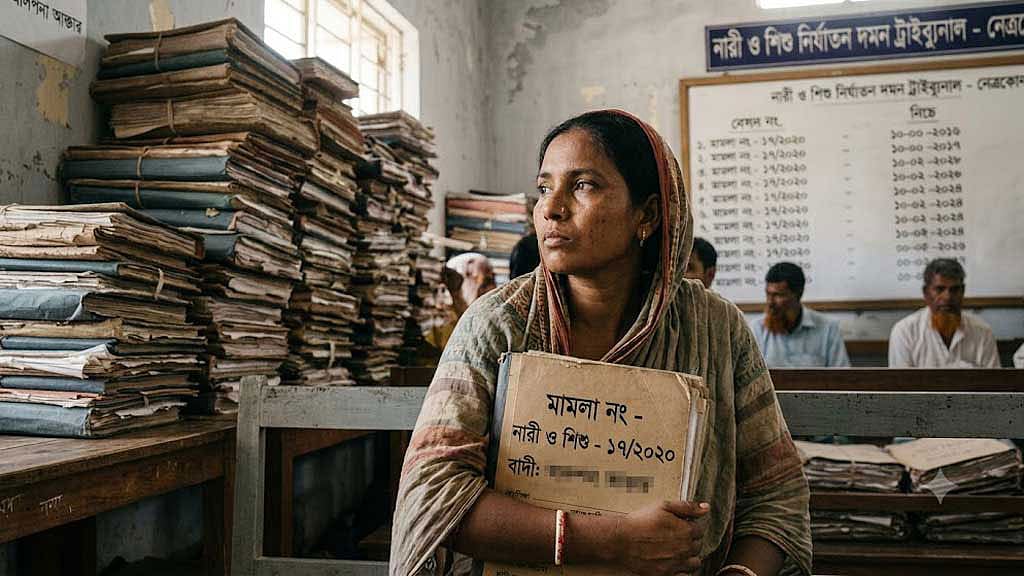
A Supreme Court-BRAC study found that cases before Women and Children Repression Prevention Tribunals take an average of three years and seven months to conclude, with 22 hearings each.
Experts cite delayed investigations, too few courts and judges, absent parties and witnesses, repeated adjournment requests and loopholes in the law.
A case over the rape of 14-year-old Panna Akter in Netrokona and allegations that she was driven to suicide was filed in 2017. Its verdict came nearly eight years later. The suspects were sentenced to death, but the punishment has yet to be carried out.
In March 2025, an 8-year-old girl was raped and murdered in Magura. The key suspect was sentenced to death within 14 working days. That sentence, too, remains unexecuted.
A death sentence must go to the High Court before execution. Supreme Court and prison officials say a backlog is holding up executions. The court is now hearing references from 2018; at this pace, verdicts delivered in 2026 may not be resolved until 2034.
Retired Supreme Court judge Krishna Debnath, who spent 43 years in the courts, said the speed of a few cases should not obscure the thousands left waiting.
“I have worked in the courts for 43 years. There are 100,000 cases, among them 20,000 Ramisas.
“I spent around four years in the High Court’s death reference court. I saw convicts whose cases had been decided 10 years earlier still in the condemned cell.”
The Supreme Court and BRAC analysed 4,040 cases disposed of between January and June 2025 in 42 tribunals across 32 districts.
The study identified absent parties, frequent adjournment requests, slow investigations, weak evidence, missing witnesses and inadequate witness protection as major causes of delay.
As of Jun 30, 2026, 116,392 cases were pending in tribunals across the 64 districts. Of these, 1,609 were stayed by higher court orders and 11,879 remained at the inquiry or investigation stage, leaving 104,513 awaiting trial. Another 26,249 had been pending for more than five years.
Why Cases Take So Long
The Women and Children Repression Prevention Act 2000, amended in 2026, sets a 15-working-day deadline for investigations from the date a suspect is arrested.
Krishna called verdicts in five or six working days “abnormal”.
“I do not know how these cases encourage people.
“There are 100,000 cases, and 20,000 Ramisas. The Ramisa who never made it into the media did not get justice so quickly. I am completely opposed to delivering a verdict in six days.”
She said, “Under pressure from the media, under pressure from society… justice should be allowed to take its proper course. A case should be concluded in at least 15 or 21 working days. But I cannot even imagine how it is possible in six days.”
Panna’s mother Alpana Akter told bdnews24.com that pursuing the case had cost her dearly.
“I spent a lot of money pursuing the case. I worked at a brick kiln and in shops to keep it going. There was the cost of transport to and from court, food and many other expenses. I pursued the case for nine years.”
“They took a bag full of money and told me to withdraw the case. Because I would not withdraw it, they beat me. I was admitted to hospital.”
“At night, they poured kerosene around the four sides of my house and set it on fire. People from nearby came and put it out with water.”
Police investigators and state lawyers told bdnews24.com that delays in DNA tests, medical reports and forensic examinations often hold up investigations. DNA results can take more than a year.
In a child rape case in Chattogram’s Bakalia, suspect Monir Hossain, 30, was sentenced to life imprisonment within 13 days. Investigation officer Inspector Tanvir Ahmed submitted the charge sheet in five working days.
“The case was given priority, you could say. The case was sensational. As a result, the medical and DNA reports came quickly.”
For other cases, he said, “One of the main reasons most investigations cannot be completed is that the medical reports are not received. Sometimes it takes more than a year to get these reports.” A shortage of personnel was another problem.
Mahmud-ul Alam Chowdhury Maruf, a state lawyer at two Chattogram tribunals, said delays weakened cases and discouraged plaintiffs.
“Often, after a case is filed, the plaintiff changes address. Because of the change, summons are not properly served. Many witnesses also move away. As a result, they cannot be brought to court properly.”
He added that accused people sometimes manipulate the process to make summons disappear.
A special bench formed by the chief justice on Jun 10 to speed up death references and appeals has disposed of more than 22 references, Supreme Court figures show.
The Long Wait after a Death Sentence
Krishna said too few High Court benches were another obstacle. A hearing takes at least a week, as judges must read the full file and hear both sides.
“If there is one death reference court or two, when we hear a death reference, the hearing takes at least one week. First, the entire file is read, every witness… all the documents. Then the state argues for one day, the defence for one day, and we, the judges, have some queries. This way, it takes five working days. The judgement is delivered after the hearing.”
She said one court could hear about four references a month. With the High Court closed for three months a year, that meant 36 cases annually; two benches could hear 72.
A senior High Court official, speaking anonymously, said: “The death reference court is currently hearing verdicts from 2018.
“The sensational cases come up earlier on the list and are heard quickly. The others are taken up year by year.”
For Krishna, the way forward begins with more courts and more judges. But expanding the judiciary takes time and experience cannot be acquired overnight.
“The number of courts must be increased. To increase the number of courts, judges must be appointed. But you cannot appoint someone today and put them in a death reference court tomorrow,” he said.
Ramisa's verdict showed that justice can move swiftly. The greater test is whether the system can make that possible for every child -- not just those whose suffering captures the nation's attention.