Published : 25 Sep 2026, 09:58 AM
Updated : 25 Sep 2026, 09:54 AM


Prime Minister Tarique Rahman has urged the global community to replace lethal weapons with debate, diplomacy, education, and humanity as the primary tools for driving global change.
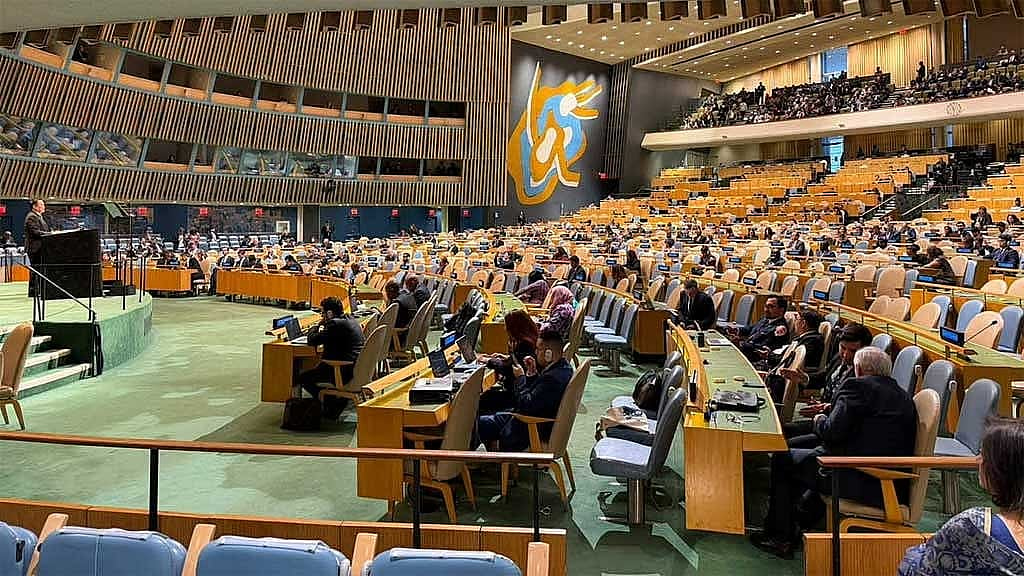
In his maiden address to the United Nations General Assembly on Thursday, Tarique outlined Bangladesh’s position on global conflicts, peace and security before setting out his government’s plans for the country.
Speaking in Bangla at the 81st session, Tarique said “equality, fairness, protection of mutual interests, respect and dignity” should form the basis of bilateral or multilateral relations among states in conflict.
“We aspire to a peaceful world, a humane global community where, rather than lethal weapons, reason and debate, diplomacy, education and humanity become the instruments of change.
“Bangladesh sees the United Nations as the centre of efforts to establish an understanding-based global community that respects the independence and sovereignty of one another.”
The premier said wars and conflicts were putting severe pressure on the world economy, while energy security crises, disruptions in global energy supplies and rising inflation were worsening economic conditions.
He also reaffirmed Bangladesh’s support for the Palestinian people, saying the country backed their legitimate demands, including their right to self-determination and to establish an independent State of Palestine.
“The people of Bangladesh, who cherish democracy, are deeply concerned about the suffering of the freedom-seeking Palestinian people,” he said.
Bangladesh, he said, remained committed to complete and general disarmament, preventing the proliferation of nuclear weapons and arms control.
He also reaffirmed the country’s commitment to multilateralism in maintaining international peace and security, pointing to its role as vice-chair of the Peace-building Commission and the contribution of Bangladeshi peacekeepers around the world.
Tarique said the participation of Bangladeshi women in peacekeeping missions reflected the country’s commitment to the “Women, Peace and Security” agenda.
He also called for stronger global cooperation on migration, saying Bangladesh was committed to “ensuring regular, safe and orderly migration and expected greater international support for migrants’ rights, dignity and welfare”.
Rohingya Crisis
Turning to the Rohingya crisis, Tarique said Bangladesh has been providing shelter to more than 1.2 million forcibly displaced Rohingya from Myanmar for over nine years.
The prolonged presence of the Rohingya has placed immense pressure on Bangladesh’s resources, environment, security, and local communities, he noted.
“Bangladesh, a densely populated country, believes that the source and origin of the Rohingya crisis lie in Myanmar; therefore, its solution also lies there,” he said.
“The only solution to this problem is the safe return of the displaced Rohingya population to their homeland, Myanmar.”
He sought firm and effective support from the United Nations and the international community for a lasting solution, while calling for continued life-saving assistance for the Rohingya until they are repatriated.
Climate Action
Tarique said Bangladesh was among the countries most vulnerable to the adverse impacts of climate change despite its limited contribution to global carbon emissions.
He called for stronger global action at COP31 on climate justice, climate finance and adaptation support.
The government, he said, had launched a programme to plant 250 million trees across Bangladesh over the next five years, while promoting clean and solar energy.
It has also launched a programme to excavate 20,000km of canals to help tackle floods and droughts, he said.
The government has begun implementing the Teesta Master Plan and the Padma Barrage project to increase freshwater flows into the Sundarbans and conserve water through large reservoirs.
Tarique also said Bangladesh had reaffirmed its commitment to cooperation in trans-boundary water management by signing the 1992 “Water Convention”.
‘3-R’ Strategy
Tarique described Bangladesh as having become free in 2024 from what he called more than one and a half decades of “fascist rule and exploitation”.
“Having freed itself from the scourges of enforced disappearances and killings, abductions, corruption, looting and money laundering that had become the norm under fascist rule, Bangladesh is now once again embarking on the path of democracy,” he said.
“To repair Bangladesh, which was ravaged by fascist rule and exploitation, the Government is pursuing a 3-R strategy - Recovery, Restoration and Reconstruction.”
He said Bangladesh now had “an immense horizon of possibilities” and was using its demographic dividend to turn its working-age population into skilled human resources.
The government was also taking measures to create employment and develop Bangladesh as a “manufacturing hub”, he said, seeking support from development partners.
It has allocated $50 million in the current fiscal year to create opportunities for young entrepreneurs, researchers and innovators to implement start-up initiatives.
Women, Economic Empowerment
Tarique said women were at the forefront of government plans for Bangladesh’s socio-economic transformation.
The government was prioritising women’s education, employment and entrepreneurship, while expanding cash financing opportunities for women, particularly in the small and medium-sized industries sector.
It had also made free education available to women up to the undergraduate level, he said.
The government wanted to ensure “not only electoral democracy but also the democratisation of the economy”, Tarique said, so that the benefits of economic growth reached every family and citizen.
He pointed to social protection programmes including the Family Card, Farmers’ Card, Sports Card and e-Health Card.
The Family Card, issued in the name of the female head of each household, was a symbol of women’s economic empowerment, he said.
The government also plans to introduce a Universal Card by integrating the cards used to provide support across different sectors.
31-Point Programme
Tarique said the government was implementing the 31-point programme presented to voters before the February election.
He said at least 73 percent of the activities under the programme had a direct alignment with the United Nations Sustainable Development Goals’ “Leave No One Behind” theme, while 27 percent had an indirect alignment.
The government expects the programmes to reduce development disparities between urban and rural areas and advance accountability and inclusive sustainable development under the 2030 Agenda.
Education, Sports
The government had given special importance to education, health and sports, Tarique said, adding that Bangladesh had made its highest-ever budget allocation for education.
There are plans to gradually raise education spending to 5 percent of GDP within the next five years, while a curriculum focused on technical and practical education has been developed to create an ethically sound, employment-oriented system.
School bags, uniforms and free midday meals are being provided to primary school students from the first grade, he said.
Sports has also been included as a subject in the education curriculum for the first time, with the aim of establishing it as a profession.
More than 2 million students took part in a month-long football tournament across Bangladesh last June, the prime minister added.
Technology, AI
Science and technology will shape the future as the world enters a new era of artificial intelligence, biotechnology, and science, Tarique said.
He noted that Bangladesh's large young population and growing digital capabilities have opened new doors, though access to modern tools remains unequal.
"We do not want today's digital divide to become tomorrow's artificial intelligence divide," Tarique said.
He pushed for technology transfer, skills development, and affordable access to modern tech for developing nations.
"No country should be left behind in this advancement of science," he said, urging the United Nations to adopt an effective policy framework so the benefits of artificial intelligence and social media can be harnessed positively across the globe.
Turning to Bangladesh's upcoming graduation from the Least Developed Countries category, Tarique said sustained international support in assured financing, market access, technology transfer, and capacity building will be crucial to make the transition last.
Cooperation, Public Welfare
According to him, countries are interdependent and can help one another achieve prosperity through trade facilitation, expansion, effective connectivity, and meaningful cooperation.
Recalling the COVID-19 pandemic, he noted that the crisis delivered a clear message to the world: mutual assistance, empathy, and cooperation are essential for the global community to survive.
Tarique called for the sustainable production of vaccines, medical supplies, and diagnostic equipment in developing countries to make them readily accessible to all.
“A state can never become strong by keeping its citizens powerless.”
He said the government aims to establish "a prosperous, self-reliant, welfare-oriented democratic state" where citizens—regardless of political affiliation, religion, or race—can live without anxiety and in safety, with equal rights, respect, and dignity.
‘Bangladesh First: Bangladesh for All’
Tarique said Bangladesh’s progress in democracy, human rights, good governance, accountability, political stability, and the investment environment continues to move forward.
The government is working to establish a safe and stable nation with a business- and investment-friendly environment, he noted.
“In the present democratic Bangladesh, we welcome partnership, innovation and both domestic and foreign investment,” Tarique said.
Standing on the world stage, he spoke of feeling "somewhat nostalgic" as he recalled his father late president Ziaur Rahman, and mother late prime minister Khaleda Zia, addressing the UN General Assembly from the exact same platform.
"In the same spirit, I stand here today to speak for the interests of my country and its people, and with the hope of a peaceful world community," he said.
Tarique said he wants to build a nation where young people can pursue their dreams without fear or hindrance, women can lead their lives with confidence, and every child has the opportunity to realise their full potential.
“Above all, the people will have the assurance of a safe and peaceful life. That is why we say, ‘Bangladesh First: Bangladesh for All’,” he said.
Climate Action
Tarique said Bangladesh was among the countries most vulnerable to the adverse impacts of climate change despite its limited contribution to global carbon emissions.
He called for stronger global action at COP31 on climate justice, climate finance and adaptation support.
The government, he said, had launched a programme to plant 250 million trees across Bangladesh over the next five years, while promoting clean and solar energy.
It has also launched a programme to excavate 20,000km of canals to help tackle floods and droughts, he said.
The government has begun implementing the Teesta Master Plan and the Padma Barrage project to increase freshwater flows into the Sundarbans and conserve water through large reservoirs.
Tarique also said Bangladesh had reaffirmed its commitment to cooperation in trans-boundary water management by signing the 1992 “Water Convention”.
‘3-R’ Strategy
Tarique described Bangladesh as having become free in 2024 from what he called more than one and a half decades of “fascist rule and exploitation”.
“Having freed itself from the scourges of enforced disappearances and killings, abductions, corruption, looting and money laundering that had become the norm under fascist rule, Bangladesh is now once again embarking on the path of democracy,” he said.
“To repair Bangladesh, which was ravaged by fascist rule and exploitation, the Government is pursuing a 3-R strategy - Recovery, Restoration and Reconstruction.”
He said Bangladesh now had “an immense horizon of possibilities” and was using its demographic dividend to turn its working-age population into skilled human resources.
The government was also taking measures to create employment and develop Bangladesh as a “manufacturing hub”, he said, seeking support from development partners.
It has allocated $50 million in the current fiscal year to create opportunities for young entrepreneurs, researchers and innovators to implement start-up initiatives.
Women, Economic Empowerment
Tarique said women were at the forefront of government plans for Bangladesh’s socio-economic transformation.
The government was prioritising women’s education, employment and entrepreneurship, while expanding cash financing opportunities for women, particularly in the small and medium-sized industries sector.
It had also made free education available to women up to the undergraduate level, he said.
The government wanted to ensure “not only electoral democracy but also the democratisation of the economy”, Tarique said, so that the benefits of economic growth reached every family and citizen.
He pointed to social protection programmes including the Family Card, Farmers’ Card, Sports Card and e-Health Card.
The Family Card, issued in the name of the female head of each household, was a symbol of women’s economic empowerment, he said.
The government also plans to introduce a Universal Card by integrating the cards used to provide support across different sectors.
31-Point Programme
Tarique said the government was implementing the 31-point programme presented to voters before the February election.
He said at least 73 percent of the activities under the programme had a direct alignment with the United Nations Sustainable Development Goals’ “Leave No One Behind” theme, while 27 percent had an indirect alignment.
The government expects the programmes to reduce development disparities between urban and rural areas and advance accountability and inclusive sustainable development under the 2030 Agenda.
Education, Sports
The government had given special importance to education, health and sports, Tarique said, adding that Bangladesh had made its highest-ever budget allocation for education.
There are plans to gradually raise education spending to 5 percent of GDP within the next five years, while a curriculum focused on technical and practical education has been developed to create an ethically sound, employment-oriented system.
School bags, uniforms and free midday meals are being provided to primary school students from the first grade, he said.
Sports has also been included as a subject in the education curriculum for the first time, with the aim of establishing it as a profession.
More than 2 million students took part in a month-long football tournament across Bangladesh last June, the prime minister added.
Technology, AI
Science and technology will shape the future as the world enters a new era of artificial intelligence, biotechnology, and science, Tarique said.
He noted that Bangladesh's large young population and growing digital capabilities have opened new doors, though access to modern tools remains unequal.
"We do not want today's digital divide to become tomorrow's artificial intelligence divide," Tarique said.
He pushed for technology transfer, skills development, and affordable access to modern tech for developing nations.
"No country should be left behind in this advancement of science," he said, urging the United Nations to adopt an effective policy framework so the benefits of artificial intelligence and social media can be harnessed positively across the globe.
Turning to Bangladesh's upcoming graduation from the Least Developed Countries category, Tarique said sustained international support in assured financing, market access, technology transfer, and capacity building will be crucial to make the transition last.
Cooperation, Public Welfare
According to him, countries are interdependent and can help one another achieve prosperity through trade facilitation, expansion, effective connectivity, and meaningful cooperation.
Recalling the COVID-19 pandemic, he noted that the crisis delivered a clear message to the world: mutual assistance, empathy, and cooperation are essential for the global community to survive.
Tarique called for the sustainable production of vaccines, medical supplies, and diagnostic equipment in developing countries to make them readily accessible to all.
“A state can never become strong by keeping its citizens powerless.”
He said the government aims to establish "a prosperous, self-reliant, welfare-oriented democratic state" where citizens—regardless of political affiliation, religion, or race—can live without anxiety and in safety, with equal rights, respect, and dignity.
‘Bangladesh First: Bangladesh for All’
Tarique said Bangladesh’s progress in democracy, human rights, good governance, accountability, political stability, and the investment environment continues to move forward.
The government is working to establish a safe and stable nation with a business- and investment-friendly environment, he noted.
“In the present democratic Bangladesh, we welcome partnership, innovation and both domestic and foreign investment,” Tarique said.
Standing on the world stage, he spoke of feeling "somewhat nostalgic" as he recalled his father late president Ziaur Rahman, and mother late prime minister Khaleda Zia, addressing the UN General Assembly from the exact same platform.
"In the same spirit, I stand here today to speak for the interests of my country and its people, and with the hope of a peaceful world community," he said.
Tarique said he wants to build a nation where young people can pursue their dreams without fear or hindrance, women can lead their lives with confidence, and every child has the opportunity to realise their full potential.
“Above all, the people will have the assurance of a safe and peaceful life. That is why we say, ‘Bangladesh First: Bangladesh for All’,” he said.