


Published : 05 Aug 2019, 09:02 AM
Updated : 17 Oct 2022, 11:43 AM


But instead of banding together against a common adversary, the two US allies in the path of the missiles — Japan and South Korea — were locked in their own bitter battle with roots stretching back over 100 years.
The discord stems from Japan’s colonial occupation of the Korean Peninsula before and during World War II, and what, if anything, it still owes for abuses committed during that era, including forced labor and sexual slavery. The long-simmering conflict erupted into a full diplomatic crisis Friday, when Japan threatened to slow down exports of materials essential to South Korean industries.
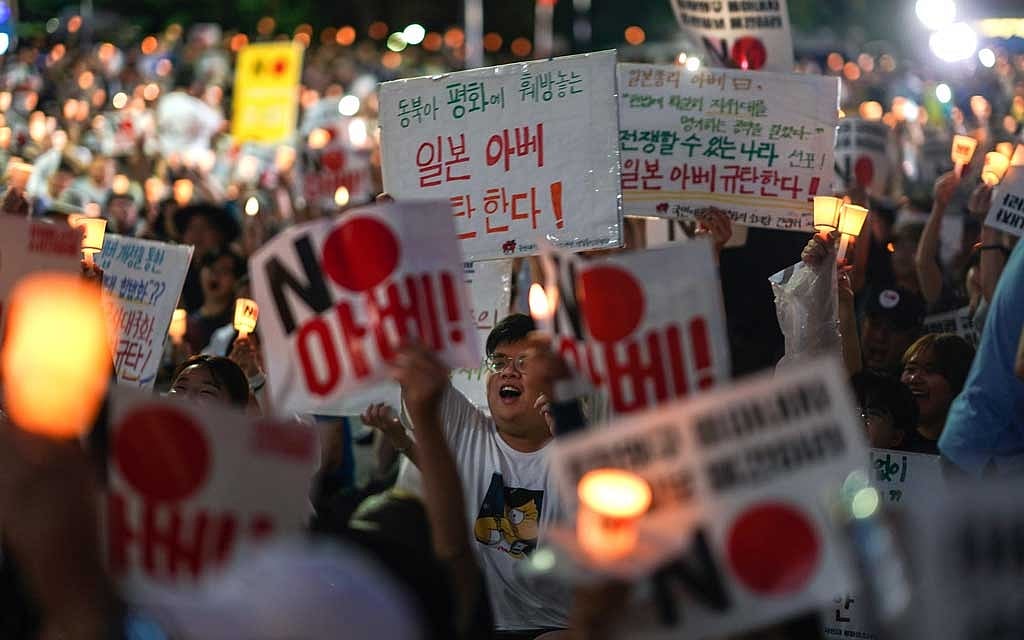
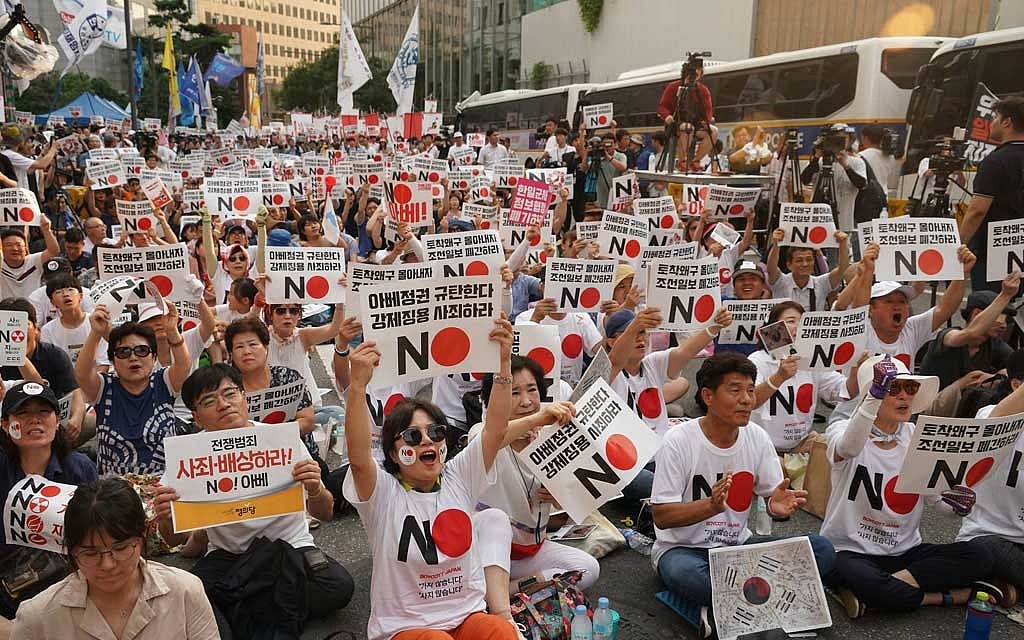
By Saturday night, thousands of protesters marched in the streets of Seoul, accusing Japan of an “economic invasion” and threatening an intelligence-sharing agreement that the United States considers crucial to monitoring North Korea’s nuclear buildup.
Washington has long relied on both countries to stand alongside it to help counter China’s rise and the nuclear-armed North. But despite the dangers of a deepening divide between its allies, the Trump administration has been reluctant to get involved to repair the rift.
President Donald Trump said he might take some action if asked by both parties, but added that trying to referee the dispute would be “like a full-time job.” And State Department officials had said they want the two countries to work it out on their own.
Still, as tensions escalated in recent days, Secretary of State Mike Pompeo attempted Friday to orchestrate a reconciliation at an Asian security conference attended by regional foreign ministers. A photo from the conference showed Pompeo flinging his arms wide open to the foreign ministers of the two countries, appearing to invite them to come together.
The two ministers stayed far apart, however, with Taro Kono, Japan’s foreign minister, grimacing, and South Korea’s, Kang Kyung-wha, turning away, stone-faced.
It was a telling sign not just of the worsening relationship between the two allies, but perhaps more significantly, of America’s diminished leadership role in a region where the United States has often played the role of mediator among its allies.
In the past, when tensions between the two nations flared, “the US administration sent signals, sometimes privately, that this harms US security interests,” said Michael J Green, senior director for Asian affairs at the National Security Council under President George W Bush. “I think Pompeo sent that message, but it was late. It came very late from the administration.”
“Trump has made it worse,” added Green, now a professor at Georgetown University. “He himself has done nothing to create a sense that there is a team of allies in Asia.”
The latest pressure point between the countries is, on the surface, a trade spat. Japan on Friday expanded controls over exports to South Korea of items ranging from ball bearings to precision machine tools.
The trade action followed an earlier move tightening controls on exports of chemicals used to make advanced semiconductors and digital flat screens — some of the most important products to the South Korean economy.
Seeming to wield trade as a political cudgel in the model of Trump, Japan cited unspecified national security concerns and suggested South Korea “mishandled” items that could be used for military purposes.
In response, President Moon Jae-in of South Korea vowed “we will never again lose to Japan,” hearkening back to Japan’s colonial occupation. Government officials said South Korea was considering withdrawing from a vital intelligence-sharing deal that the two countries, which both host US military bases, signed in 2016 at Washington’s urging.
But the current divide between South Korea and Japan is as much about their painful shared history as it is about trade.
Tensions between Japan and South Korea have waxed and waned since Japan’s surrender in World War II brought the occupation to an end.
Starting in the 1990s, relations began to warm as South Korea dropped its bans against Japanese videos and comic books. In 2002, the two countries were co-hosts of the World Cup in soccer. Tourists flow between the two countries and its companies are mutually dependent.
Still, the wounds of the colonial era have never fully healed. South Koreans argue Japan has not sufficiently apologised for its wartime atrocities while the Japanese argue they have done enough, both legally and politically.
Prospects for de-escalation seem bleak. In both countries, polls show public distrust of the other nation at their highest levels in decades.
The toll of the dispute is also starting to go beyond the economic damage of the trade standoff. Last month, two South Korean men in their 70s set themselves afire in protest against Japan. Both died.
Analysts criticised the two US allies for letting their dispute spin so far out of control.
“It’s just insane that Japan and Korea are doing this to each other,” said David C. Kang, director of the Korean Studies Institute at the University of Southern California. “They’re diverting so much energy to this. There are only so many things a government can do at one time.”
Over the decades, South Korean leaders have invoked deeply rooted nationalistic sentiments against Japan.
Prime Minister Shinzo Abe’s political party, the Liberal Democrats, has also stoked nationalist feelings in Japan with various actions, for example by proposing new language for school textbooks stating that there is still a dispute about whether the Japanese army played a direct role in forcing “comfort women” from Korea and elsewhere to work as sex slaves for its soldiers.
In the current global climate, it may be even easier for these long-existing nationalist sentiments to intensify.
“You have an era where international leaders are much more fixated on themselves and their own political agendas and are not willing to step up and sacrifice anything for international leadership, especially here in the United States,” said Susan A. Thornton, former acting assistant secretary of state for East Asia and the Pacific in the Trump administration and a senior fellow at Yale Law School.
“Unfortunately,” Thornton added, “it seems to be having some kind of contagion effect.”
An agreement in 2015, reached between the governments of Abe and Park Geun-hye, Moon’s impeached predecessor, was meant to settle one of the most searing disputes: how to acknowledge and compensate the Korean women who were forced to work in brothels for Japan’s military during World War II.
Demonstrators protest Japan’s decision to remove South Korea from a so-called “white list” of favored export partners, in Seoul, on Aug. 3, 2019. While North Korea test-fires barrages of missiles, two crucial American allies in Asia are locked in their own bitter battle, and the Trump administration is struggling with how to end the discord.
But in November, the Moon government dissolved a foundation established under the settlement, inciting distress in Tokyo. A month earlier, South Korea’s Supreme Court ruled in the first of a series of cases awarding compensation from Japanese companies to victims conscripted as forced labour during Japan’s imperial expansion before and during World War II.
Japan argues that the court ruling violates a 1965 treaty that established diplomatic relations between the two countries and provided $500 million in aid and loans to South Korea. The treaty describes all claims arising from the colonial era as “settled completely and finally,” wording that Japan has repeatedly highlighted when arguing the Supreme Court rulings are invalid.
The two countries have tussled over various proposals to resolve the dispute, with both sides claiming the other has ignored requests for negotiations.
Now both countries seize every opportunity to taint the other.
South Korea has cancelled cultural exchanges, and consumers are boycotting Japanese beer and products from companies like Uniqlo.
In Japan over the weekend, the governor of Aichi prefecture, an independent who won a recent election with the support of Abe’s governing party, decided to shut down an art exhibition that featured a statue meant to symbolise a Korean comfort woman, citing terrorist threats if the statue was not removed.
The tiff has spilled into the military realm. Late last month, when a Russian patrol plane flew into airspace over a cluster of disputed islands that South Korea controls but Japan also claims, South Korea fired warning shots. Japan immediately said that it should have fired the shots, calling the islands “our territory.”
Such incidents can unsettle US military planners, who depend on cooperation between the allies to contain North Korea and secure the region.
“The Americans are worried that we have ships and planes in the air space and waters between these two countries,” said Daniel C Sneider, a lecturer in East Asian studies at Stanford University. “And they have to worry about whether a Korean military vessel might fire at a Japanese military vessel.”
Trump administration officials say they are particularly concerned about the possibility that Seoul will end the intelligence-sharing agreement that Japan and South Korea reached in 2016, a key element of military cooperation that helps the United States.
That “would deal a blow to US efforts to strengthen bilateral cooperation and deterrence on the Korean Peninsula,” said Bonnie S Glaser, senior adviser for Asia at the Centre for Strategic and International Studies.
©2019 New York Times News Service












