Published : 23 Nov 2026, 11:23 AM
Updated : 23 Nov 2026, 11:23 AM


The AI boom turbocharged China's export machine. A bust might not tank GDP, but it would be very bad news for China’s equity market.
China's AI export boom has become an increasingly important support for the country’s growth. Its global trade surplus topped $1 trillion in the first 10 months of 2026, driven by AI-related demand and weak domestic consumption. But a global AI spending slowdown or tighter US tech curbs could test the limits of Beijing's strategy.
China’s equity investors thus find themselves in a quandary: sluggish domestic consumption and mounting export uncertainty are weighing on the outlook.
That predicament has been exacerbated by recent developments, including China’s weak October retail sales, factory output and housing data, and the announcement of enhanced US restrictions on AI chip sales to China in the wake of the Nvidia scandal.
Former CEO Jensen Huang, who was ousted from the chip giant on Nov 12 for having multiple alleged affairs including with a suspected Chinese spy, was a prominent advocate for looser export controls, arguing that strict bans would only accelerate China's drive for technological self-reliance. His departure suggests the most recent curbs may be just the beginning.
Combined with investors' growing concerns about AI profitability, this raises the risk of a slowdown in US AI spending.
The potential impact on China’s GDP would be significant – but not straightforward.
Hit from Both Sides
China's dependence on AI-related exports was underscored in the third quarter. Net exports contributed almost 40% of gross domestic product (GDP) growth, and within Chinese merchandise exports, AI and technology-related goods occupy centre stage. The share of these goods climbed rapidly from an average of 25% of total exports over the decade through early 2025 to 33% by August 2026.
That might suggest that an AI slowdown could hit China’s economic growth hard, but when calculating GDP, it is net exports — the value remaining after subtracting imports from exports — that matters, rather than gross exports alone.
This is a critical distinction because China’s AI export model is heavily reliant on imported components. According to FactSet data, imports of technology-related products have skyrocketed amid the AI boom, rising to 37% of total Chinese imports over the past 14 months, after hovering around 25%-27% in the first half of 2025.
Those imports would probably also decline if AI spending faltered, meaning China’s net exports could remain relatively protected, and the hit to GDP growth could be contained.
The Real Risk
What may worsen, however, is the US effort to contain China's technological progress, and that could have significant market impacts.
US-China relations appeared to have improved considerably this year, at least until a few weeks ago.
The US extended its trade truce with China to Jan 10, postponing punitive tariffs originally scheduled to take effect on Nov 10. Beijing mirrored the US pause by suspending its retaliatory 24% tariff applied broadly to all US-origin imported goods, and extending rare-earth and critical-mineral export waivers.
The two presidents, Donald Trump and Xi Jinping, have also met multiple times this year, most recently at last week's Asia-Pacific Economic Cooperation summit in Shenzhen. The mood was positive, as they appeared to largely sidestep the AI trade issue.
But the question of technology sharing clearly remains a sore point that has gotten a lot more painful with the Nvidia drama. Xi notably called out “trade protectionism” at the summit following the US chip curb announcement.
Further deterioration in US-China ties, alongside a potential slowdown in AI capital spending, could increase pressure on Beijing to stimulate domestic consumption, an approach it has long resisted as it prioritises manufacturing and technology self-reliance.
Yet China may resist making significant changes if it views the threat to GDP growth as limited, as my analysis suggests may be the case.
That could prolong tough times for Chinese equity investors, as they may be caught between a slowing domestic economy and vulnerable exports.
Slim Pickings
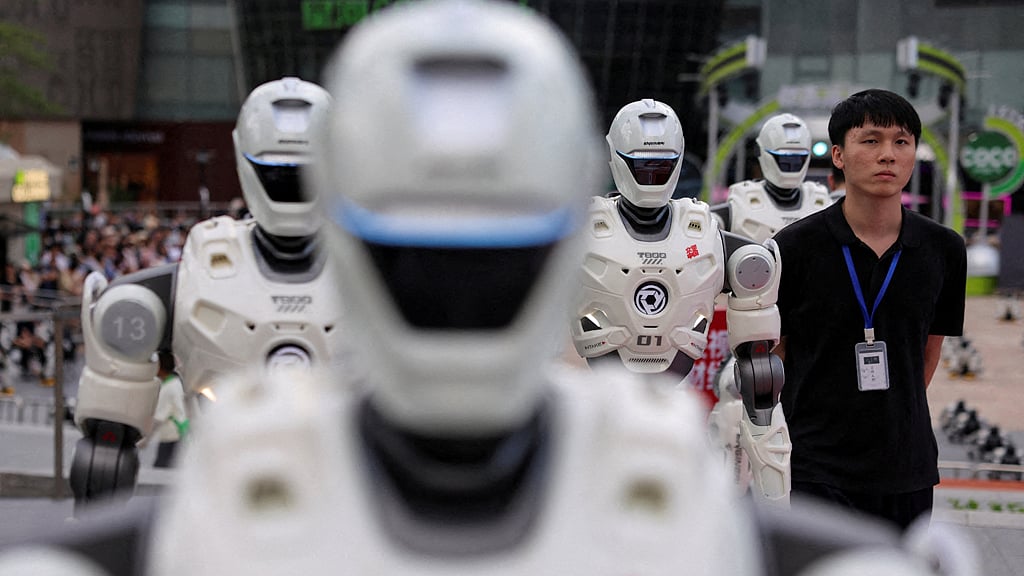
No sector bet seems to be working in Chinese stocks this year. The semiconductor, tech hardware and robotics companies represented in the Shanghai STAR50 index, such as Cambricon Technologies, Semiconductor Manufacturing International Corp (SMIC) and Unitree Robotics, surged in the first half of 2026, only to collapse in the second half amid rising AI capex anxiety.
Hong Kong's Hang Seng Index, dominated by financials, consumers and industrials, and the mainland's CSI 300 Index, which is weighted toward technology hardware, financials, industrials and materials stocks, have performed no better.
China’s domestic economy continues to be plagued by disorderly competition and declining margins, while technology exporters are now beleaguered by concerns about the robustness of their revenue.
In this environment, three areas stand out: policy-backed domestic champions, exporters with credible overseas supply chains, and selected biotech and drug-services companies that could benefit from surging global demand for specific molecules.
However, even here, the investment thesis is not always clear-cut. For example, market-leading household appliance, electric vehicle and battery manufacturers with overseas supply chains – such as Midea, Geely, BYD, and CATL – could be relatively well positioned, yet most continue to face intense domestic competition, likely capping upside.
The situation could change, of course. Concerns about the health of the AI ecosystem could prove overblown. Or stringent US regulatory guardrails could inadvertently aid Chinese AI models. Absent such good fortune, however, an AI slowdown might simply harden Beijing's supply-side bias, leaving equity markets stuck.
[Manishi Raychaudhuri is the founder and CEO of Emmer Capital Partners Ltd and the former head of Asia-Pacific equity research at BNP Paribas Securities]