Published : 23 Nov 2026, 09:42 PM
Updated : 23 Nov 2026, 09:42 PM


For years, Nur Hosen Vegetable Store, situated in the vicinity of Gulshan, depended almost entirely on customers walking through its doors. The neighbourhood shop had fresh vegetables and everyday essentials, but its reach was limited to people living nearby. But now some of their orders arrive on a tablet.
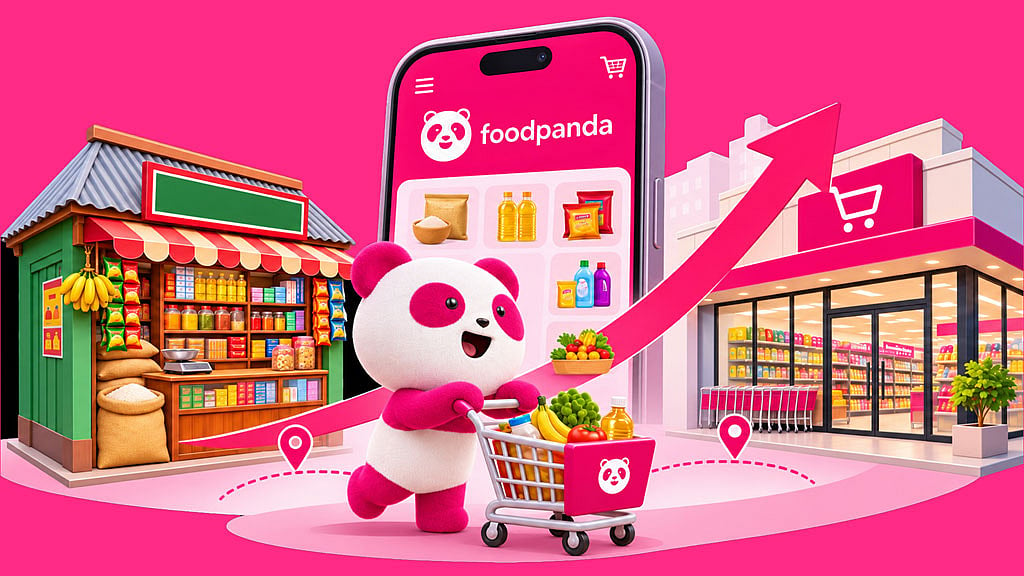
The neighbourhood shop is now part of foodpanda Shops, an on-demand retail and grocery delivery feature within the foodpanda app that connects customers with local supermarkets, pharmacies, and specialty stores for fast home delivery.
For owner Kamrul Hassan, the shift has turned a traditional walk-in business into one that can reach customers beyond its immediate neighbourhood.
“Earlier, most of our sales depended on customers visiting the store in person, and some fresh produce would remain unsold by the end of the day. By joining foodpanda, we have been able to reach customers in surrounding areas whom we would not have reached otherwise,” Hassan, the owner of the Nur Hosen Vegetable Store, said. “It has helped us generate over BDT 20 lakh in additional monthly sales while reducing the amount of produce going to waste.”
His experience offers a glimpse into a broader transformation taking place in Bangladesh's retail market: the country's traditional mudi dokan, specialty stores and large supermarkets are increasingly finding a digital storefront alongside their physical ones.
And foodpanda Shops is helping bring those very different businesses onto the same digital marketplace.
Launched in Bangladesh in 2020 during the COVID-19 period, foodpanda Shops has expanded steadily, listing more than 900 stores and over 150,000 products, spanning from neighbourhood grocers to major supermarket chains, according to foodpanda.
The network includes neighbourhood businesses such as Nur Hossen Vegetables, UK Product Gallery and Izhan Mart, alongside retailers such as Khulshi Mart, Shopping Bag Supermarket and Utshab Supermarket in Chattogram, and Safeway Express in Cox's Bazar.
It also includes established chains such as Shwapno, Agora, Unimart, Amana Big Bazar, Metro Mart by Akij and Fresh Mart by MGI.
The mix is significant because Bangladesh's retail market remains dominated by traditional bricks-and-mortar stores. According to the US Department of Agriculture's 2026 Exporter Guide, modern retail accounts for an estimated 3 percent to 4 percent of retail sales in the country, including online sales.
For many smaller retailers, moving online independently can be expensive and complicated. They would need a website or app, digital inventory management, customer acquisition and, perhaps most importantly, a reliable delivery operation.
foodpanda Shops essentially allows them to plug into an existing digital ecosystem.
A retailer continues to operate its physical shop and manage its inventory, while customers discover and order products through the foodpanda app. Once an order is placed, the store prepares it for collection by a foodpanda delivery partner.
According to foodpanda, some participating retail partners have recorded sales growth of around 30 percent to 40 percent after joining the platform.
One platform, two kinds of retailers
For a large supermarket, the value is different.
Unimart, for example, has listed more than 8,000 daily essentials, fresh produce and imported products on foodpanda. Its physical stores remain central to the business, but the digital channel allows the retailer to reach customers who may prefer shopping from home.
“Being on foodpanda has allowed us to take the convenience of our stores beyond their physical locations,” said the CEO of Unimart. “We can now reach digital-first customers more easily, serve their everyday shopping needs and tap into new customer segments.”
For a small vegetable shop, meanwhile, the same platform can mean something more fundamental: gaining a digital presence without having to build one.
That is the opportunity foodpanda is trying to create across the retail spectrum.
“Our focus is to make digital commerce accessible to retailers of different sizes, not just large supermarket chains,” said Mohammad Tabrej Khan, Director of Quick Commerce at foodpanda Bangladesh.
“By bringing existing businesses into one platform, we are creating opportunities for them to participate in the growth of online retail without significant upfront investment. The aim is to help more retailers adapt to changing customer habits while continuing to build on their existing businesses.”
The changing way Bangladesh shops
The growth of platforms such as foodpanda Shops comes as consumers themselves become more comfortable buying products online.
According to the Bangladesh Bureau of Statistics' ICT Access and Use by Households and Individuals Survey 2024–25, 14.4 percent of individuals in Bangladesh used the internet to purchase goods or services online. Nearly 35 percent of internet users buy their food and groceries online.
For consumers, the attraction is straightforward: the ability to browse a wide range of products, compare options and order from home without travelling to multiple stores.
“I usually buy vegetables from the shop near my home, but when I am at work or stuck in traffic, I order from the same shop through foodpanda. I know the store and its products already, so I feel comfortable ordering online,” said Ratna Ahmed, a marketing executive working for an FMCG company.
For retailers, the equation is equally clear. A physical store can now serve customers who are not physically present.
This is particularly relevant for smaller businesses that may have strong local customer relationships but limited geographic reach.
A shop that once depended on people living within walking distance can potentially serve customers several kilometres away. A supermarket with thousands of products can make that inventory available to customers who may never visit the store.
The technology does not replace the shop. It extends it.
Bringing Bangladesh's retail under one digital roof
That may ultimately be the more important change taking place.
Bangladesh's retail future is unlikely to be defined simply by traditional stores being replaced by large supermarkets or online platforms. Instead, the next phase could see physical and digital retail increasingly working together.
For the neighbourhood mudi dokan, foodpanda Shops can provide a digital storefront. For supermarket chains, it can create another customer channel. And for consumers, it brings both within the same app.
At Nur Hosen Vegetable Store, the shelves are still stocked the same way they have been for years. The difference is that the customer no longer has to be standing in front of them.
The shop has acquired a new storefront—one that fits inside a smartphone.
As internet use and online purchasing continue to grow, Bangladesh’s next phase of retail may therefore be less about replacing the traditional mudi dokan with a supermarket—and more about putting both on the same digital shelf. And for thousands of Bangladesh's retailers, that could be what the next chapter of shopping looks like.
[Disclaimer: This is a sponsored article, not a news report. bdnews24.com is not responsible for information published in this article.]