Published : 30 Sep 2026, 12:31 PM
Updated : 30 Sep 2026, 12:31 PM


A team of researchers has identified a large, densely packed and strongly magnetised rock formation beneath the moon’s surface, offering new clues about its geological history and past activity.
The feature, about 60km wide and around 9km deep, could be an ancient volcanic complex that became magnetised when magma rose from the moon’s interior and solidified before reaching the surface, according to a study published Sept 23 in Science Advances.
The characteristics of the rock body suggest the moon had a magnetic field when the rock formed about 4.2 billion years ago, with the field likely between one-fifth and one-third as strong as Earth’s current magnetic field, the study authors said.
Life on Earth as we know it likely would not be possible without its magnetic field.
It creates the magnetosphere, a vast region of space surrounding the planet that shields it from harmful solar wind, cosmic rays and radiation, preventing the atmosphere from being stripped away.
Molten metal constantly churning in Earth’s outer core generates electrical currents that sustain the magnetic field through a process known as the dynamo effect.
The mechanical principle is similar to a bicycle dynamo, which uses a rotating wheel to spin magnets inside a generator and produce an electrical current to power lights.
The moon may also have had a core-powered magnetic field in its past, but that activity has long ceased.
About 3.2 billion years ago, as the moon’s interior cooled, the field significantly weakened, according to NASA.
Without strong protection, solar radiation stripped away the moon’s atmosphere.
A Long-Running Debate
The formation and existence of the ancient magnetic field, however, have long been debated in astronomy.
“The debate stretches back to the 1970s, when the Apollo missions first returned lunar rocks that showed signs of having recorded a magnetic field,” study coauthor Anna Mittelholz, a lecturer at the Swiss Federal Institute of Technology Zurich, or ETH Zurich, told CNN.
For a long time, Mittelholz said, experts broadly agreed that the moon’s past dynamo was active from roughly 4.25 billion to 3.5 billion years ago.
“This is probably still what the majority of the community believes, but in the last decade, new analyses of Apollo samples have found no magnetic signal at all for parts of that same period,” she wrote in an email, “and some researchers have gone as far as questioning whether an early dynamo existed.”
The new study provides evidence for that early dynamo without relying on samples collected during the Apollo missions, the American broadcaster said.
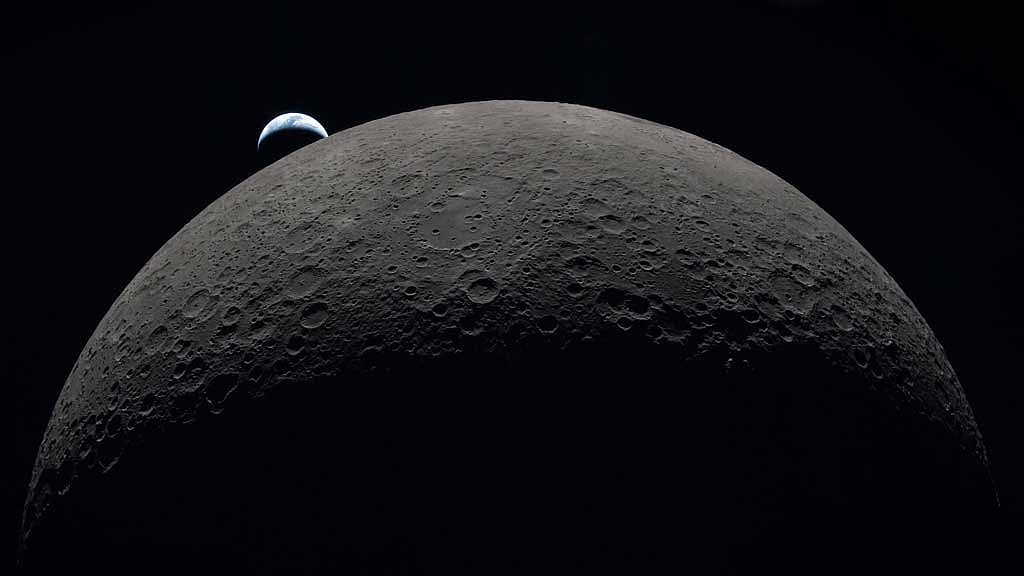
Instead, researchers used data gathered from orbit by lunar probes to examine Dewar, a region on the far side of the moon not visible from Earth, where they detected the magnetic rock, it added.
Pinning down the history of the moon’s past magnetic field is key to understanding the moon itself, according to study coauthor Adrien Broquet, a researcher at the German Aerospace Center in Berlin.
“Earth and the moon had drastically different geological histories. The moon was smaller and fully molten for a long time. It also had a lot of volcanism early on, and there are many questions we cannot exactly answer if we don’t know how the moon looked like back then,” Broquet said.
“Analysing the magnetic field of the moon is a good way to estimate how the moon looked like early on.”
The findings could potentially help scientists study other celestial bodies as well, Mittelholz said.
If the moon “managed to run a dynamo for any length of time, that tells us something about the minimum conditions needed to sustain a dynamo”, she said. “Getting its history right helps calibrate what we think is possible for other small rocky and icy bodies too.”
A Rocky Debate Over Apollo Samples
The researchers used data from NASA probes including Lunar Prospector, launched in 1998; Kaguya, launched in 2007; and GRAIL, launched in 2011.
One advantage of using orbital data rather than lunar rocks is that the samples were removed from their geological context more than 50 years ago, according to Mittelholz.
“Their magnetic record can be disturbed quite easily through heating, shock, or even routine handling and storage in a lab,” she said.
“So two samples that look similar can end up giving different answers, not necessarily because the moon’s field wasn’t there, but because the evidence itself has had a lot of chances to get scrambled along the way.”
Launched in 1998, NASA’s Lunar Prospector mapped the moon’s elemental composition, gravity fields and magnetic fields. The new study used archival data from the probe.
Researchers have used orbital data before to investigate the lunar magnetic field, but the new study takes a different approach.
“Other magnetic studies using satellite data sets generally look at the magnetic signal by itself and try to infer what kind of rock might have produced it,” Mittelholz said. “We instead combined magnetic data with gravity data in one model.”
Gravity measurements described the density of the buried rock, while magnetic readings showed how strongly it was magnetised, she explained.
“Together they let us pin down an actual buried structure rather than just a signal that could be produced by many magnetised rock configurations,” she said.
The researchers could not estimate how long the active dynamo existed. They also said it remains unclear how the moon’s small core could have generated a magnetic field potentially as strong as Earth’s, as previous studies have suggested.
However, the study authors said they believe their findings shift the debate from whether the moon had a dynamo to how it worked.
Earlier studies have proposed different explanations for the formation of the lunar magnetic field, the CNN said.
A 2025 paper suggested that an impact from a large asteroid could have temporarily strengthened an existing, weaker magnetic field.
A February study based on Apollo samples, meanwhile, suggested that the melting of rocks rich in titanium deep inside the moon temporarily boosted its magnetic field, causing it to flicker over time.
Lunar Swirls Offer Another Clue
As part of the new study, the researchers also observed something peculiar about lunar swirls, patches on the moon’s surface that are brighter than their surroundings.
The swirls are often paired with magnetic anomalies, or regions where the rock is magnetised, the study found.
“The leading hypothesis is that these magnetic anomalies deflect solar wind and protect the surface from getting weathered by it,” said lead study author Xi Yang, a doctoral student in the department of Earth and planetary sciences at ETH Zurich.
While the observation is only preliminary, Yang said it could mean that lunar swirls may eventually help identify areas of the moon’s surface that are more protected from harmful solar wind, which could be valuable for lunar missions.
Magnetic Fields Beyond The Moon
The new study further supports the idea that the moon was able to generate an intense dynamo early in its history, according to Claire Nichols, an associate professor of geology of planetary processes at England’s University of Oxford.
She was not involved in the research.
However, much more work is needed to determine how long the moon could generate a dynamo and how much its activity varied, Nichols wrote in an email.
“Overall, I think this study provides further motivation to keep adding to our observations during upcoming missions such as Artemis and Chang’e -- there are still a lot of open questions about the moon we are yet to figure out,” she said, referring to lunar exploration programmes run by NASA and the China National Space Administration, respectively.
The research also adds to the growing body of evidence that the moon once possessed a stronger magnetic field more than 4 billion years ago, said Isaac Narrett, lead author of an unrelated 2025 study on the lunar magnetic field.
Narrett, a doctoral student in the department of Earth, atmospheric and planetary sciences at the Massachusetts Institute of Technology, was not involved in the new study.
By using data collected by orbiting lunar probes, Narrett said, the research leaves room for future work while “laying the groundwork for uncovering clues of planetary evolution with other gravity and magnetic datasets of the moon, Mercury and Mars”.