Published : 28 Jul 2018, 10:27 AM
Updated : 19 Oct 2022, 02:16 PM


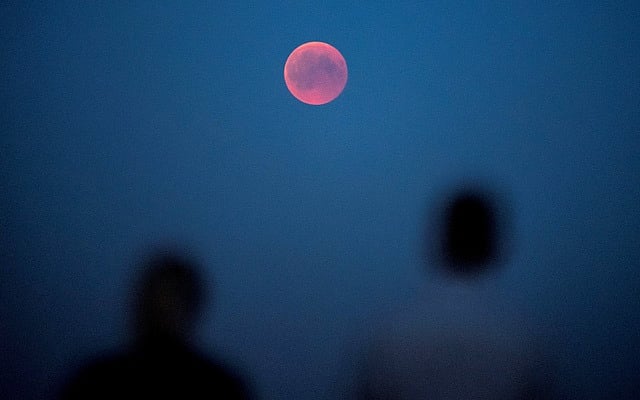
From the Cape of Good Hope to the Middle East, and from the Kremlin to Sydney Harbour, thousands of people turned their eyes to the stars to watch the moon, which turned dark before shining orange, brown and crimson in the shadow.
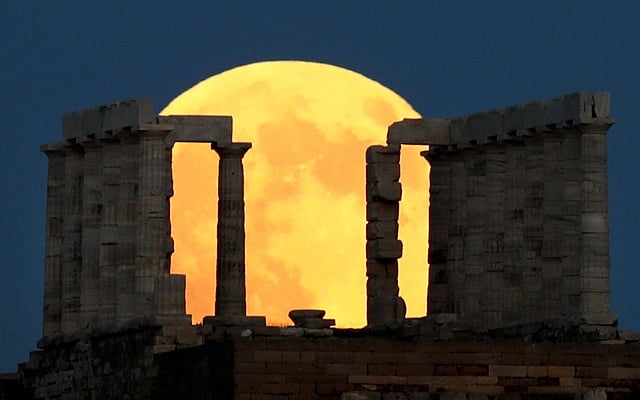
A full moon rises behind the Temple of Poseidon before a lunar eclipse in Cape Sounion, near Athens, Greece, Jul 27, 2018. Reuters
The fullest eclipse was visible from Europe, Russia, Africa, the Middle East, and much of Asia and Australia though clouds blocked out the moon in some places.
The eclipse will not be visible from North America or most of the Pacific.
Reuters charted the eclipse from across the world, capturing a shimmering orange and red moon above Cairo, the Temple of Poseidon in Cape Sounion, near Athens, the Bavarian village of Raisting in Germany, Rio beach in Brazil and Johannesburg.
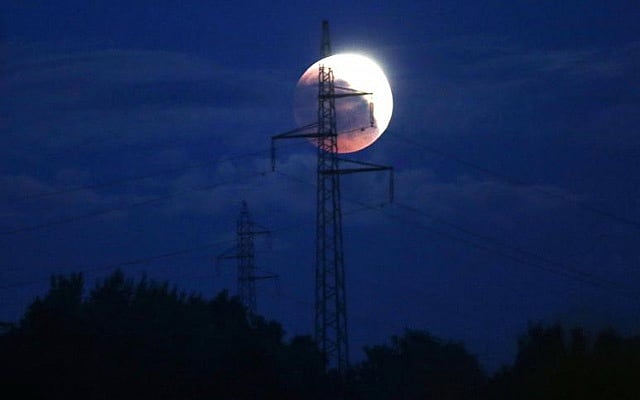
A full moon during an eclipse rises behind power line in Zenica, Bosnia and Herzegovina, Jul 27, 2018. Reuters
"This is what life is all about: Magical moments like this," said Teddy Muthusi as he watched from Uhuru Park in Nairobi. "It's just beautiful. It's well worth it."
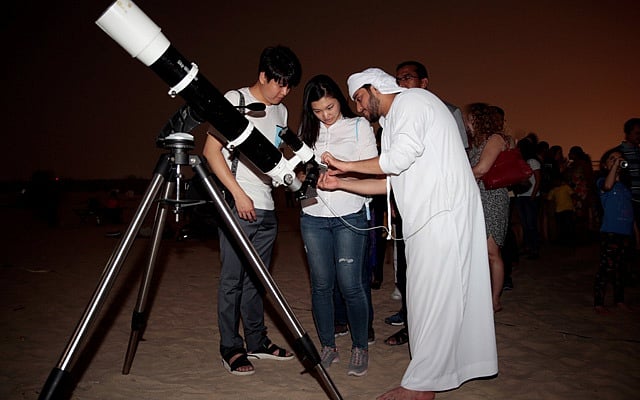
On the banks of India's Ganges, temples were closed ahead of the eclipse. Enthusiasts watched through telescopes at the Marina South Pier in Singapore and at the Al Sadeem Observatory in Al Wathba near Abu Dhabi.
Hundreds of people in Australia paid to watch the eclipse from the Sydney Observatory before sunrise.
An Emirati man uses a telescope to take a picture of the lunar eclipse of a full "Blood Moon" at Al Sadeem Observatory in Al Wathba near Abu Dhabi, United Arab Emirates Jul 27, 2018. Reuters
"It's called a blood moon because the light from the sun goes through the Earth's atmosphere on its way to the moon, and the Earth's atmosphere turns it red in the same way that when the sun goes down it goes red," Andrew Fabian, professor of astronomy at the University of Cambridge, told Reuters.
At the same time, Mars is traveling closer to Earth than it has done since 2003, so some observers may see what looks like an orange-red star - and is in fact the red planet.
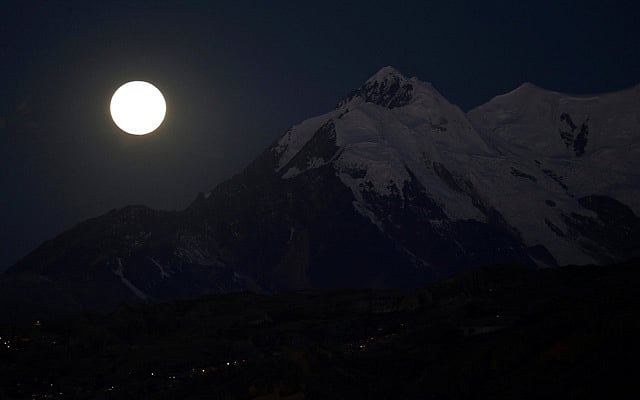
The moon is seen near the Illimani mountain during a full lunar eclipse in La Paz, Bolivia, Jul 27, 2018. Reuters
For thousands of years, man has looked to the heavens for omens of doom, victory and joy. The Bible contains references to the moon turning into blood and some ultra-Orthodox Jews consider lunar eclipses ominous and a cause for moral contemplation.
According to some Hindu beliefs, celestial bodies such as the sun and moon emit negative energy during an eclipse and so some temples in India were closed to minimize any disturbance.
Astronomers, though, said there was no cause for worry.
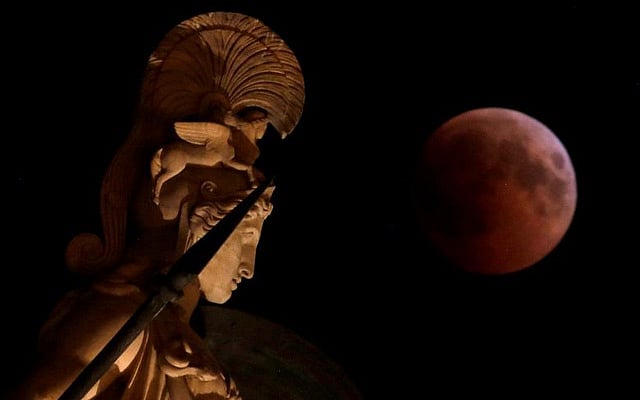
A full moon rises during a lunar eclipse behind the statue of the ancient goddess Athena in Athens, Greece, Jul 27, 2018. Reuters
The next lunar eclipse of such a length is due in 2123.