Published : 14 Oct 2023, 04:10 PM
Updated : 14 Oct 2023, 05:13 PM


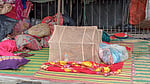
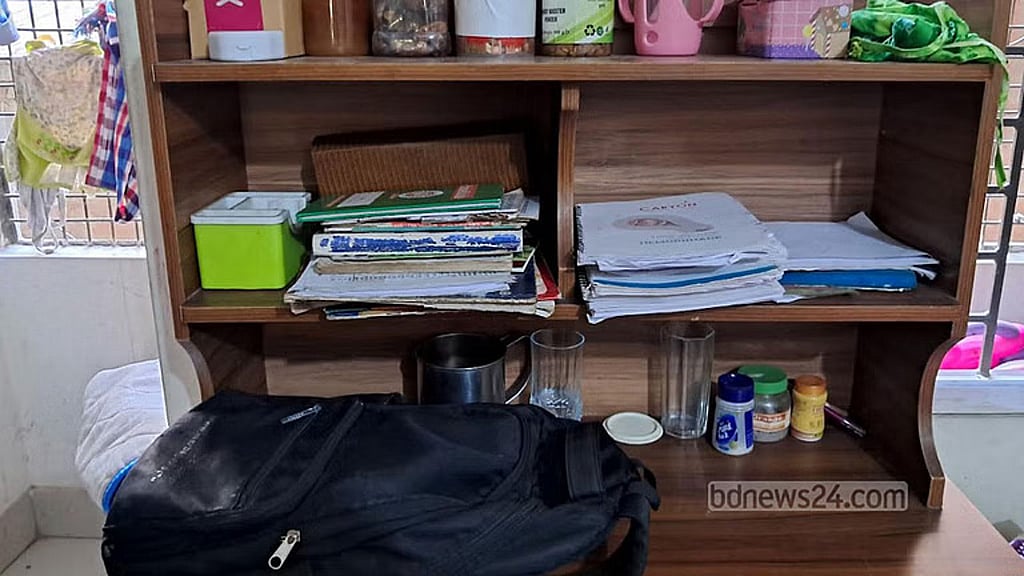
A small water pot sits solemnly atop the reading table, accompanied by a few jars of untouched dry food. Below, the books, the school bag -- all remain undisturbed, just as they were before. But the vibrant presence that once filled this space is conspicuously absent.
The heart-wrenching story of Hafsatunnesa Tasnim has become a sombre addition to this year's grim dengue statistics. The nine-year-old resident of Mirpur succumbed to the mosquito-borne disease, leaving her family with a void that only a new addition could momentarily fill.
Her mother, Rakiba Akhter Rupa, reveals that Hafsa was eagerly awaiting the arrival of her little brother, expected in October. But the loss of her daughter left Rupa disconsolate.
"She was so overjoyed about having a brother! She would always ask, 'Mother, when will my brother come? When can I hold my brother?'"
Hafsa, a third-grader, came down with a fever in September. Concerned for her health, and with her mother expecting another child, Hafsa was sent to stay with her aunt on the same street.
Tragically, Hafsa never returned home, as she passed away on Sept 18, just three days before her 10th birthday.
The reality of losing a child to a three-day fever is still unfathomable for her mother. "My daughter wanted me to cook biryani for her birthday. My biryani remained uncooked, and my daughter went without a meal. Why did she leave us like this?"
"She couldn't meet her brother. If only my daughter were here, I wouldn't wish for anything else. My room now feels empty. Even when she had a fever, she played with her younger sister in front of the house, and now she's gone."
Hafsa's aunt, Morjina Akhter Ripa, expressed her grief while pointing to Hafsa's books, saying, "Our girl found happiness in the simplest things. She was such a lovely child. Hafsa was our family's first child.”
"After years of my own marriage without children, I loved Hafsa like my own. But we couldn't save her. She was a lively child and had no prior illnesses. It's still hard to believe that she's gone."
ANGER BOILS OVER AT HEALTHCARE INADEQUACIES
Amid their profound grief, there's also anger at the medical care provided for Hafsa. Rupa recounted how, after three days of fever, the doctor advised against further tests when Hafsa's condition seemed to improve.
"On the fourth day, I saw her sitting down suddenly, complaining of chest pain. I urged her father to get a CBC and dengue test done," Rupa said.
"Her father promptly got the tests done, only to discover that her platelet count had dropped to 23,000. The doctor insisted on PICU admission, but we were turned away by multiple hospitals due to a lack of beds."
Hafsa was eventually admitted to the PICU of a private hospital in Dhanmondi, but the prognosis was grim. The family clung to a thread of hope even when the doctor mentioned a mere 10 percent chance of survival.
Hafsa's father, Abul Kalam Hafez, recounted his daughter's final wish. "She kept saying, 'I want to go home, father.' Now, I am bringing her home, lifeless."
Frustration simmered over the state of healthcare and government response. Hafez, an ambulance driver, vented his anger, pointing out the ineffectiveness of government efforts in combating dengue.
"What's the use of informing the government? They use kerosene instead of mosquito repellent. Corruption runs deep in the healthcare sector. Has the health minister ever visited a hospital to see the situation firsthand?"
"If he had taken action, ordinary people like us wouldn't suffer. How many mothers are left with empty arms due to dengue? This crisis should never have happened. If measures were taken during the dengue season, it wouldn't have turned into an epidemic."
Demanding an increase in the number of PICU units, he said, "When demand rises, supply should follow. Why should people endure this suffering? Why this crisis? The government must address this crisis, be it the saline shortage or the blood bag crisis. They need to look into it."