Published : 08 Jan 2023, 01:43 AM
Updated : 08 Jan 2023, 01:50 AM


Professor Dame Sarah Gilbert, who co-developed Oxford–AstraZeneca COVID-19 vaccine, has advised governments to take adequate preparations to avoid similar havoc the COVID-19 virus wreaked on humanity as she believes another pandemic is “inevitable”.
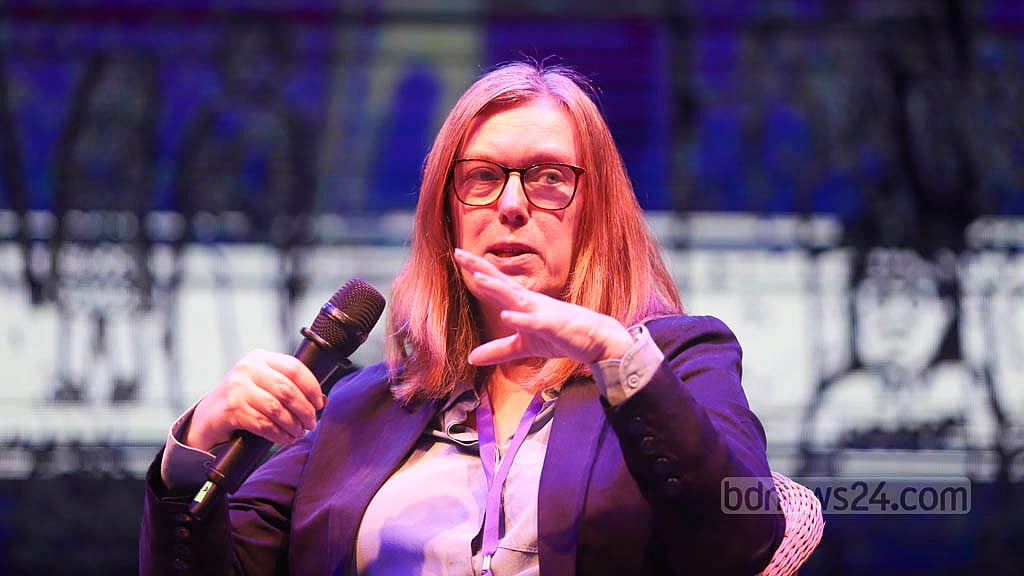
She issued the warning during a session called ‘Science Vaxxers’ on Saturday, the third day of Dhaka Lit Fest. The session was organised to learn about how Dame Sarah and her team rushed to develop a vaccine to tackle the most dangerous virus that threatened the human race in modern times.
“Sorry to worry people, but there's always going to be another pandemic. And what we need to do is to make sure that we are as well prepared as possible so that when it happens, because it inevitably will happen, we can respond much better next time and we can have a better outcome.
"And if we can stop an outbreak from becoming a pandemic that will save so much money for the economy of the world then it's really worth investing in trying to do that,” she said when asked by the presenter of the session about if there was any risk of another pandemic.
The 60-year-old vaccinologist also presented her theories about what approaches governments can take to prevent an outbreak from turning into a pandemic.
“We should be making vaccine stockpiles for the viruses we know about so that if there is an outbreak, we can roll them out immediately,” she said.
“The other thing that we should be thinking about is new viruses that we haven't seen before. We should be getting our systems in place for surveillance, but also how will we make a vaccine more quickly next time if there’s a new virus?
"And what we can do to help with that is if we have already spent time developing a vaccine against each of the different types of viruses.
"One example from each of the virus families so that we know what works for each of the virus families. Then if a new virus emerges, we need to know which family it falls into. What's been done already for viruses in that family? So this is the approach that is successful. This is what we will do. A new one.”
In January 2020, Prof Gilbert read an article about four people in China with a strange variant of pneumonia. Within two weeks, she and her team had designed a vaccine against a pathogen no one had ever seen before. Less than 12 months later, vaccination was rolled out across the world to save millions of lives from the disease, known as COVID-19.
In December 2020, the vaccine was first approved for use in the UK inoculation programme, and the first vaccination outside a trial was administered in January 2021. Later, more than 2.5 billion doses of the vaccine have been released to more than 170 countries, including Bangladesh.
WHO IS SARAH GILBERT?
Professor Gilbert joined the Nuffield Department of Medicine at Oxford University in 1994 and became part of the Jenner Institute when it was founded in 2005.
Her chief research interest is the development of viral vectored vaccines that work by inducing strong and protective T and B cell responses.
She leads work on influenza vaccine development as well as vaccines for many different emerging pathogens, including Nipah virus, MERS, and Lassa virus.
Professor Gilbert’s work also focuses on the rapid transfer of vaccines into GMP manufacturing and first in human trials.
The mother of triplets became a Dame Commander of the Order of the British Empire (DBE) in the 2021 Queen’s Birthday Honours for services to science and to public health in COVID-19 vaccine development.
‘THIS WAS VACCINE FOR THE WORLD’
During the session, Prof Gilbert shared her team’s thoughts about why they needed to be partnered with AstraZeneca to develop the vaccines.
“We're a university and so we're never going to be able to manufacture the vaccine at scale. We organised the manufacturing trials, but we weren't going to be able to organise to manufacture the vaccine for use once it gets licenced. We need a company to work with. To do that we need a pharma [Pharmaceuticals] partner and we need somebody who's going to think big,” she said.
“AstraZeneca became a partner and they agreed to produce the vaccine without profit during the pandemic and without profiting off it in perpetuity for low and middle-income countries.
"So once the pandemic ended, they were allowed to make some profits in high-income countries, but not in low-income countries. And so because they weren't making a profit and because it was suitable for very large-scale manufacture, it meant that the price was kept very low. And that really helps with making the vaccine much more accessible because somebody has to pay to produce the vaccines and make it cheaper.
"The other thing that AstraZeneca did that was enormously important was start thinking from the very beginning of our partnership in the late spring of 2020 about how they would make large quantities of this vaccine. And they had to invest.”
Dame Sarah said she was confident about the success of the clinical trials as they ran similar trials in the case of the MARS virus. She also said since they were quite familiar with the procedure and distribution systems of the previous vaccines and they used the knowledge in the case of the AstraZeneca virus as well.
“We were able to see three billion doses produced by the beginning of 2022. Serum Institute of India did a great job. They produced probably about half those doses.
"In Brazil, there was a company [that] put the vaccine into the vials so that it could then be distributed. That was quite complicated, which was why they received the technology for the whole manufacturing process and started to manufacture vaccines in Brazil, to use in Brazil and in Latin America.”
The world’s leading vaccinologist also expressed frustration over the lateness of vaccine delivery in some cases, especially in middle and lower-income countries.
“The UK wanted their vaccine first as they have invested in it. India put an export ban on the vaccine because they decided they needed the vaccine in India. And then it was until that was lifted that more could be supplied into the WHO-led COVAX programme, which was arranging the distribution of the vaccine for other countries.
"And so it was frustrating to see that we couldn't get the vaccine to everybody quickly enough. But I think if this was to happen again, we'd be better prepared next time because all of these systems are now in place.”