Published : 17 Aug 2023, 03:48 AM
Updated : 17 Aug 2023, 03:48 AM


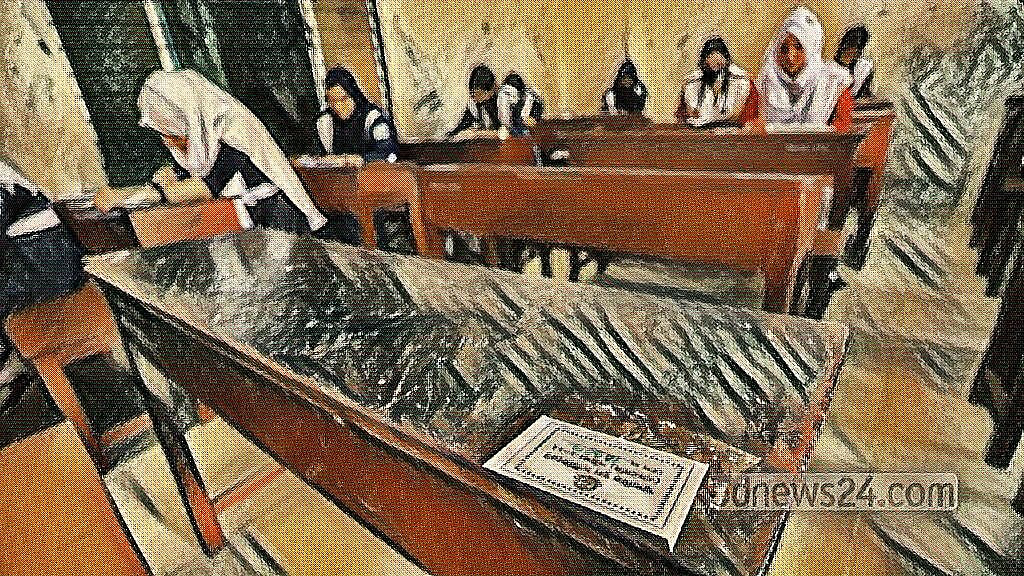
More than 3 million candidates passed the Primary Education Completion or PEC and Ebtedayee exams in 2015. Fast forward seven years, and those students should be sitting for the Higher Secondary Certificate (HSC) or equivalent tests.
Shockingly, only about 1.36 million are doing so. This translates to a staggering dropout of over 1.75 million students or 55 percent from that session.
Shapla Akter from Sonapur in Sunamganj was one of the 3 million successful PEC candidates of 2015. She cleared the Junior School Certificate exams for eighth graders with approximately 2.6 million students in 2018.
But poverty intervened in her educational aspirations before she could reach Class 10. Her father's death led her mother, Sona Mala Bibi, to make the tough decision of marrying off Shapla due to financial constraints.
Sona Mala, Shapla and Shapla’s sister moved to Sona Mala’s brother's home after Sona Mala’s husband had died.
“We struggled financially after my husband's death,” Sona Mala revealed, “It became almost impossible to afford books for my daughters.”
Similarly, Sajeeb Islam from Savar in Dhaka, despite achieving an A grade in his Secondary School Certificate exams, had to forgo further education to work in construction due to a financial crisis.
“My brother and I had been studying together. We had a dream of getting a good job. But, witnessing the financial strain our education placed on our parents, I had to abandon those dreams,” he lamented.
Like Shapla and Sajeeb, hundreds of thousands of children find their educational journey cut short every year, mainly because of poverty.
A study by Dhaka University’s Institute of Education and Research highlighted how girls often enter early marriages while boys take up jobs to support their families.
Many girls also start a professional career early, especially in the readymade garments sector, to help out their poor families.
The dropout rate increased significantly after the coronavirus pandemic, observed Fahima Khatun, a former director general of the Directorate of Secondary and Higher Education.
“COVID has caused great damage to our education. I’ve seen the number of students falling to 30 in Class Eight from 50 in Class Six in schools in the rural areas,” she said.
“Children’s passion for education has fallen. After COVID, the number of admissions to Class Eleven after SSC tests has decreased significantly.”
Emdadul Haque, a senior teacher at Sonapur Model High School in Sunamganj’s Doarabazar, agreed with Fahima.
“The students were out of education for two years. I doubt if this gap can be covered in the next 10 years,” he said.
He said although the cost of education has decreased, many parents believe it is better for their children to start earning for their families at an early age.
“We can’t stop dropouts without raising awareness among the parents, besides putting an end to child marriage and labour.”
Professor SM Hafizur Rahman of Dhaka University’s IER said he observed dropout rates rising in areas where economic zones were built.
Besides child labour and marriage, teachers’ inability to give lessons properly at the secondary level is also responsible for drop outs, he said.
The DSHE, however, claims that the drop-out rate is very low.
Citing a survey after the pandemic, DSHE Director Prof Amir Hossain said the rate is below 7 percent.
“We gave assignments to students from Class Six to 10 and 93 percent of them submitted the assignments. It means 93 percent of the students have not dropped out,” he said.
He also said many of the drop-outs take up diploma courses.
However, the government was conducting motivational and research work to stop drop-outs, according to him.
“We’re trying to arrange extra classes for the students who have gaps in their lessons. I hope we’ll be able to do it soon.”