Published : 19 Oct 2026, 04:16 PM
Updated : 19 Oct 2026, 04:16 PM


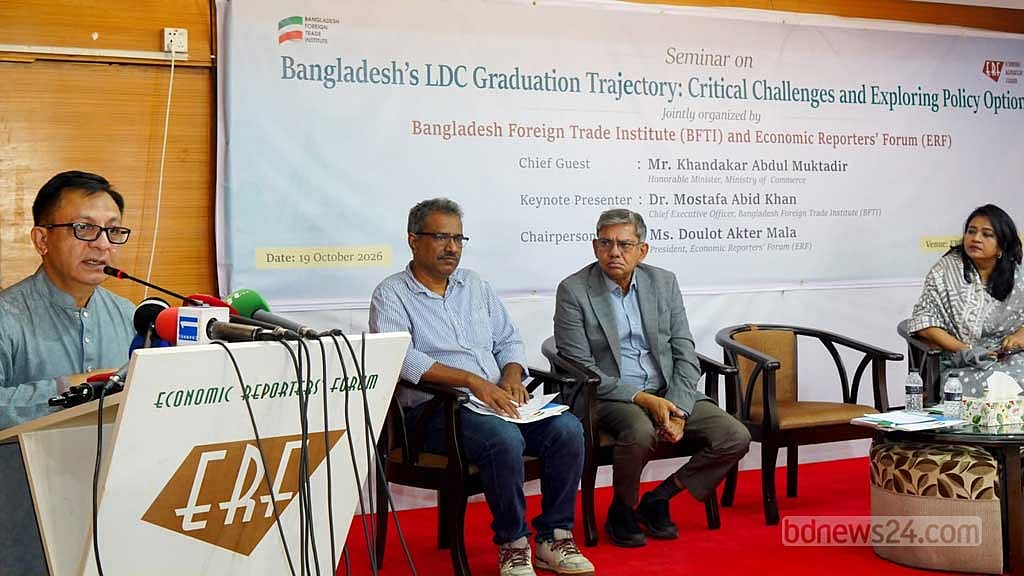
Commerce Minister Khandakar Abdul Muktadir has pinned hopes on a decision within October to delay Bangladesh’s graduation from least developed country (LDC) status by three years.
At a seminar on Monday, Muktadir said Bangladesh had cleared the Committee for Development Policy (CDP) stage and had sought the extension from the UN Economic and Social Council (ECOSOC).
“…I am very hopeful that we will see this settled next week or the week after.”
He claimed the European Union (EU) and other parties have “agreed” to Bangladesh getting more time, and that a decision will come before the Nov 24 deadline.
The Economic Reporters Forum and the Bangladesh Foreign Trade Institute jointly organised the seminar on the challenges of graduation and the way forward.
Bangladesh’s graduation process began in 2018, with preparations originally scheduled to end in 2024.
The country received a two-year extension due to the COVID-19 pandemic and is set to leave the LDC list on Nov 24, 2026, if all goes to plan.
As an LDC, Bangladesh benefits from duty-free and quota-free access to European export markets.
Those trade preferences are likely to end after graduation.
The day after taking office on Feb 17, the new BNP-led government wrote to the UN seeking a three-year extension.
Prime Minister Tarique Rahman later sought the UN secretary-general’s personal support in a letter sent on Apr 6.
The finance ministry announced on Jun 2 that the CDP had responded positively to Bangladesh’s request, but a final decision is still pending.
Explaining the need for more time, Muktadir said Bangladesh had not been adequately prepared for the challenges of graduation.
He said efforts to portray graduation as a political achievement had overshadowed the economic and financial challenges, leaving insufficient focus on using its benefits or building capacity to address potential setbacks.
The minister said Bangladesh had shared a time-bound action plan with the European Union on how it would use any extension.
To maintain access to global markets, the government is also pursuing trade agreements with several countries.
Bangladesh aims to conclude comprehensive economic partnership agreements (CEPAs) or free trade agreements (FTAs) with eight to 10 countries in 2026 and 2027, Muktadir said.
A chief negotiator has been appointed for FTA talks with the EU, and preparations are under way for the first round of technical discussions, although no date has been set.
The minister hopes to complete negotiations before Bangladesh graduates from the LDC category.
Preparations to secure Generalised Scheme of Preferences Plus (GSP+) benefits in the EU market will continue in parallel.
Muktadir, however, hopes an FTA will be concluded before Bangladesh needs to rely on GSP+.
The country is also working towards joining the Regional Comprehensive Economic Partnership (RCEP).
Muktadir said the policy approval for Bangladesh’s inclusion had been secured and procedural work was under way.
The minister said attracting investment would require not only access to international markets but also reliable energy supplies, simpler business procedures and transparent legal mechanisms for resolving disputes.
Citing the energy shortage as a major barrier to new investment, he said work was under way to install new floating liquefied natural gas (LNG) terminals and drill gas wells.
The government is also taking steps to increase solar power generation, he added.