Published : 15 Oct 2026, 11:31 PM
Updated : 15 Oct 2026, 11:33 PM


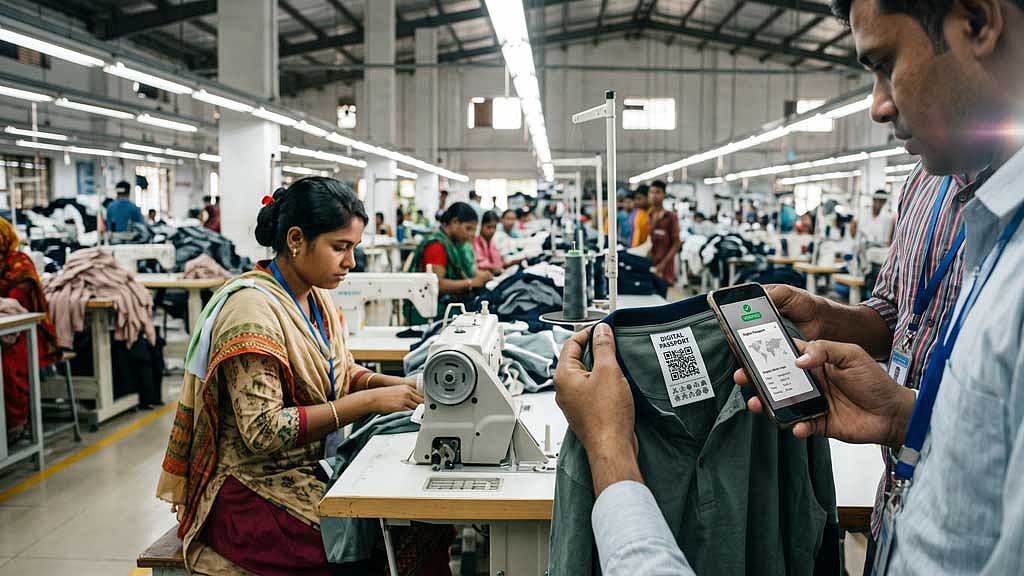
In a few years, a shopper in Lyon will be able to scan a small code on a T-shirt label and see what it is made of, where the cotton was grown, which mill spun the yarn and which factory sewed it. She will probably glance at the screen and move on. The authorities will not. Without that record, the shirt cannot be sold in the European Union.
This is the EU’s Digital Product Passport. The regulation behind the idea took effect in 2024, and Brussels is setting requirements for one product group at a time, with textiles among the first. Rules for garments are expected in 2027, with passports mandatory roughly 18 months later.
The United States has no similar passport law, but it seems to be headed for the same destination. Under the Uyghur Forced Labor Prevention Act, cotton goods with links to Xinjiang are presumed to involve forced labour unless the importer proves otherwise, and US Customs has detained billions of dollars’ worth of shipments when that proof was missing. A factory using imported yarn carries this risk whether or not it knows where the yarn came from. Country of origin now also decides what tariff a shipment pays, and Customs has tightened scrutiny of goods routed through third countries. American shoppers, like European ones, increasingly want to know what their clothes are made of and who made them. A supplier that can document its products for Brussels can document them for Washington, and for its American customer too.
The pressure is building on several fronts at once. Europe’s ban on products made with forced labour applies from late 2027. Bangladesh, which sends around half its garment exports to Europe and is a major supplier to the United States, is also preparing to leave the UN’s least-developed-country category, either this November or, as now seems likely, in 2029. That will eventually end the duty-free access to Europe that has helped its factories compete on price.
Brands everywhere are being told to prove where their products come from, and they can only prove what their suppliers can document.
For Bangladesh, this carries an opportunity that gets too little attention. Once preferential access ends, the EU’s rules of origin generally become stricter, requiring more of a garment’s production to happen in the exporting country. Knitwear makers that spin and knit locally are well placed to meet that test, provided they can show it shipment by shipment, and the records that feed a passport are exactly what would show it.
The industry also starts from a stronger position than outsiders often assume. Bangladesh has more LEED (Leadership in Energy and Environmental Design) certified green garment factories than any other country, and its safety overhaul after the 2013 Rana Plaza collapse was carried out under intense international scrutiny. Very little of that progress, however, exists as data a buyer could verify independently. A certificate on a factory wall in Gazipur does not help a compliance officer in Rotterdam or New Jersey.
The concerns are real. A large manufacturing group can afford a compliance team; a 600-worker factory, or the small dyeing unit it subcontracts to, usually cannot. If passports follow the path social audits took, with each brand demanding its own portal and questionnaire, smaller suppliers will carry the heaviest load, and some will be dropped from supply chains rather than helped into them.
Data ownership is an equally serious concern. A passport exposes a factory’s material sources and sub-suppliers, and hints at its costs. Suppliers should control their records and decide who sees what. The data also has to be believable. Spreadsheets and PDFs are easy to alter, and AI has made it cheap and easy to forge convincing fake certificates. If one country’s supplier data gains a reputation for being unreliable, every exporter there pays for it.
None of this requires anything exotic. Most factories already gather material, chemical and social data for schemes such as Higg, amfori BSCI, SMETA and ZDHC, often entering the same facts several times. Capturing it once, at the source, signed by the person responsible, and reusing it across audits saves effort now and produces the passport later. The tools must work in Bangla and on a phone, because that is how the people entering the data actually work. The industry’s trade bodies, BGMEA and BKMEA, could set shared data standards and report sector-wide performance without exposing individual factories. The government can treat trade data as export infrastructure, like ports and power. Buyers should share a cost their own regulators created.
Vietnam, India and Turkey are reading the same regulations. As price advantages narrow, brands will favour suppliers who can answer that shopper in Lyon, or in Chicago, quickly and convincingly. After 2013, Bangladesh showed it could turn hard scrutiny into a stronger reputation. It now has a few years’ notice to do so again.
[Zeeshan R Khan is a Silicon Valley software veteran with over 30 years of experience at companies including Cisco and Oracle. He founded SurroundApps, developer of the Provena supply-chain platform and VigilantOne security app]