Published : 29 Nov 2026, 04:22 PM
Updated : 29 Nov 2026, 04:21 PM


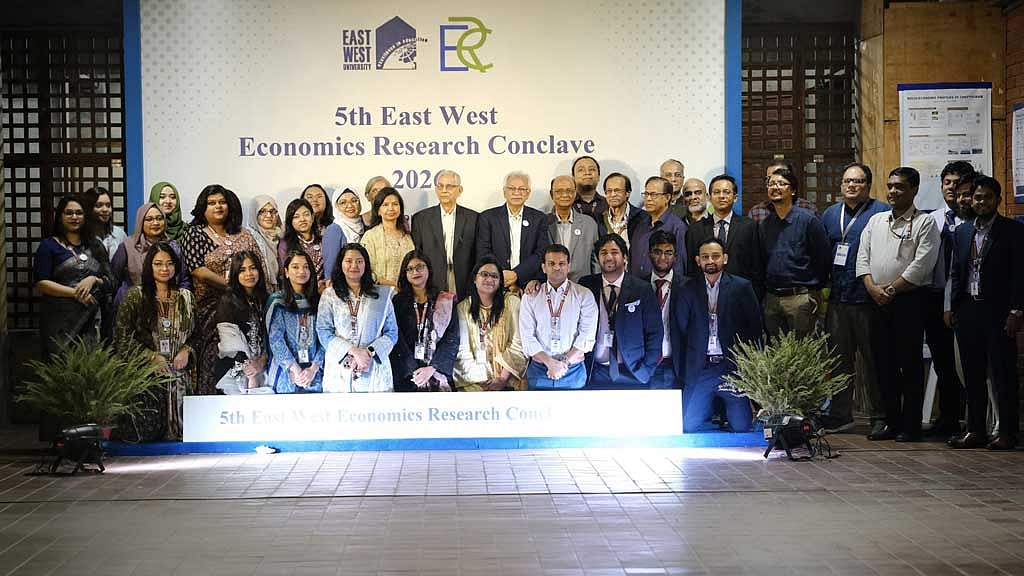
The Department of Economics at East West University (EWU) has hosted its largest-ever economics conclave, drawing over 500 participants from Bangladesh, India, Pakistan, Nepal and the US.
Held in a hybrid format under the theme "Regional Economics at a Crossroad: Challenges and Opportunities" on Nov 27 and 28, the conference featured 44 presentations across three rounds of parallel sessions, including eight plenary and featured talks, according to a media statement.
In the opening keynote, Prof E Somanathan of the Indian Statistical Institute examined how rising temperatures undermine productivity and economic growth, particularly in poorer nations.
World Bank economists addressed social protection, job creation and demographic transitions, while researchers from the Bangladesh Institute of Development Studies (BIDS) presented findings on rural livelihoods.
Other sessions explored trade, human capital, labour, energy, financial markets, climate vulnerability, public health, migration, gender and disaster resilience.
Featured speakers included former World Bank lead economist Qaiser M Khan, who compared the post-1971 development trajectories of Bangladesh and Pakistan, and economist and EWU Board of Trustees member Kona Lasker Hoque, who analysed global economic and geopolitical headwinds.
The Centre for Policy Dialogue (CPD) also led a session on the reforms required to navigate Bangladesh’s least developed country (LDC) graduation.
At the closing session, Delhi School of Economics Prof Rohini Somanathan noted that boosting female labour force participation remains the region’s largest untapped source of prosperity.
BIDS Director General and Conclave Advisory Committee Head Prof AK Enamul Hoque reflected on the platform’s origins and the value of nurturing research.
Chief Guest Jean Pesme, World Bank country director for Bangladesh and Bhutan, emphasised skills development, university–industry collaboration and inclusive opportunities.
EWU Founding Vice-Chancellor and Board of Trustees Chairperson Prof Mohammed Farashuddin highlighted challenges facing women, access to education and the need to recognise unpaid household work in GDP calculations.
The conclave reaffirmed the role of research in shaping policy and sustainable development, the statement read.