Published : 26 Nov 2026, 01:37 AM
Updated : 26 Nov 2026, 01:41 AM


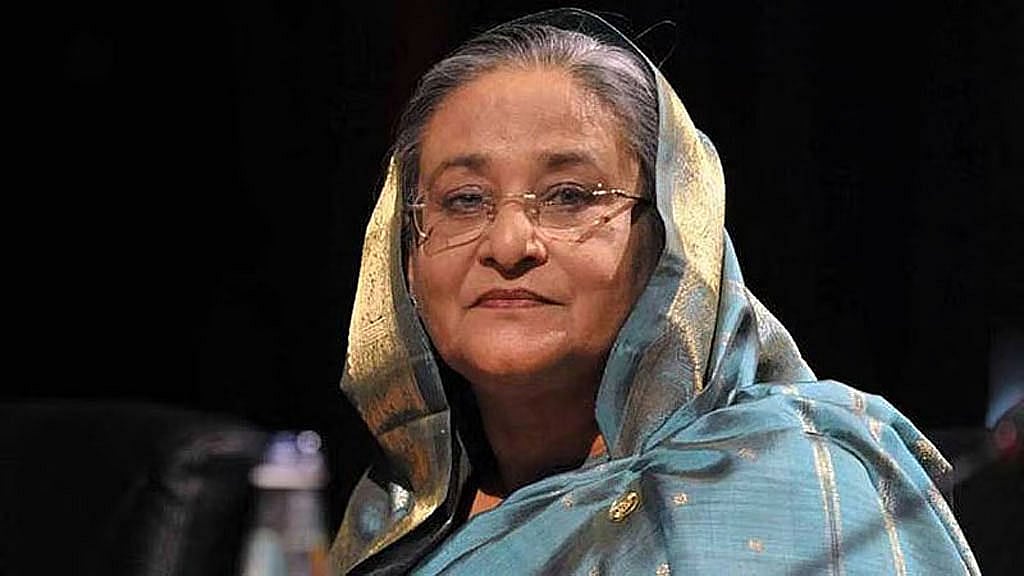
The die, apparently, is cast. After four months of suspense, former prime minister Sheikh Hasina’s spokesman has announced a date for her return to Bangladesh. Hasina let it be known, through an interview given by her spokesman to the Reuters news agency, that she intends to return on Dec 16.
Strange though it may seem, the government in Dhaka is not viewing this as an opportunity to achieve the often-stated goal of putting Hasina in jail. Instead, it views her attempted return as a challenge, a threat that must be confronted with street power. The government’s overall position on this issue seems to have taken on the appearance of a person inflicting self-harm; or a footballer wilfully scoring own goals.
On the one hand, there is a chorus of voices declaring undying resolve to put Hasina in the dock to face charges of crimes against humanity, as well as implementation of the death sentence passed on Nov 17, 2025.
For either of that to happen, Hasina needs to be physically present in the jurisdiction of Bangladeshi law enforcement. One would think Hasina’s return would be seen as a god-sent event for those pressing for the former prime minister’s hanging. But no, that does not seem to be really the case.
No sooner has Hasina declared her intention to voluntarily return to Bangladesh, than the same chorus of voices became disapproving. From ministers to prosecutors to commentators, the chorus this time is that she could not possibly return of her own free will. She can only return in handcuffs, as a prisoner, under the Extradition Treaty.
Extradition Slow Train
The fact that the extradition process could take months, even years, and most likely produce a negative outcome, does not seem to matter. The government thus remains caught in a web of contradictions.
Their publicly-stated desire for justice appears to be in conflict with their publicly-stated rejection of Hasina’s voluntary return and surrender to the courts. There does not seem to be any credible answer to a simple question: If putting Hasina in the dock to face justice is the goal, then what does it matter how she returns?
The Dhaka-Delhi Extradition Treaty of 2013 was signed to deal with suspected criminals hiding in each other’s territory. An extradition request by one country, backed by chargesheets and/or other court documents, would then be scrutinised by magistrates of the other country. The matter may even go to court. But Hasina’s case is not a straightforward “government seeks criminal” scenario.
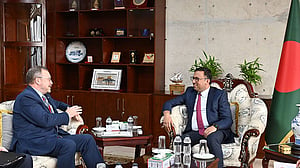
As Indian High Commissioner to Bangladesh Dinesh Trivedi recently pointed out, Hasina did not flee to India as a fugitive. She was flown to New Delhi by the Bangladesh Army, and India received her on Aug 5, 2024 as the prime minister of her country. She has been a guest of the Indian state since then.
Would India do a somersault and treat their guest as a crime suspect and put her in handcuffs? That may not be impossible, given that there is no last word in politics; but perhaps it is a little fanciful.
India’s Position Clarified
Government spokesman Zahed Ur Rahman added yet another twist to the tale, by suggesting that, since Hasina has announced intention to return, this would simplify the extradition process. Instead of returning in her own way, she could let the authorities know, who would then simply “extradite” her. But this suggestion has already met its demise.
According to Reuters, Indian foreign ministry spokesman has ruled out any linkage between Hasina’s intention and the extradition request.
“The case of a citizen willing to return voluntarily to her country on a travel document is a matter separate from the extradition request,” Randir Jaiswal said during a regular briefing on Nov 25.
In Bangladesh, the whole government machinery is now geared, not to facilitate Hasina’s return to face justice, but to actually prevent her crossing the border. By allowing her to cross the border, the government would draw Hasina into their jurisdiction, but that does not seem to matter. This is where their words and deeds take leave of each other.
It seems the BNP of Prime Minister Tarique Rahman and other anti-Awami League groups such as the Jamaat-e-Islami and NCP, are stuck in a time-warp. Back in 2024, student leaders as well as experienced politicians had claimed that Hasina would never return, and that she would die in a foreign land, alone and unmourned. As a result, they probably view her return as their defeat, and a triumph for Hasina.
BNP’s Opportunity
They are most probably also worried about Hasina’s impact on a resurgent Awami League, ban or no ban. Hanging Hasina would turn her into a martyr and form a rallying point for Awami League supporters; keeping her in jail would provide a constant source of inspiration for her partymen and women.
The idea, propagated since 2024, that a fallen Hasina is a spent force, does not seem to be holding water any more.
However, things do not have to be like this for the BNP. They can allow Hasina to return, let her appeal her death sentence, apply for bail etc., and still declare victory for the 2024 student-led uprising. Hasina’s return need not mean a defeat for the 2024 coalition of forces which ousted her from power.
For that to happen, saner heads need to prevail. Otherwise, continued confrontation could be a recipe for further violence and instability which could lead to economic ruin.
But the prospect of political upheaval and economic ruin does not appear to be bothering the government all that much. They are seemingly locked-in the 2024 time capsule, to the extent that Tarique’s big move has been to try to resurrect the BNP’s alliance with Jamaat and NCP to confront the Awami League in the street.
The government appears to have failed to anticipate every one of Hasina’s moves. Hasina seemed to catch the government off-guard with her first announcement of return made in July. Despite warnings that the Awami League would try to set the scene for Hasina’s return before December, the government was caught napping when the Awami League launched its lockdown programme.
Lack of Strategy
Tarique knows the issues surrounding the Awami League in general, and Hasina in particular, are both essentially political. Such political issues require political solutions. But it appears the government does not have a clear strategy on how to deal with the issues. It is stumbling from one crisis to the next challenge, making up responses as it goes along.
With only several weeks to go before the deadline, the prime minister has reached for a very familiar response, by gathering allies for a street showdown. Not quite the Bangladesh 2.0 that was promised back in 2024.
Hasina’s latest announcement triggered predictable reactions from the government ministers, but one stood out for its naiveté. State Minister for Foreign Affairs Shama Obaed Islam tried to sound belligerent, but ended up saying something that risks turning her into a laughing stock.
She claimed that, if Hasina visited any of Bangladesh’s embassies in foreign capitals -- be it New Delhi or London -- she would be arrested. This was not a serious comment from a serious minister.
Apparently, no one had briefed her that embassies, despite their immunity, are still in the jurisdiction of the host countries. Embassy officials do not have the power -- or indeed, the role -- to “arrest” anyone.
If any Bangladeshi embassy detained Hasina against her own free will, then that diplomatic venue would become a prison, which would be a violation of international law and jurisdiction of the host country. Only the host country has the authority to detain, arrest or imprison anyone, not any foreign embassy.
Preparing for ‘Something’
Hasina and other Awami League leaders and workers in foreign countries, are Bangladeshi citizens. Preventing their return to their own country would be tantamount to a denial of their constitutional rights.
However, constitutional niceties are not paramount in anybody’s mind at present. Although many people on the anti-Awami League camp are seriously sceptical about Hasina’s return on December 16, there is little doubt that both sides are making preparations precisely with that date in mind.
Tarique’s outreach to Jamaat and NCP, preparation by BGB at Benapole, arrangements being made by Indian authorities on the other side of the border at Petrapole, organisational activities among AL leaders and workers on both sides of the border etc, all point to heightened anticipation about “something” happening on Victory Day. It remains to be seen whether it will be a big bang, or just a damp squib.
In a democratic society, politics is meant to be the “art of the possible”. But in Bangladesh, politics has been, and continues to be, a “zero-sum game”, where each actor sees a gain for their rivals as a loss for itself and vice versa. There does not seem to be an end to this vicious, self-defeating cycle.
[Sabir Mustafa is a journalist and podcaster]