Published : 02 Nov 2026, 01:20 AM
Updated : 02 Nov 2026, 01:20 AM


The Awami League has been out of power and barred from political activity since the mass uprising that toppled its government. Yet the party's possible return has become a flashpoint in a growing war of accusations, with the ruling BNP, opposition Jamaat-e-Islami and its ally, the National Citizen Party (NCP), each accusing the others of seeking an understanding with the former ruling party.
Jamaat and the NCP say the BNP is trying to reach an accommodation with the Awami League and fracture the political unity forged during the uprising to please India.
BNP leaders, including Prime Minister Tarique Rahman, have in turn accused Jamaat of colluding with the Awami League.
None of the leaders making these allegations has publicly produced evidence to substantiate them.
The question, therefore, is whether there is any real initiative to bring the Awami League back into politics, or whether its return has become a convenient weapon in the political contest.
Some politicians and analysts see the exchanges as little more than a blame game.
bdnews24.com spoke to several ministers, BNP leaders and opposition figures. Some government and BNP sources said the prime minister's allegation should not be dismissed as mere rhetoric.
They argued that, given past political contacts, communication between Jamaat and the Awami League was not inconceivable.

Opposition leaders, meanwhile, say they are making the allegations seriously. They point to a series of Awami League marches in Dhaka and elsewhere as grounds for suspicion.
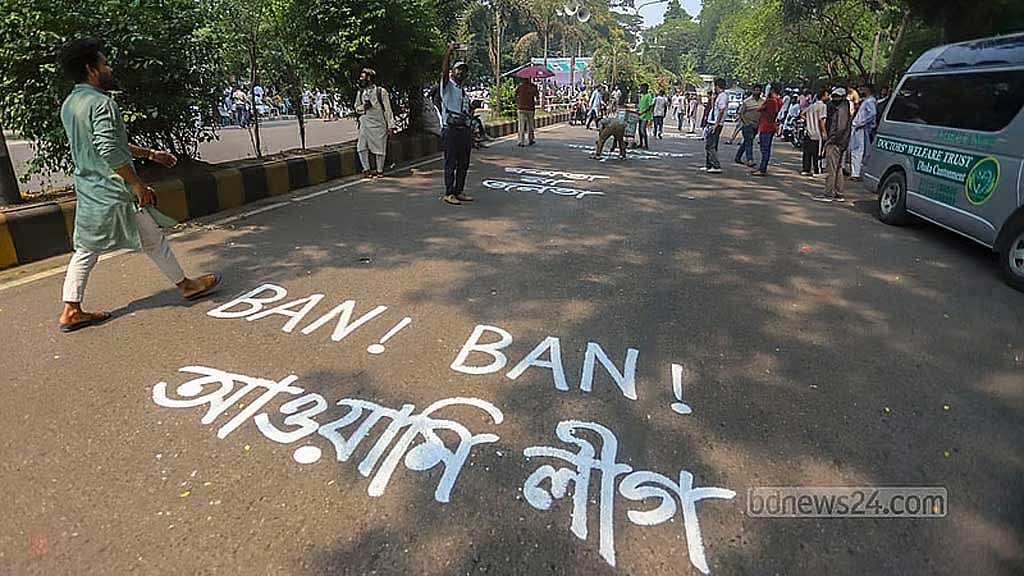
The Awami League government fell on Aug 5, 2024, following a mass uprising. On May 12, 2025, the interim government led by Nobel laureate Muhammad Yunus banned the activities of the party, one of the country's oldest, and its affiliated organisations.
The ban was to remain in force until the International Crimes Tribunal concluded the party's trial over allegations of crimes against humanity. The BNP government has kept the prohibition in place.
The tribunal has since sentenced ousted prime minister Sheikh Hasina and former home minister Asaduzzaman Khan Kamal to death in a case involving crimes against humanity.
Hasina, now in exile in India and facing the death sentence, has announced plans to return to Bangladesh in December.
Both the interim administration and the BNP government have repeatedly asked India to send her back. New Delhi has said it is examining the matter through legal procedures.
Her possible return, and the Awami League's political future, are therefore bound up in legal as well as political questions.
A Widening War of Accusations
The latest round of claims gathered pace in June, less than six months after the BNP took office. Opposition Chief Whip Nahid Islam accused the government of entertaining a “dream” of rehabilitating the Awami League politically.
In July, Hasina told Reuters by telephone that she and Awami League members wanted to return voluntarily and surrender before the courts. The political argument over the party's future intensified thereafter.
In September, NCP Senior Joint Convenor Nasiruddin Patwary accused the BNP of fracturing the unity born out of the July Uprising to “please Delhi”. Later that month, after several hundred people marched in Gulshan-1 shouting “Joy Bangla” slogan, Jamaat Assistant Secretary General AHM Hamidur Rahman Azad questioned whether the government had reached an “understanding” with the Awami League or struck a deal with India.
Tarique entered the dispute in October. Speaking at an event in Feni, he alleged that the “autocrats” and “clandestine forces” could soon join hands.
NCP Senior Joint Convenor Hasnat Abdullah responded with a counter-allegation that a section of the BNP had links with the Awami League.
Amid labour unrest in Savar, Tarique told a rally in Rajshahi, citing intelligence information, that two groups were behind worker unrest in different parts of the country and in factories.
He alleged that the “fugitive autocrat” was supplying money from across the border, while people who had tried to sell nomination tickets before the election were helping foment unrest.
Nahid, the NCP convenor and a Dhaka MP, countered that the government was running the country through an understanding of sorts with the Awami League and India.
The latest allegation came from the prime minister's political assistant, Mohammad Rashed Khan, who claimed that Jamaat Secretary General Mia Golam Porwar and two other leaders had held a secret meeting with a senior Indian intelligence official.
Porwar demanded evidence. Rashed insisted the allegation was “100 percent true” and posted a video on Facebook in support. bdnews24.com could not independently verify the footage.
Rashed had earlier accused Jamaat of conspiring with the Awami League to create instability.
BNP Acting Secretary General Ruhul Kabir Rizvi has also repeatedly accused opposition forces, without naming them directly, of trying to strike an understanding with India's ruling Bharatiya Janata Party.

Evidence, Suspicion and Political Calculations
Asked what evidence supported the allegations, Golam Porwar rejected the suggestion that Jamaat was playing a blame game.
“No, this is not a blame game. In fact, we are looking at it very seriously and sincerely. A section of the government is maintaining a secret connection with the Awami League,” he said.
He questioned how Awami League marches could take place across the country on the same day, including in the prime minister's constituency, despite intelligence and administrative surveillance. “This is an understanding,” he said.
Patwary argued that, as the Awami League was now trying to return to the streets, the government was plotting to implicate opposition parties in a conspiracy with it and arrest their activists.
Rashed Khan said his allegations were based on reasoning and information. “There are arguments and information behind these claims. I have also written about Golam Porwar on Facebook.
“Just because I have said something from a responsible position does not mean it is automatically established, does it?”
He claimed Jamaat had already agreed to launch a movement alongside the Awami League and was preparing a plan for a campaign like the one in 1996.
A prime ministerial advisor told bdnews24.com that the allegation should not be dismissed as mere blame. Saiful Haque, general secretary of the BNP's ally Revolutionary Workers Party, also said Tarique's remarks should not be brushed aside.
A BNP Standing Committee member said the party's top leadership would discuss Hasina's return and the Awami League's political future. The prime minister might also consult other parties, the member said.
A central BNP leader said the government's position was relatively lenient towards the Awami League, but how far that went would depend on the party's conduct, support from its international allies and the resolve of its leaders and activists.
Standing Committee Member Selima Rahman described blame-shifting as commonplace in the country's politics. She noted that Jamaat had previously joined movements with the Awami League and had enjoyed close ties with it.
Azad, however, rejected the allegations, pointing to the executions, torture, enforced disappearances and killings of Jamaat leaders under the Awami League government.
He said the accusations were intended to conceal the government's failures. “For this, the government has recruited some hired people.”

Who Is Trying to Avoid Responsibility?
Nagorik Oikka President Mahmudur Rahman Manna sees the accusations as a familiar political blame game, recalling similar exchanges involving the Jatiya Party and, earlier, Jamaat.
Political analyst Mushtuq Husain believes the Awami League should be allowed to engage in politics. The public had already judged its misrule through the Uprising, he said.
But the trial of crimes against humanity committed during Hasina's rule must proceed; otherwise, the consequences would linger into the future, he added.
Zobaida Nasreen, a professor of anthropology at Dhaka University, says governments often use accusations to shift responsibility onto others.
On Hasina's possible return, she noted that government advisors had said she would receive security if she came back. That, alongside other signals, was creating an impression that her return was possible.
Such questions, she said, were part of international politics and negotiations in which Bangladesh's government would inevitably be involved.
“For now, it seems that no one wants to take responsibility. That is why they are blaming one another,” she said.