Published : 14 Jul 2023, 02:33 AM
Updated : 14 Jul 2023, 02:33 AM


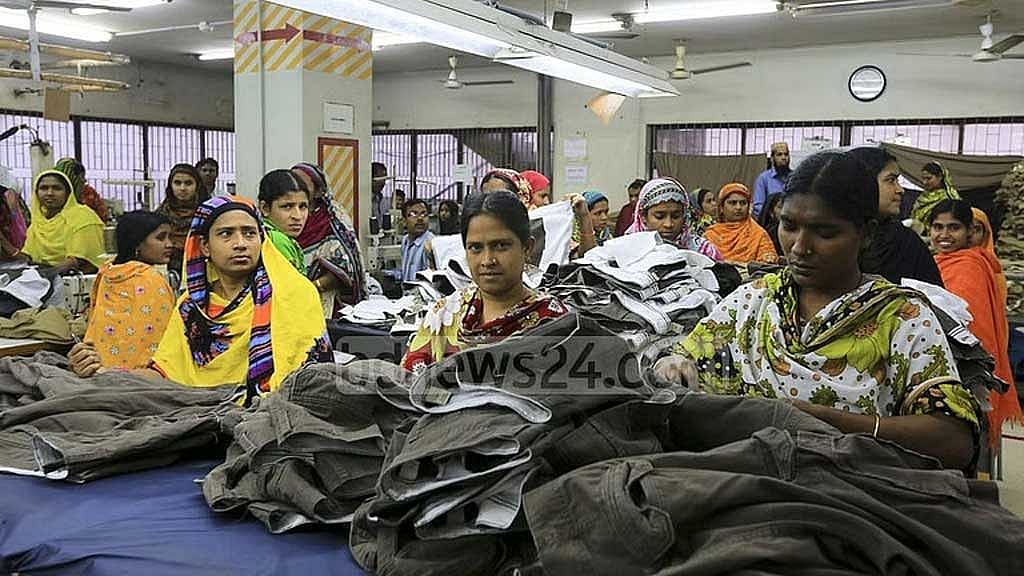
The annual export data released recently revealed that Bangladesh’s earnings from apparel exports have jumped by 10 percent, despite facing a significant decline in exports to the US, historically considered the top export destination.
According to Export Promotion Bureau, or EPB, data, exports to the US have dropped by 5.51 percent in the recently concluded fiscal year (FY23). Similarly, exports to some of the major European destinations, like Germany and Poland, within the EU have fallen sharply, by 6.81 percent and 13.66 percent, respectively.
Industry insiders indicated several reasons contributed to this decline, including global economic slowdown, inflation, US interest rate hikes, lingering effects of the Covid-19 pandemic, the ongoing Russia-Ukraine war, and unsold inventory in the US and Europe.
Quite intriguingly, though, exports to other European destinations, like Spain, France, Italy, Denmark and the Netherlands, have increased by 18.53 percent, 23.51 percent, 42.14 percent, 11.85 percent, and 25.18 percent, respectively.
Outside of the EU, export to UK and Canada has risen by 11.78 percent and 16.55 percent.
However, the data also revealed an interesting fact- a growth in apparel export in some non-traditional export destinations, mainly India, Australia and Japan.
In the last fiscal year, the exports of Bangladesh-made apparel have increased in South Korea, China, UAE, Mexico, Malaysia, Saudi Arabia and Türkiye.
AUSTRALIA, INDIA, AND JAPAN- THE NEW FRONTIERS?
The significant increase in exports to Australia, India and Japan- all part of the US-led Quadrilateral Security Dialogue, commonly known as the Quad- was a welcoming surprise to the policymakers and businesses in Bangladesh.
Data shows that in FY23, exports to Australia rose to 42.48 percent, while exports to India and Japan soared to 41.58 percent and 45.62 percent compared to the previous year.

The Bangladesh government has been urging the RMG industry stakeholders to find new markets for exporting their products as it is pushing to increase export revenue.
To that effect, the government has fixed a $62 billion overall export income target for the FY24, a 12 percent increase compared to the recently concluded fiscal year.
Since apparel products are Bangladesh’s premier export items, the industry expects to meet the bulk of the export targets.
Praising the industry’s contribution to Bangladesh's economy, Commerce Minister Tipu Munshi, in a recent programme, said that while the other export industries are still stuck in single-digit growth, despite many obstacles, the RMG industry maintained double-digit growth.
The minister also called on the industry stakeholders to make preemptive moves to fill out the vacuums left by other RMG-producing countries like China and Vietnam.
“Since China’s focus has shifted from the industry and Vietnam is struggling to employ workers, it is high time for Bangladeshi businessmen to fill out the void left by them [China and Vietnam],” he said.

Faruque Hassan, president of the Bangladesh Garment Manufacturers and Exporters Association, or BGMEA, said the new export destinations opened new doors for them, as these new markets have covered the decline in sales in the traditional markets.
“In the first five months of the year, Bangladesh’s apparel exports to the US declined by 22 percent. It still fared relatively better than China and Vietnam, which experienced contraction rates of 31 percent and 28.07 percent, respectively,” he said.
However, the apparel and knitwear businessmen made it clear to the government that they would require an uninterrupted energy supply to reach the target they were handed.
In a recent programme, Mohammad Hatem, executive president of Bangladesh Knitwear Manufacturers and Exporters Association, or BKMEA, said that their production and growth target may be unachievable unless the ongoing unstable energy supply situation normalises soon.