Published : 28 Sep 2026, 10:11 AM
Updated : 28 Sep 2026, 10:11 AM


The government is drawing up a five-year plan to revive Bangladesh's jute sector, targeting $2 billion in export earnings by 2031 as recent growth in overseas sales raises hopes for a recovery.
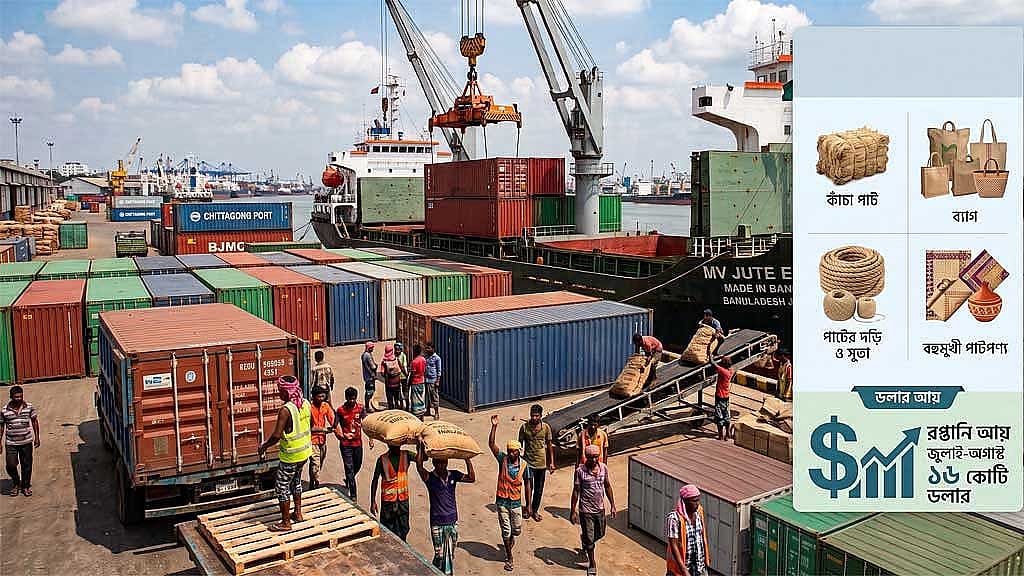
Jute and jute product exports brought in $162.5 million in the first two months of the 2026-27 fiscal year, up 37.09 percent from $118.6 million in the same period of 2025-26, according to the latest data from the Export Promotion Bureau.
The rise follows a 7.75 percent increase in jute export earnings last fiscal year, when Bangladesh earned $883.7 million from the sector, compared with $820.8 million in 2024-25, the lowest in 12 years.
Recent export data suggest growing global demand not only for jute-based home furnishings, but also shopping bags, technical textiles, garments, gardening products, automobile applications and packaging. Charcoal made from jute sticks is also in demand in China and other countries.
In July-August this year, raw jute exports rose 36 percent, jute yarn exports 58 percent and earnings from other jute products 48.15 percent. However, earnings from jute sacks and bags fell 13 percent.
Exporters say floods damaged jute production last year, pushing up the price of raw jute.
As a result, export earnings increased in value terms, although export volumes did not. With demand rising in global markets, exporters see scope for further growth in both value and volume if the supply of raw jute is kept stable.
They have also called for more research, improved product quality and increased foreign investment in the sector, including through joint ventures.
Bangladesh is the world's second-largest jute producer, producing about 9 million bales a year. A Bangladesh Investment Development Authority (BIDA) report says the country could raise jute export earnings to $5 billion by making better use of the sector's potential.
The government is now preparing a five-year action plan to increase exports.
Rather than setting an overly ambitious target, it wants to double export earnings by 2031, while moving towards near self-sufficiency in jute seeds and increasing production of higher-value jute products.
Jute Department Director General Syed Md Nurul Basir told bdnews24.com that the aim was not to recreate the sector's past, but to find a better way forward.
"We may not be able to bring back jute's golden days. But we are taking steps to find the path we have lost and move forward on it more effectively," he said.
"Our target is to earn $2 billion from the jute sector within five years."
Product-Wise Exports
According to EPB data, Bangladesh exports raw jute, jute yarn, sacks and bags, and diversified jute products to Turkey, China, India, Egypt, Uzbekistan, Indonesia, Morocco, the United Arab Emirates, Jordan, Pakistan, Russia, Iran and other countries.
In 2025-26, earnings from jute yarn exports rose 18.18 percent to $545.8 million, although export volume fell 2 percent. Bangladesh exported 428,000 tonnes of jute yarn that year, compared with 438,000 tonnes in 2024-25.
Exports of jute sacks and bags rose 5.03 percent to $132.3 million.
Raw jute export earnings, however, fell 11.64 percent to $131.2 million. In volume terms, raw jute exports plunged about 77 percent, from 167,000 tonnes in 2024-25 to 38,000 tonnes in 2025-26.
Earnings from other diversified jute products also fell 11.28 percent to $74.4 million.
What Exporters are Saying
Despite years of disappointment over the jute sector, exporters remain hopeful about its potential.
Bangladesh Jute Spinners Association President Tapash Pramanik told bdnews24.com that the sector had been hearing promises of revival for years without much progress.
"More than 90 percent of the country's foreign exchange earnings came from this sector after independence. The sector lost its way, while we all watched and later focused on the ready-made garment industry," he said.
Referring to the closure of 35 state-owned jute mills, Tapash said he was uncertain about the benefits of the move and the government's current attempts to reopen the mills through leasing.
He said jute product exports could easily be raised to $2-3 billion if the supply of raw jute remained steady and incentives were introduced to help exporters enter new markets.
The sector's exports reached about $1.15 billion in 2020-21, raising hopes that the "golden fibre" was entering a new era. "But now it seems that hope has come to nothing," he said.
Tapash added that the modest increase in export earnings last fiscal year was largely driven by higher product prices.
Although diversified jute products have significant potential in the global market, Bangladesh's exports in this segment remain low.
Entrepreneurs say orders from the European Union, a major market for diversified jute products, have fallen by 20-25 percent amid the Iran war.
Higher energy costs have reduced sales of non-essential goods, while rising raw jute prices have increased production costs for diversified jute products.
At the same time, global demand is growing for jute-based home furnishings, shopping bags, technical textiles, garments, gardening products, automobile applications and packaging. There is also demand for charcoal made from jute sticks in China and other markets.
Rashedul Karim, managing director of diversified jute product exporter Creation, said businesses earn very low margins from jute yarn and sacks, making it difficult to absorb higher raw jute prices.
"There is no alternative to producing diversified products if we want to increase jute exports," he said.
Rashedul said Bangladesh needed research to develop new products and more foreign investment in the sector, which would help local entrepreneurs strengthen their capabilities.
What is in the 5-Year Plan?
EPB data show that export earnings from jute and jute products have fallen by about 29 percent over the past five years.
The government is therefore preparing a five-year action plan to revive the sector, with the main goals of doubling export earnings by 2031, achieving near self-sufficiency in jute seeds and increasing production of higher-value jute products.
The plan is expected to require up to Tk 47.5 billion in investment.
At the government's direction, the Jute Directorate under the Ministry of Textiles and Jute prepared a draft report titled "Bangladesh Jute Sector Development Strategy and Action Plan 2026-31".
A review meeting with stakeholders was held at the directorate's office in Dhaka’s Motijheel on Aug 4. The draft was later finalised after incorporating the participants' views.
The final report sets a target of raising annual exports of jute and jute products from the current $820 million to $1.64 billion by 2031.
It also aims to increase annual raw jute production from 11.5 million bales to 12 million bales, meet 85-90 percent of domestic jute seed demand through local production, and raise the share of value-added products from 45 percent to 70 percent.
The report also calls for internationally accredited laboratories to ensure global quality standards and greater use of information technology in the jute sector.
Jute Directorate Director General Nurul Basir told bdnews24.com that he remained optimistic about the sector.
"We may not be able to fully bring back its lost golden days. But if we can raise jute sector exports to $2 billion within five years, I would consider that a major success," he said.
He said the strategy and action plan were being prepared taking these issues into consideration.