Published : 17 Oct 2026, 01:37 AM
Updated : 17 Oct 2026, 01:43 AM


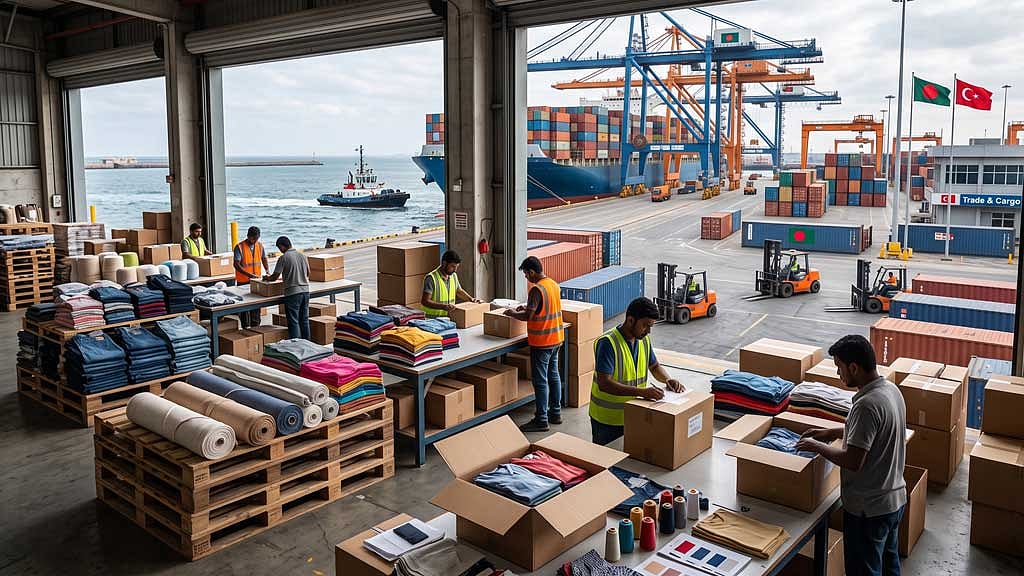
Bangladesh has often competed with Turkiye for the European garment market, but in recent months, Bangladeshi garments to the country have started to rise once again.
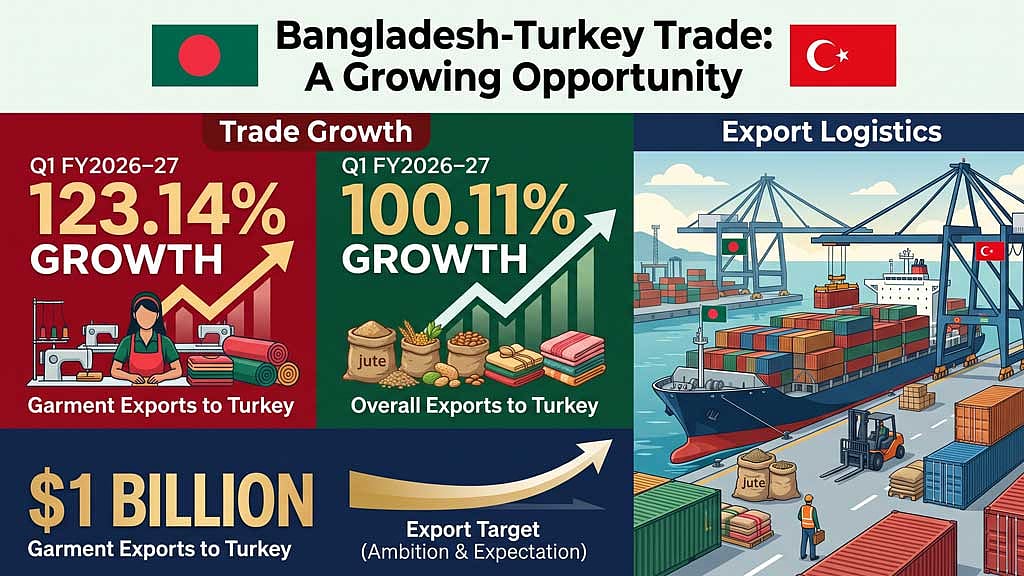
According to the country-wise export calculations from the Export Promotion Bureau (EPB), Bangladesh's ready-made garment exports to Turkiye earned $146.63 million in the first three months of the current fiscal year 2026-27, i.e. from July to September.
In the same period of the last fiscal year, this amount was $65.71 million. That is, income from garment exports increased by 123.14 percent year-on-year.
But it isn’t just garments. Bangladesh's exports of all types of goods to Turkiye have more than doubled over the period.
In the first quarter of the current fiscal year, the country exported $215.40 million worth of goods to Turkiye, up from $105.21 million a year earlier. The growth rate is 100.11 percent.
This rate is much higher than Bangladesh’s national export growth rate.
According to EPB, during this period, Bangladesh's overall product export income increased by 6.34 percent. The July-September revenue was $13.09 billion, compared to $12.31 billion the year before.
Exporters say that exports can be increased further if Bangladeshi ready-made garments take advantage of this opportunity in the Turkish market.
They project that Bangladesh's total exports to Turkiye could even rise to $1 billion in the current fiscal year. However, to achieve this goal, exports of other products, along with garments, will have to be increased.
A Chance to Regain the Market
Turkiye is not a new market for Bangladesh. Bangladesh has been exporting a variety of products, including ready-made garments, to the country for a long time.
Turkiye was once an important market for Bangladeshi garments due to duty-free benefits. However, after a change in the tariff policy, Bangladesh's exports there suffered a major setback.
According to EPB statistics, Bangladesh earned about $860 million by exporting goods to Turkiye in the 2013-14 fiscal year. Of this, $622 million came from ready-made garments. In both products and garments, it was Bangladesh's highest export earnings from trade with Turkiye.
Over the next few years, exports declined. In the 2015-2016 fiscal year, Bangladesh's total exports to Turkiye fell to $661.8 million. Income from ready-made garments decreased to about $460 million.
Although there were some fluctuations in export earnings in the following years, Bangladesh could not return to its previous peak.
A similar trend could be noted in recent years. In the 2025-26 fiscal year, Bangladesh earned $593 million from exports to Turkiye, a 6.55 percent decline from the previous fiscal year.
The income from ready-made garments that year was $401.7 million, while jute and jute products came in at $161.6 million.
In the 2024-25 fiscal year, Bangladesh's total export income from Turkiye was $634.5 million. The income from ready-made garments was about $450 million, and from jute and jute products was $144.5 million.
These statistics show that while there is an opportunity for Bangladesh to increase exports to Turkiye, maintaining growth in export earnings remains a major challenge. And so, the country must take advantage of the latest surge and turn it into sustainable export growth.
Shortage in Local Production, Opportunity in Foreign Clothing
Fazlee Shamim Ehsan, executive president of the knitwear industry owners' association BKMEA, gave his opinion on how Bangladesh's ready-made garment exports to Turkiye have increased.
He told bdnews24.com that as the standard of living and income in Turkiye has increased, the country's workers are gradually moving away from the ready-made garment industry. As a result, there is a kind of shortfall in local production. The demand for foreign clothing is increasing to fill that shortage.
"Turkiye has now emerged as a potential market for Bangladesh's ready-made garment exports. There is an opportunity to further penetrate the market by utilising Bangladesh's production capacity, product quality, competitive prices, and timely delivery capacity."
However, Shamim believes that one should not rely solely on conventional clothing exports to seize this opportunity.
According to him, in addition to increasing the production and export of high-value garments, synthetic fibres and technical textiles, emphasis should also be placed on product diversification and value addition.
Shamim said, “In addition, there is an opportunity to expand the market for jute and jute products, shoes, and other potential products. Communication with Turkiye should be increased as well.”
The executive president of BKMEA also emphasises coordinating government and private initiatives to expand the market. He says it is possible to further strengthen Bangladesh's presence in the Turkish market by organising international trade fairs, buyer-seller meetings and increasing business communication.
Shamim said, “If we can take advantage of this new potential, it is possible to take our total exports to Turkiye to $1 billion in the current fiscal year. To achieve this, the government and the private sector must work together.”
As Bangladesh's total exports to Turkiye were $593 million in the last fiscal year, exports will need to jump dramatically to reach that target in the current fiscal year.
While growth in the first three months suggests the potential, the export situation throughout the remainder of the fiscal year will ultimately be crucial in achieving it.
Joint Investment Initiative to Boost Trade
The BNP government is taking initiatives to strengthen trade and investment relations between the two countries, in addition to increasing Bangladesh's exports to the Turkish market.
In a meeting between Turkish Ambassador Ramis Sen and the Bangladesh Garment Manufacturers and Exporters Association (BGMEA), the issue of strengthening the strategic partnership in the textile sector, in addition to increasing trade and investment between the two countries, came up.
The meeting discussed the possibility of joint investment in the synthetic fibre and technical textile sectors in Bangladesh, importing raw materials and modern textile machinery from Turkiye, and using the logistics system of Turkish Airlines and Istanbul Airport for fast transportation of goods.
Such cooperation can increase the production capacity of Bangladesh's garment industry and also create opportunities for manufacturing high-value products.
At the same time, analysts recommend finding opportunities to expand the market for other export products to Turkiye, including jute and jute products.
During Turkish Foreign Minister Hakan Fidan's visit to Bangladesh last June, the two countries discussed their interest in expanding trade from $1.3 billion to $2 billion. Discussions were also held on creating a more favourable framework to facilitate that expansion.
Jute as Well as Garments
Tapash Pramanik, chairman of the Bangladesh Jute Spinners Association (BJSA), a jute mill entrepreneurs' organisation, has suggested prioritising jute and jute product exports to Turkiye in addition to ready-made garments.
He told bdnews24.com, "Turkiye is also a big market for our jute and jute products. The government's policymakers should keep this issue in mind. It is not enough to just sit on RMG."
He says that, in the plan to increase Bangladesh's exports to the Turkish market, jute and other products should be given equal importance to ready-made garments.
Tapash said, “If we really want to capture the Turkish market again, then we have to pay equal attention to other products, including jute, along with ready-made garments.”
Expressing disappointment over Bangladesh’s longstanding inability to utilise the potential of the jute sector, he said: “We have been hearing optimism about jute for years, but nothing is happening. Since independence, the sector that used to generate more than 90 percent of our total foreign exchange has lost its way. We all looked and looked. Eventually, everyone stuck with ready-made garments.”
Tapash says that if Bangladesh can maintain its export momentum to Turkiye, it can deepen the economic relations between the two countries. Therefore, exports, investments and joint ventures of other products must be increased alongside garment exports.
How to Meet A $1bn Target
Experts say that although there is a possibility of increasing Bangladesh’s exports to Turkiye, several factors will play an important role in whether the $1bn target is realised.
Firstly, competitive prices and quality must be maintained in the ready-made garment market while ensuring timely supply of products.
Secondly, the capacity in high-value garments and technical textiles must be expanded.
Thirdly, effective initiatives need to be taken to expand the market for jute and jute products and other products.
EPB Vice Chairman Mohammad Hasan Arif also sees the jump in exports to Turkiye as a positive sign.
He said, “It is very good news that a new ray of hope has emerged in our exports to Turkiye. To maintain this trend of increasing exports, we need to analyse product-based export capacity and customer demand and exploit new opportunities.”
In addition to conventional products, emphasis should also be placed on expanding the market for potential products such as jute and jute products, shoes and opticals, medical and textile equipment, he added.