Published : 04 Oct 2026, 10:17 AM
Updated : 04 Oct 2026, 10:17 AM


Garments, which bring in more than 80 percent of earnings, are the first sector that comes to mind when thinking of Bangladesh’s exports.
Jute, home textiles, frozen shrimp and leather goods follow, yet the pharmaceutical industry – rarely in the spotlight - has quietly come a long way.
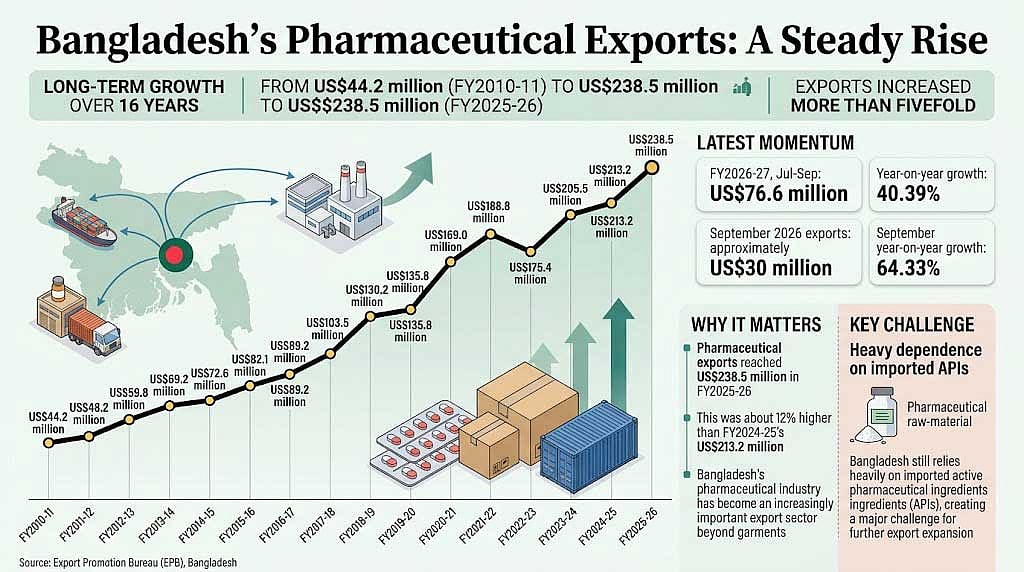
Export Promotion Bureau (EPB) data show the country exported $44.2 million worth of medicines in fiscal 2010-11. The figure rose to $238.5 million in 2025-26, nearly 5.5 times higher in 16 years.
The first quarter of 2026-27 shows the momentum continuing.
Exports reached $76.6 million in July-September, against $54.54 million a year earlier, a rise of about 40 percent.
September saw the sharpest growth, with almost $30 million exported against $18.1 million in September last year.
August exports stood at $24.2 million, so September rose about 18 percent on the month.
Nearing $250mn
Bangladesh set a record in the previous fiscal year too. Earnings rose about 12 percent to $238.5 million in 2025-26 from $213.2 million in 2024-25.
Exports first crossed the $200 million mark in FY24, at $205.48 million.
They had fallen about 7 percent to $175.42 million in FY23, but the sector bounced back the next year.
EPB figures show earnings of about $130 million in FY19, $135.8 million in FY20, $169.02 million in FY21 and $188.78 million in FY22. Exports have climbed steadily since 2023-24.
Exporters Upbeat
Drugmakers are pleased with the start to the new fiscal year.
Abdul Muktadir, president of the Bangladesh Association of Pharmaceutical Industries and chairman and managing director of Incepta Pharmaceuticals, said the sector had made a good start and he hoped the trend would hold.
The industry aims to lift export earnings to $500 million by the next fiscal year.
Many countries lack the facilities, so Bangladesh is becoming a global hub for good-quality, low-cost generic drugs, he said. “Our main problem is raw materials.”
He expects the active pharmaceutical ingredient (API) park under construction in Gajaria, Munshiganj, to ease the problem somewhat once fully operational.
Made at Home, Raw Materials from Abroad
About 98 percent of medicines used in Bangladesh are made locally, but much of the API, the core active ingredient, has to be imported. Industry insiders put the share at around 90 percent.
Gonoshasthaya Pharmaceuticals began API production in 1988 with the antibiotic amoxicillin and later made two more. Progress has been slow since.
Companies large and small make one or two APIs each, without the policy support and financial incentives they need.
China and India are the main sources of raw materials. The dependence strains foreign exchange reserves and puts drug production at risk if global supply chains are badly disrupted.
After the West Asia conflict in March, the health ministry told the industry to find alternative sources of raw materials. Raising API output is now seen as the next big challenge.
Global Opportunity
Bangladesh has the skilled workforce the sector needs. It directly employs about 200,000 people and indirectly about 300,000 more.
The local market has tripled in 16 years, from Tk 90 billion in 2010 to more than Tk 300 billion.
The global generics market is worth about $400 billion.
Bangladeshi medicines now reach more than 150 countries, with the United States, Britain, Canada, Australia and the European Union among the big markets.
EPB's latest figures show exports of $238.5 million in 2025-26 to more than 130 countries.
Medicines still make up a small slice of total merchandise exports, which were about $48 billion in FY26.
The share was around 0.5 percent, leaving Bangladesh's footprint in the world market limited despite the potential.
Even a 1 percent share of the global market would add $4 billion to exports, Muktadir said.
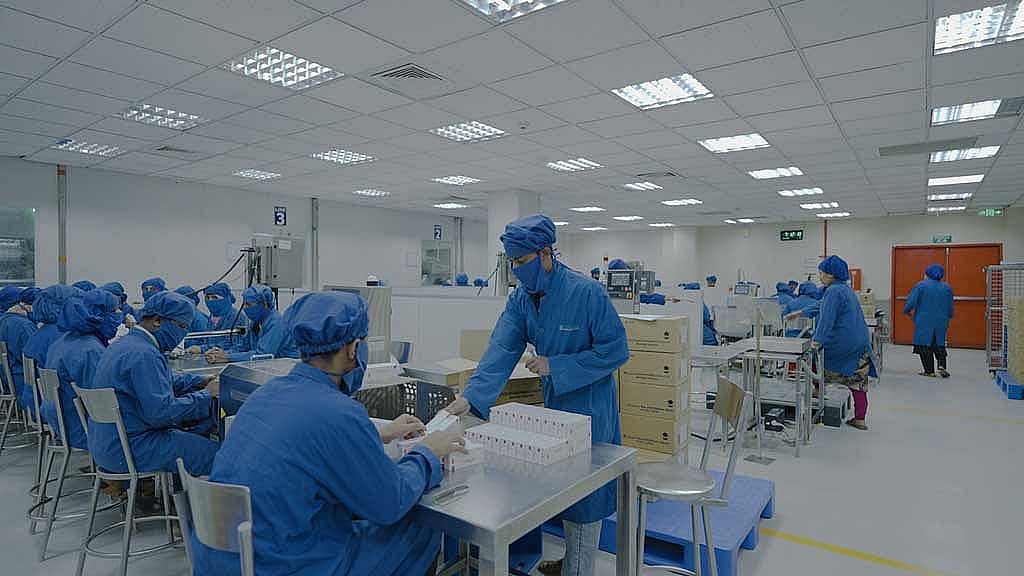
Apart from China, India and a few Western countries, no one matches Bangladesh in drug manufacturing, he said, leaving wide room for growth.
At home, Bangladesh also leads Singapore, Malaysia, the Philippines and Vietnam, richer countries that rely on imports for 60 to 80 percent of national demand.
Muktadir believes Bangladesh can repeat its garment success in drug raw materials. It can now make any “molecule”.
In garments, Bangladesh faces 30 to 35 competitors, while in medicines or raw materials the rivals are just two or three, such as China and India.
“Our drug companies have completed all preparations to raise exports. Exports will keep rising now,” he said.
“We are hopeful that, with government support and more local raw material production, this sector will bring in even more foreign currency.”
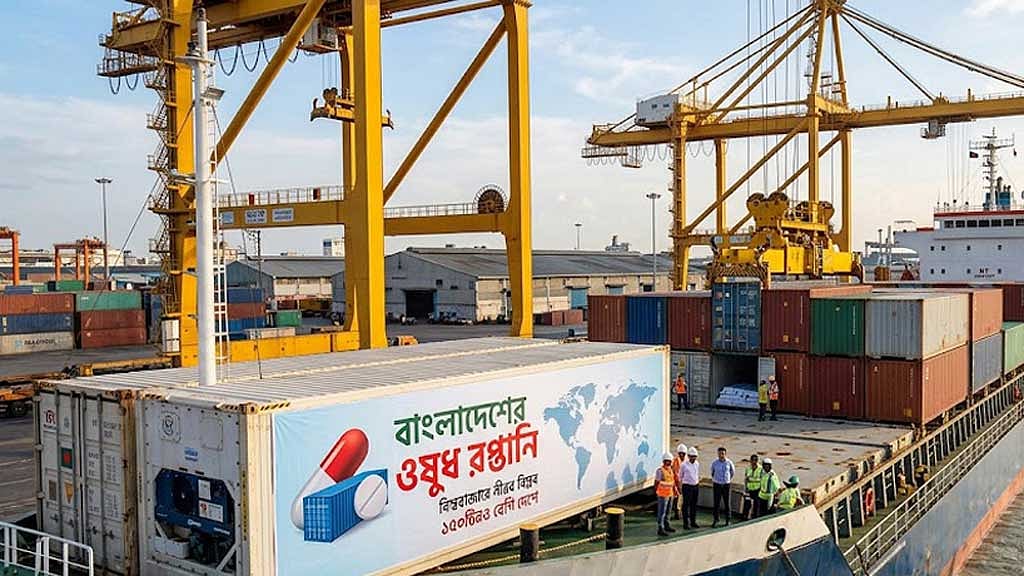
Big Changes Ahead
Bangladesh began exporting medicines in 1985 and has since become a major supplier to the least developed countries.
The pharmaceutical association's website says exports are growing fast.
Over the past two years, 1,200 products have been registered for export, now shipped to more than 150 countries including the United States, Britain, Canada, Australia and Germany.
As per EPB data, three companies, Beximco, Square and Incepta Pharmaceuticals, accounted for nearly half of last year's exports.
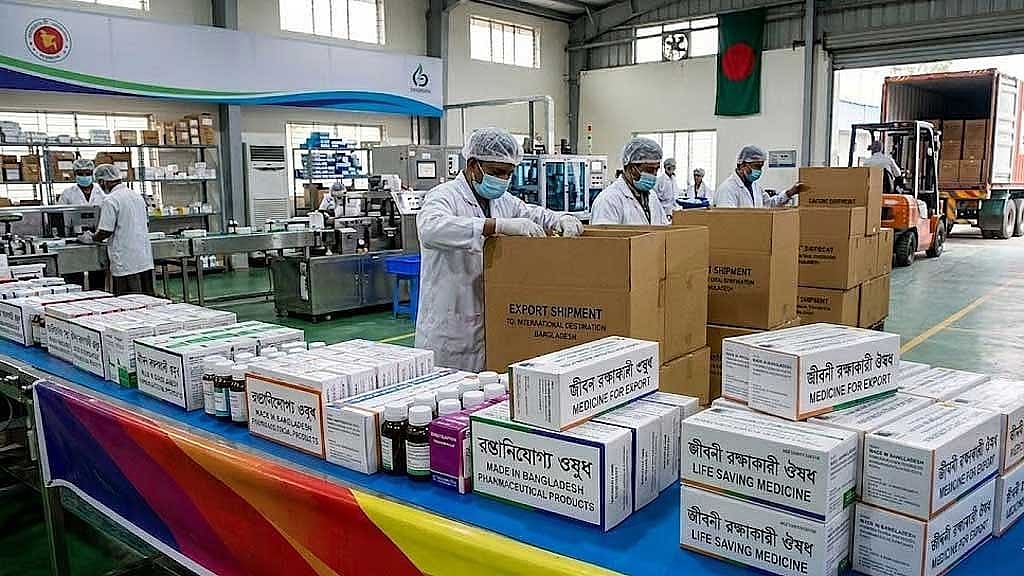
Beximco Pharma exported the most, followed by Incepta and Square Pharmaceuticals. The other top 10 exporters are Renata, ACME, Aristopharma, SK+F, General, Beacon and Orion Pharma.
Despite the growth, the industry faces big challenges. Besides raw material dependence, there is Bangladesh's preparation to graduate from least developed country (LDC) status.
The country was due to leave the LDC list on Nov 24, 2026. The government has applied for three more years to prepare, and the UN General Assembly will decide on the issue.
Graduation touches on intellectual property and trade facilities, so raising local raw material output and holding on to international competitiveness have become crucial for the industry.
Rabbur Reza, chief operating officer of Beximco Pharmaceuticals, called the export market for the sector very bright.
Beximco had plenty of orders last fiscal year, he said, but could not supply them all because of domestic demand.
“Our sector now stands so strong that big global companies will come forward to invest here,” he added.