Published : 25 Sep 2026, 01:04 AM
Updated : 25 Sep 2026, 01:04 AM


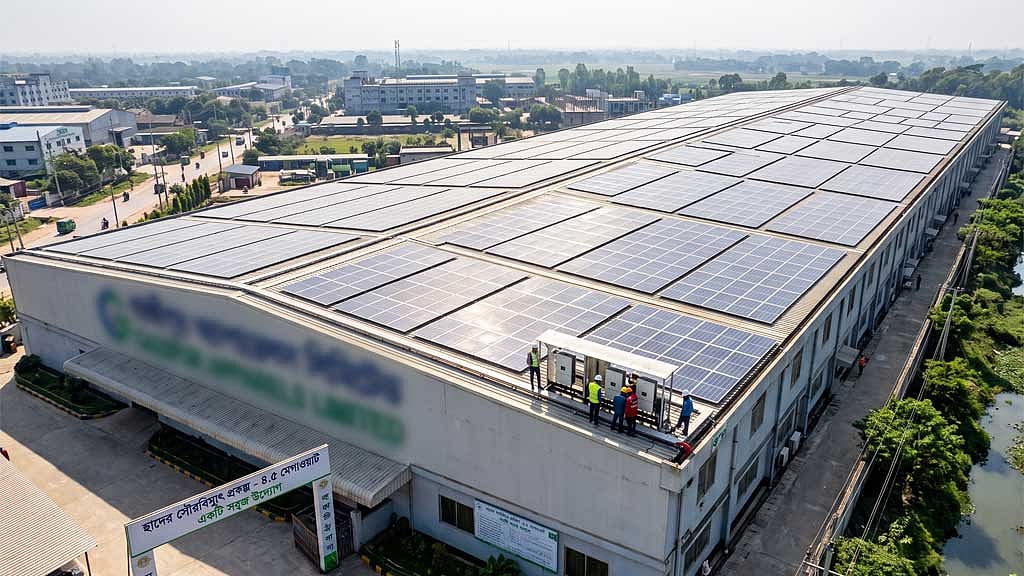
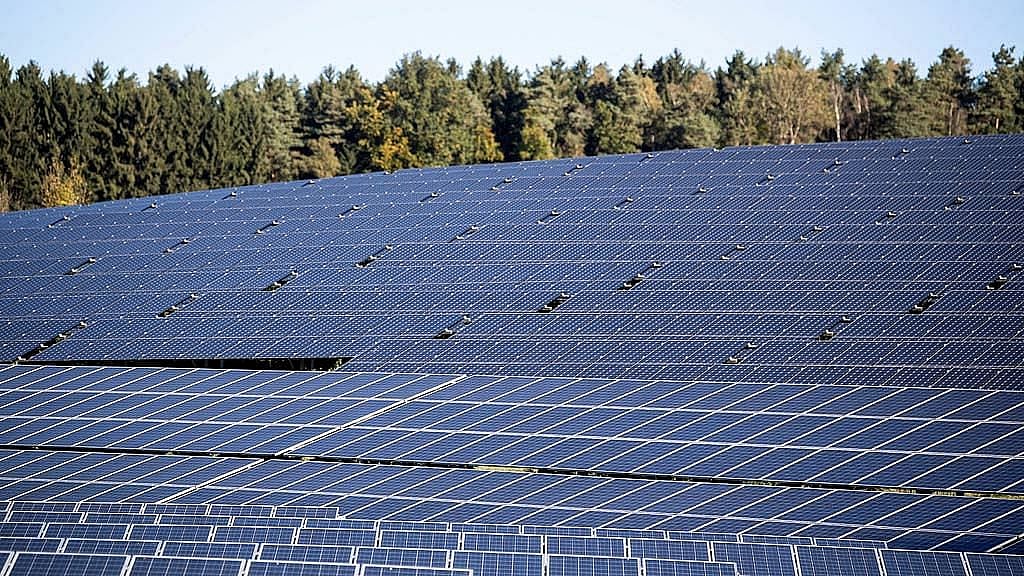
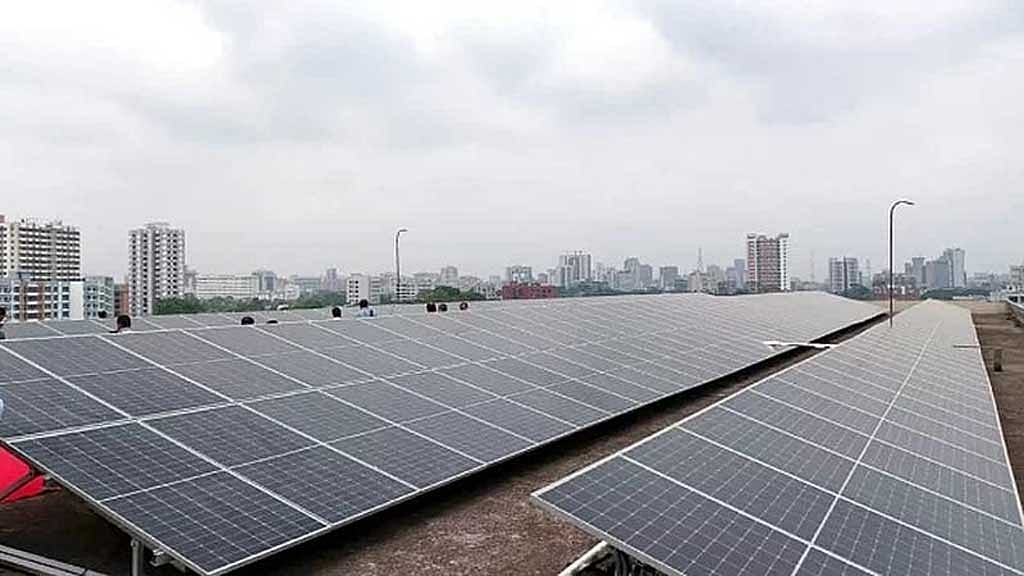
In the sprawling industrial park of Gazipur’s Kashimpur, the balance of power has quietly shifted. In less than three and a half years, RANCON has transformed its factory rooftops into a source of electricity that increasingly rivals the national grid in importance.
The company entered the rooftop solar market in February 2023 with a 350kW-peak system. It has since expanded capacity to nearly 4MW and plans to take it to 7MW-peak.
RANCON says its dependence on grid electricity has fallen by about 87 percent. Before solar, the industrial park consumed roughly 4.72 million units of grid electricity a year. That has fallen to about 613,600 units, while solar now supplies around 4.11 million units annually.
The company expects to recover its investment in roughly seven years.
RANCON is not alone. Across Bangladesh, industrial groups are covering factory roofs with panels as frequent load-shedding and gas shortages expose the limits of conventional power supplies. Rooftop solar, once largely framed as an environmental choice, is increasingly being treated as a business decision.
The Economics Behind the Panels
AkijBashir Group has gone further. At one of its factories in Faridpur’s Boalmari, a monthly electricity bill that once stood at around Tk 19 million has fallen, after the installation of an 18MW rooftop solar system with battery storage, to mostly fixed charges such as demand fees and meter rent, according to the company.
The integrated system has been operating for about two months, said Project Manager Hussain Mohammad Al Amin.
“It’s now negligible. We only have to pay the demand charge, meter rent and such fixed costs.”
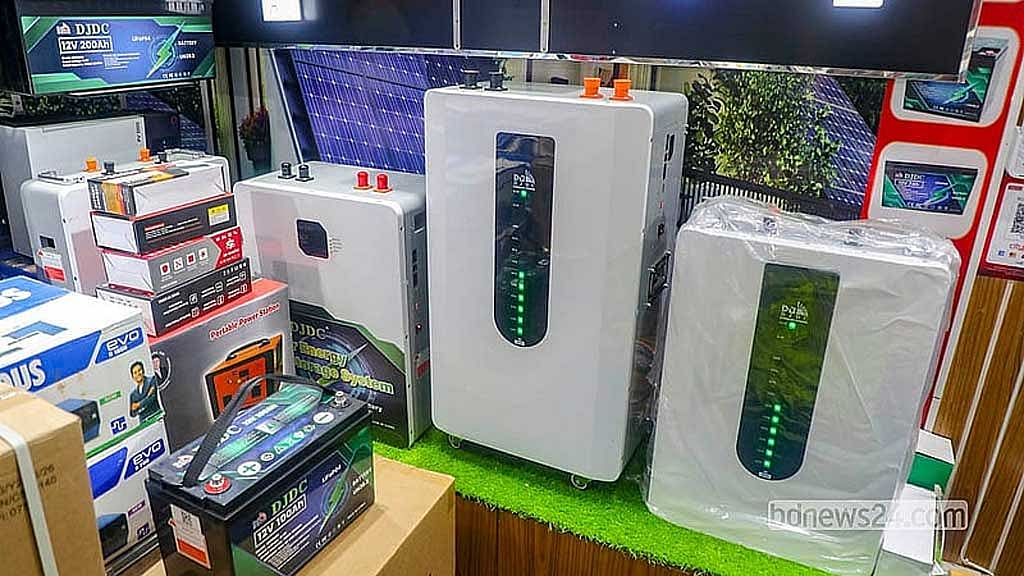
The batteries and inverters are central to the change. AkijBashir now has about 90MW of solar capacity across its factories, Al Amin said, with Chinese manufacturers supplying panels for about 95 percent of that capacity.
Mohammad Subail Bin Alam, chief operating officer of RANCON Solar and a director of the Bangladesh Sustainable and Renewable Energy Association, estimates that installing 1MW of rooftop solar currently costs Tk 35 million to Tk 45 million.
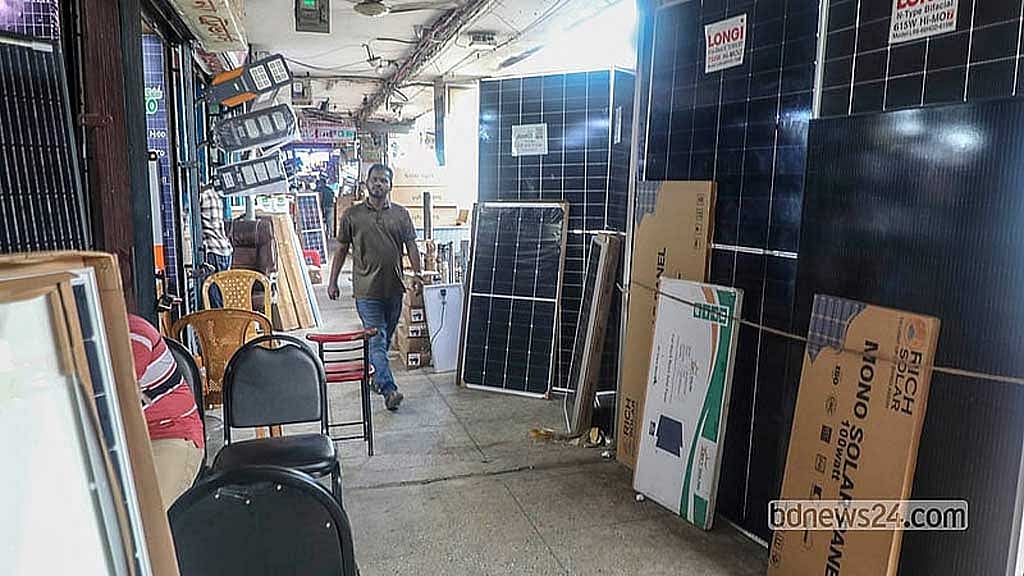
Panels account for about 55 percent of the cost, inverters 20 percent, and structures, cables, earthing and other work the remainder.
Such a system typically generates 100,000 to 120,000 units a month. Including savings from reduced diesel-generator use and electricity bills, monthly savings can reach Tk 600,000 to Tk 700,000.
The investment can be recovered in four and a half to five and a half years when financed directly, or seven to nine years when bank interest is included.
At some AkijBashir projects, Al Amin said, solar power costs about Tk 3 per unit after financing, maintenance and other expenses. Batteries raise the cost, but they also allow factories to continue operating when the grid fails, reducing the need for diesel.
The attraction is especially strong amid Bangladesh’s gas shortage. Daily gas demand is around 3,800 million cubic feet, against supplies of only 2,600 million to 2,700 million cubic feet.
Power plants, industries, CNG stations and households all compete for the shortfall.
Rooftop solar cannot replace gas for every industrial process. Motors, pumps, compressors, sewing and cutting machines, effluent-treatment plants, packaging, lighting and air-conditioning can run on electricity. Boilers, steam systems, dyeing and finishing, furnaces and dryers, however, require sustained high-temperature heat.
“Solar provides electricity; it does not provide heat,” Subail said.
He estimates rooftop solar can meet roughly 15 to 30 percent of a factory’s daytime electricity demand, and more where sufficient roof space exists.
Shafiqul Alam, Bangladesh energy lead analyst at the Institute for Energy Economics and Financial Analysis, says greater renewable generation could ease pressure on gas-fired power plants during the day, freeing scarce gas for industrial use.
A Market Growing Beyond Official Numbers
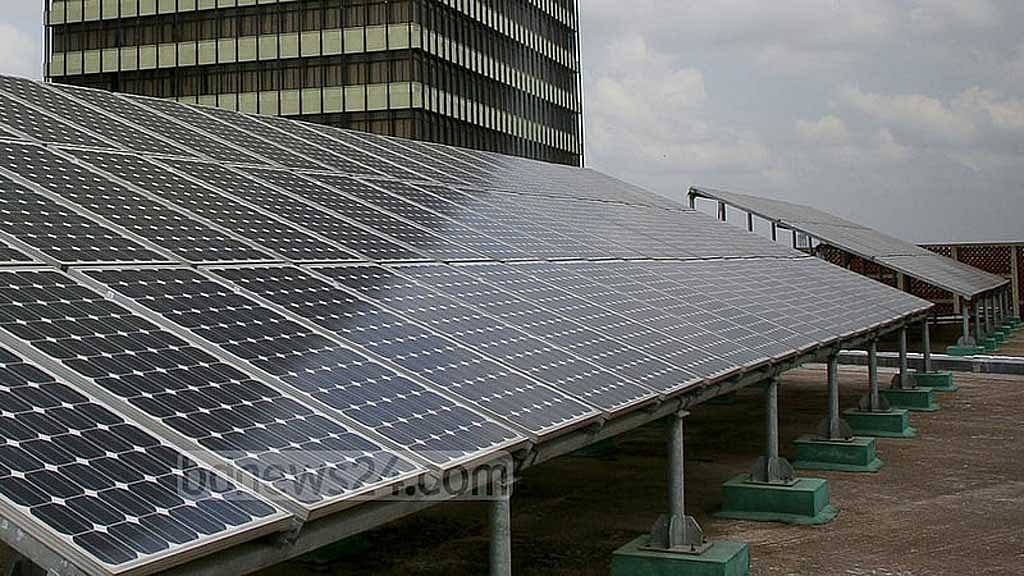
The Sustainable and Renewable Energy Development Authority’s database lists 5,028 net-metered solar systems with a combined capacity of 338.06MW-peak, plus 436 systems outside net metering with 95.286MW-peak. Together, the official rooftop capacity is 433.35MW-peak.
But IEEFA’s August assessment suggests the real figure may be considerably higher. Combining information from industries, engineering, procurement and construction companies, IDCOL and other sources, it identified 667MW of solar capacity across 239 companies and industrial groups. Projects below 150kW were excluded, meaning total capacity could be close to 1,000MW.
Industry estimates put the potential much higher. Mustafa Al Mahmood, president of the Bangladesh Sustainable and Renewable Energy Association, says industrial and commercial rooftops alone could accommodate 3,000 to 3,500MW.
The government’s National Renewable Energy Development Strategy 2026-2030 sets an even larger target: 5,500MW of rooftop solar and 4,500MW of ground-mounted solar by 2030.
Incentives Grow, but So Do the Hurdles
New incentives are also arriving. For rooftop systems with batteries installed by Feb 28, 2027, customers exporting surplus electricity to the grid after meeting their own needs will receive Tk 10.50 per unit. The scheme is scheduled to run until Feb 28, 2030, with payments to be made to bank accounts every three months.
The Power Division set the incentive after estimating the maximum generation cost of battery-backed rooftop solar at Tk 8 per unit.
Industry players had previously complained that taxes and other conditions were pushing up project costs despite different incentives. On Sept 8, the government approved a proposal to exempt specified solar power plant equipment and components from customs duties above 1 percent, regulatory duty, supplementary duty, VAT, advance tax and advance income tax for 180 days.
Yet financing remains a barrier. A study of 661 garment factories by the International Growth Centre found that 94 percent of factories using renewable technology financed the investment themselves, while 65 percent of non-users cited high upfront costs as the main obstacle.
IEEFA says green financing remains limited, lenders demand substantial collateral and approval delays persist. Mustafa argues that long-term low-interest financing, OPEX or RESCO models and faster approvals will be necessary for rooftop solar to spread beyond large industrial groups.
Chinese Technology, Local Opportunity
The market remains heavily dependent on Chinese equipment. Panels, inverters and batteries are largely imported from China. But industry players see room for local businesses to expand in assembly, mounting structures, cabling, installation, maintenance and after-sales services.
AkijBashir Project Manager Al Amin recently visited several solar technology factories in China. He said manufacturing complete solar panels from wafers and cells requires substantial investment, specialised technology and raw materials, making full-scale domestic production difficult under Bangladesh’s current industrial conditions.
Importing cells or wafers and assembling panels locally, however, is possible, he said. Mounting structures and cables are relatively easy to produce domestically, while inverter components could be imported and assembled locally. Installation and maintenance could also create greater opportunities for Bangladeshi engineers.
Chinese solar technology company Sungrow has trained engineers from its Bangladeshi partner Superior Electromechanical Services in inverter installation, commissioning and operation. The company is also listed as a Sungrow distributor.
The government’s National Rooftop Solar Programme similarly plans training for EPC contractors, electricians and entrepreneurs in site preparation, design, installation, safety and maintenance.
The result is a market still dependent on imported equipment but gradually developing local expertise around its installation, commissioning, maintenance and engineering services.
Why China Dominates
Bangladesh does not have comprehensive country-by-country market data for solar panels and inverters. Subail estimates that Chinese companies account for more than 80 percent of the market for both products.
Documents submitted to SREDA for several industrial projects in 2026 tell a similar story. A 684.53kW-peak project at Executive Greentex in Sreepur, Gazipur, uses inverters from two Chinese companies. Madar Textile Mills’ proposed 5.08MW-peak project also specifies solar panels from a Chinese manufacturer.
China’s dominance extends well beyond Bangladesh. According to the International Energy Agency’s 2026 figures, China accounts for about 85 percent of global solar technology manufacturing capacity. The scale of production and intense competition helped drive global solar module prices down by about 50 percent between 2023 and 2025, while battery-pack prices fell by about 30 percent.
Shahidur Rahman, Bangladesh country manager for Chinese solar manufacturer Jinko Solar, said large-scale production in China has brought down module prices, benefiting Bangladesh’s industrial sector and reducing the upfront cost of rooftop installations.
Higher-efficiency N-type TOPCon panels are also becoming available in Bangladesh, he said. Their ability to produce more electricity from limited roof space, along with relatively strong performance in hot weather, makes them increasingly suitable for industrial facilities.
Demand is particularly strong among garment factories seeking to cut electricity costs while meeting global buyers’ emissions-reduction targets.
But the growing dependence on Chinese equipment comes with a warning about quality rather than origin.
“The problem is not that the equipment is Chinese. The problem is cheap products from suppliers without proper quality control or certification, particularly B-grade, C-grade and refurbished products,” Subail said.
Low-quality panels can produce less electricity and lose efficiency faster. Poor inverters can fail, while inferior cables and connectors can create excessive heat.
For that reason, Subail said, the key question is not whether the equipment is Chinese but whether it has undergone third-party testing, received SREDA approval and meets BDS or IEC standards.
For Bangladesh’s factories, the rooftop is becoming something more consequential than unused space. It is turning into a hedge against an uncertain grid, a tool for controlling costs and, increasingly, another piece of the country’s energy infrastructure.