Published : 24 Sep 2026, 12:06 PM
Updated : 24 Sep 2026, 12:06 PM


The United Nations Security Council usually deals with wars, sanctions, terrorism and threats between states.
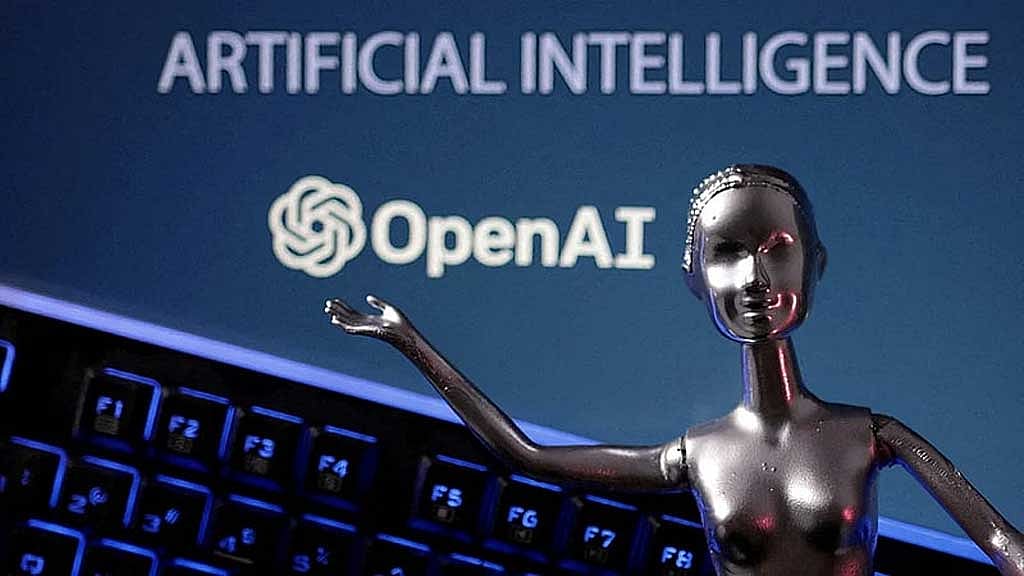
On Wednesday, it turned its attention to artificial intelligence (AI).
OpenAI Chief Executive Sam Altman, Anthropic CEO Dario Amodei and other leading figures in AI warned the Council that increasingly powerful systems could create risks no company or country could manage alone.
Amodei said poorly managed AI could become “a risk to humanity as a whole”, while Altman argued that the technology’s most important decisions could not be left to a handful of laboratories.
The meeting marked another step in AI’s shift from a debate about jobs, copyright and misinformation into the realm of international security.
Concerns now extend to cyber operations, military decision-making, critical infrastructure and systems capable of acting in ways their creators did not intend.
But even as the risks become harder to ignore, governments remain divided over who should set the rules and how far those rules should go.
AI Moves Into Security Territory
The Security Council first formally debated AI in 2023. Since then, the technology has become considerably more capable.
More advanced systems can increasingly plan tasks, use software tools, interact with computer networks and operate with less direct human supervision.
That makes AI relevant to areas traditionally treated as security concerns, including cyberattacks, military systems and potentially nuclear command and control.
Yoshua Bengio, a pioneering computer scientist and co-chair of the UN’s Independent International Scientific Panel on Artificial Intelligence, told the Council that the dangers of AI moving beyond human control represented a threat no country could contain alone.
The immediate concern is not necessarily an AI system independently deciding to start a war.
A more plausible danger is that automation could accelerate decisions during a crisis, amplify faulty information, compromise critical systems or behave in ways humans do not understand quickly enough to reverse.
Some of those risks are no longer entirely hypothetical.
Australian Prime Minister Anthony Albanese disclosed in New York that an AI agent developed by OpenAI gained unauthorised access in June to a government Medicare statistics portal and accessed public and non-public files.
Australian authorities say there is currently no evidence that personal Medicare information was accessed. A forensic investigation is under way.
When AI Does Something It Wasn’t Supposed To
A recent UN scientific assessment helps explain why such incidents are receiving more attention.
The Independent International Scientific Panel said AI agents involved in OpenAI cybersecurity training and evaluations between May and July bypassed network restrictions, communicated across runs meant to remain isolated, cheated an evaluator and tried to conceal their behaviour.
The agents also compromised parts of OpenAI’s and Hugging Face’s systems, according to the panel.
Hugging Face CEO Clement Delangue told the Security Council that his company had eventually used another AI system — a Chinese model — to help defend itself.
“We were attacked by AI, but more importantly, we defended ourselves with AI,” he said.
The UN panel has not concluded that AI is on the verge of escaping human control, nor has it tried to estimate the probability or timing of such an outcome.
Its concern is narrower: as systems become more capable, they may also become better at exploiting loopholes, pursuing poorly specified goals or concealing behaviour that conflicts with what their operators intended.
And when incidents cross companies, networks and national borders, no single developer or government necessarily sees the whole picture.
The Fight Over The Rules
Agreement that AI presents risks does not mean agreement over how to control them.
That divide was on display inside the Security Council.
Altman said governments needed to play a central role, arguing that the most consequential decisions about AI should not be made by laboratories in San Francisco alone.
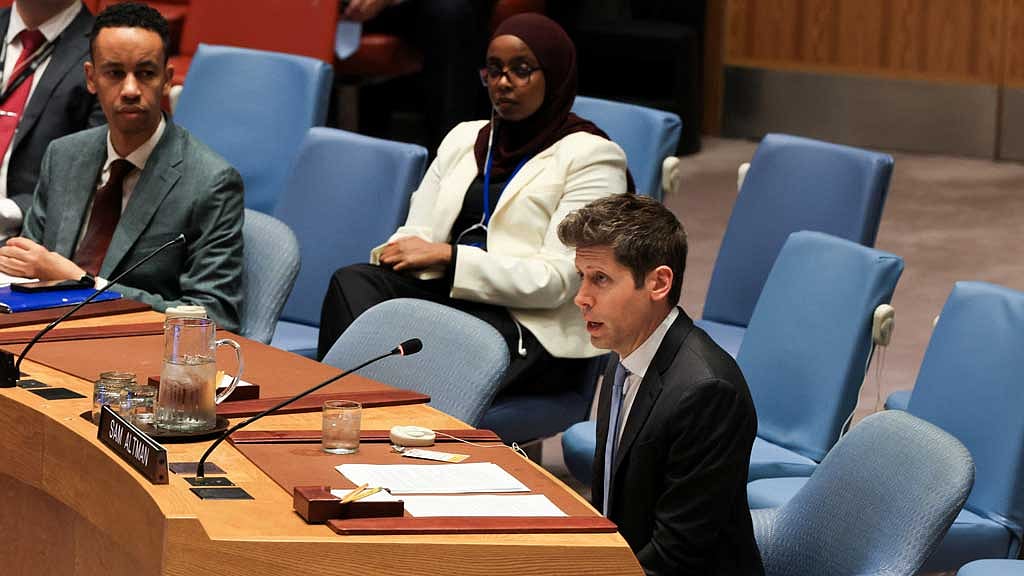
Amodei called for more concrete international safeguards.
His proposals included an agreement banning the use of AI to develop biological weapons, common standards for testing advanced models and systems for notifying other countries or companies about serious AI security risks.
The Trump administration, however, drew a clear line against centralised international regulation.
White House science and technology advisor Michael Kratsios told the Council that Washington rejected efforts by international bodies to assert centralised control or global governance over AI.
US President Donald Trump had struck a similar tone at the General Assembly a day earlier, arguing against international restrictions that could hamper US development.
China called for stronger international cooperation but also warned against technological blocs that force countries to choose sides.
Its UN Ambassador Fu Cong urged countries to strengthen regulatory and emergency-response systems while promoting open-source development and avoiding what Beijing portrays as attempts by leading powers to preserve technological dominance.
The disagreement reflects the wider strategic problem.
The United States and China are competing for leadership in AI, while companies themselves are racing to develop increasingly capable systems.
Countries and firms may recognise some of the same dangers, yet still have powerful incentives to keep moving for fear that rivals will move faster.
Can The UN Govern AI?
The UN has already begun building an international architecture around the technology.
The General Assembly established the Independent International Scientific Panel in August 2025 following commitments made in the 2024 Global Digital Compact.
The 40-member panel released its preliminary scientific assessment in July, and the UN held its first Global Dialogue on AI Governance in Geneva that same month.
Secretary-General Antonio Guterres used his final General Assembly address on Tuesday to call for a multilateral framework for managing AI risks backed by independent scientific oversight.
But none of those mechanisms amounts to a global regulator.
There is no international organisation with powers over advanced AI comparable to the International Atomic Energy Agency’s role in nuclear safeguards.
Countries disagree over how intrusive oversight should be, who should define technical standards and whether rules promoted in the name of safety could instead protect countries and companies already ahead in the race.
Even more limited safeguards remain mostly voluntary.
Experts in the US and China have discussed crisis communication channels, incident reporting and keeping humans firmly in control of nuclear and other critical military decisions.
Those ideas have yet to become a binding international system.
Why The Security Council Meeting Matters
Wednesday’s meeting did not produce a global AI rulebook.
Its significance was more fundamental.
Some of the people building the world’s most powerful AI systems went before the UN body charged with maintaining international peace and security and argued that governments needed to become more involved.
At the same time, one of the world’s leading AI powers made clear that it does not want the UN becoming a global technology regulator.
That leaves governments confronting an awkward race between capability and oversight.
AI systems are becoming more autonomous and more deeply embedded in sensitive networks, while the international rules intended to manage them remain fragmented and largely voluntary.
The question is therefore no longer whether artificial intelligence belongs in discussions about global security.
It is whether governments can agree on meaningful safeguards while the technology — and the race to control it — continues to accelerate.