
Published : 30 Nov 2026, 01:03 AM
Updated : 30 Nov 2026, 01:03 AM


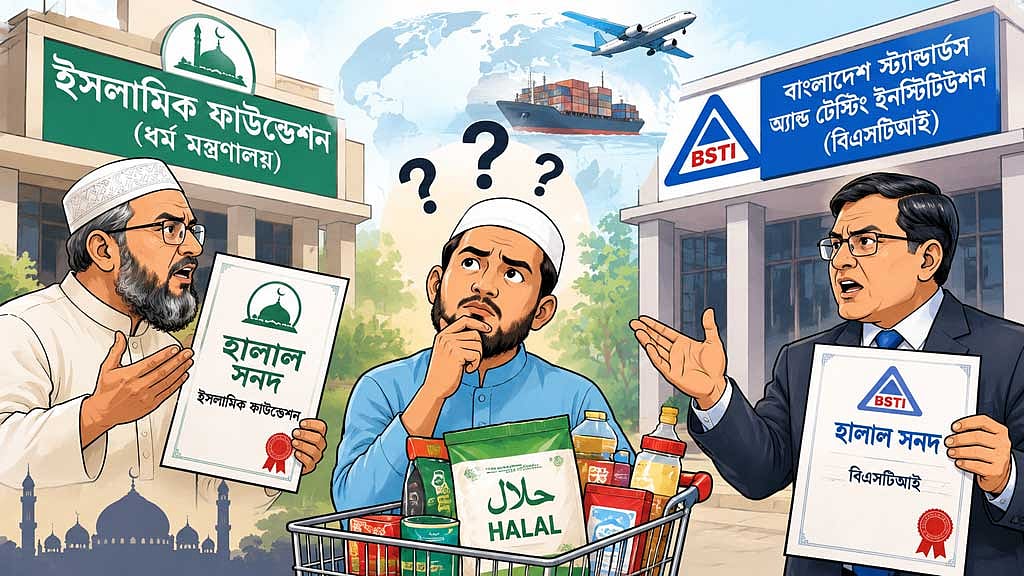
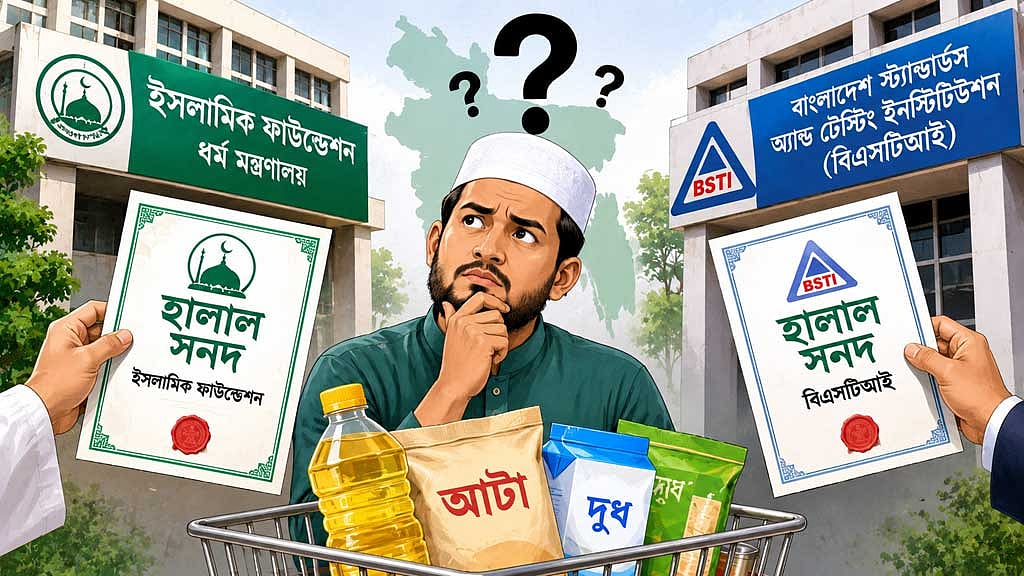
Two government bodies issue Halal certificates in Bangladesh, each claiming a role in determining whether products meet Islamic requirements.
Their unresolved turf war has left exporters navigating a fragmented system, with neither institution’s certificates recognised in Saudi Arabia.
The Islamic Foundation, under the religious affairs ministry, and the Bangladesh Standards and Testing Institution (BSTI), under the industries ministry, both certify products.
In August 2026, the government assigned responsibility for Halal standards and certification to the religious affairs ministry.
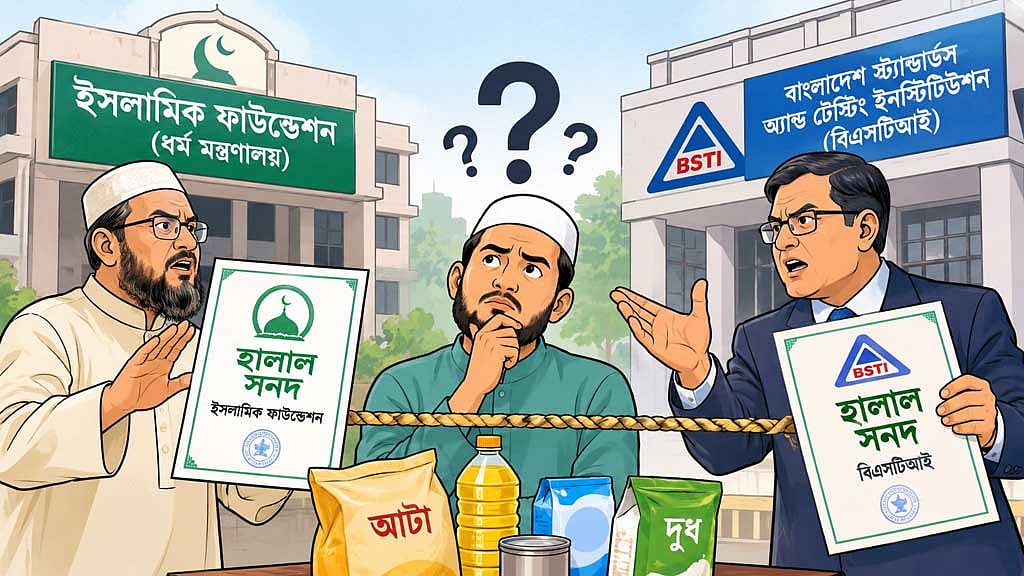
BSTI, however, continues issuing certificates and has asked the Cabinet Division to reconsider the decision.
A meeting on Nov 8 failed to settle the dispute. Both bodies have laboratories to test product ingredients, but neither has Saudi recognition.
Businesses want a national authority to coordinate certification, testing and international recognition.
A Dispute without a Decision
A gazette notification on Aug 23 added Halal standards and certification to the religious affairs ministry’s responsibilities under the Rules of Business.
It did not explicitly order BSTI to stop its existing work.
“We are issuing them as usual,” said SM Abu Sayed, deputy director of BSTI’s Halal certification department.
He said the Cabinet Division had called the agency for a review. “A meeting was held on Nov 8 to resolve the dispute. But no decision has been announced yet.”
BSTI has 50 pending applications, he said. “The certification process is still in place. I have 50 applications with me, and I am issuing certificates.”
The agency says it has issued 228 certificates and has legal authority under the BSTI Act 2018 to set standards, test products and certify them. It says it has the staff, laboratories and expertise required.
Religious Affairs Secretary Munshi Alauddin Al Azad says certification should remain with his ministry. “We want this. It should be ours. The reason is that the word Halal is connected with religion.”
BSTI’s role, he said, concerned food safety. “What BSTI does is safe food. This is not about Halal; it is about safe food.”
He said he would take fresh steps to resolve the impasse.
Recognition is not Automatic
BSTI says it follows international Halal standards and received accreditation from the Bangladesh Accreditation Board on Oct 14, at a World Standards Day event.
Its certification follows standards set by the Standards and Metrology Institute for Islamic Countries (SMIIC), under the Organisation of Islamic Cooperation, it says.
Abu Sayed said the accreditation opened the way for exports bearing BSTI certificates to 46 SMIIC member countries. But accreditation does not guarantee automatic acceptance in every market.
Saudi Arabia requires recognition by the Saudi Halal Centre, under the Saudi Food and Drug Authority, for specified imports.
“There has only been an exchange of letters with Saudi Arabia on this issue. There have been no direct discussions,” Al Azad said.
The issue was on the agenda during his latest Saudi visit but was not discussed, as the trip focused on Hajj. “These have to be treated as separate agenda items,” he said.
Bangladesh is also seeking recognition elsewhere. “We are exchanging letters with Indonesia. They have also proposed working with us,” Al Azad said.
He plans to discuss certification with Turkey. Asked about Malaysia, he said: “There is no news on Malaysia.”
Islamic Foundation documents, however, say its certificates have been recognised by Malaysia’s Halal authority, Jakim, since 2011.
A Bangladeshi business delegation met Jakim in September to discuss developing a local certification system with Malaysian support.
Exporters Caught in the Gap
Bombay Sweets and Company, which had obtained Islamic Foundation certificates since 2017, illustrates the commercial complications.
At a Bangladesh Chamber of Industries event in July, its general manager for international business and corporate affairs, Khurshid Ahmed Farhad, said it had paid about Tk 1.45 million for BSTI certification but had not received a certificate.
Lack of Saudi recognition had forced it to remove Halal logos from about 50 products, he said, with replacement packaging costing around Tk 6.2 million.
The company has since received a BSTI certificate. “That has been resolved,” Farhad told bdnews24.com.
Its products now reach 42 or 43 countries, he said, but he could not speak for other exporters. “Yes, in our case it has been sorted out. I cannot say what has happened in other cases.”
The Saudi issue remains unresolved, he said. “There is no such problem in other countries. Having a Halal certificate is enough.
“But in Saudi Arabia, recognition by the country’s Halal board is required. Getting that recognition is still hanging.”
Testing and Fees
The two bodies also differ over laboratory testing. Al Azad questioned whether it was necessary. “Does Halal require a laboratory?”
Explaining his understanding of Halal, he said: “Halal concerns the method of slaughter and whether the animal itself is permissible to eat.”
BSTI argues that checks must go beyond slaughter practices. Laboratories can detect prohibited ingredients in processed food, medicines and cosmetics. Its national Halal laboratory uses DNA analysis to identify pork-derived substances, the agency says.
Five specialist teams inspect factories, drawing on religious, food, livestock, fisheries and technical expertise.
BSTI says its 15-member committee includes Shariah and technical experts, government agencies, Islamic Foundation representatives and businesspeople.
It has developed 18 standards and three guidelines covering food, additives, cosmetics, medicines and clothing.
The Islamic Foundation’s 2023 policy also provides for laboratory testing, including assistance from BSTI and the Bangladesh Council of Scientific and Industrial Research.
It allows samples to be tested for Halal and Haram ingredients and envisages a foundation laboratory.
The foundation says its Halal diagnostic laboratory opened on Aug 4, 2017, but its current operations and international recognition could not be confirmed.
Fees differ, too. BSTI says it charges no application fee; annual certification costs Tk 1,000 for small industries, Tk 3,000 for medium-sized ones and Tk 5,000 for large ones.
These are certificate fees alone, excluding a full breakdown of testing costs.
The Islamic Foundation charges 0.05 percent of a product’s factory price for a new certificate and logo, and 0.04 percent for renewal.
Exporters say multiple agencies, repeated inspections and separate foreign-recognition applications increase costs.
A 16-year Search for One System
The government considered a separate Halal food certification board in 2010, but the initiative did not materialise.
BSTI added Halal certification to its regulations in 2021 and began issuing certificates the following year. The Islamic Foundation’s policy was gazetted in November 2023.
The August 2026 decision assigning responsibility to the religious affairs ministry has yet to settle the overlap.
The market opportunity is substantial. Muslim consumers spent $1.53 trillion on Halal food in 2024, according to DinarStandard’s State of the Global Islamic Economy 2025-26 report. Spending could reach $2.06 trillion by 2029.
On Aug 14, the Bangladesh Chamber of Industries urged the prime minister to establish an independent Bangladesh Halal Development Authority to coordinate certification, testing, international recognition, training and export promotion.
A Dhaka conference on Nov 7 put Bangladesh’s Halal exports at about $943 million in fiscal 2025-26. Participants also called for a dedicated authority.
For exporters, the opportunity is clear. But without coordination at home and recognition abroad, Bangladesh risks losing ground in a fast-growing market.