Published : 18 Oct 2026, 12:38 PM
Updated : 18 Oct 2026, 12:57 PM


Protecting national interests, sovereignty and self-respect will be the core commitments of Bangladesh’s future, Prime Minister Tarique Rahman has said.
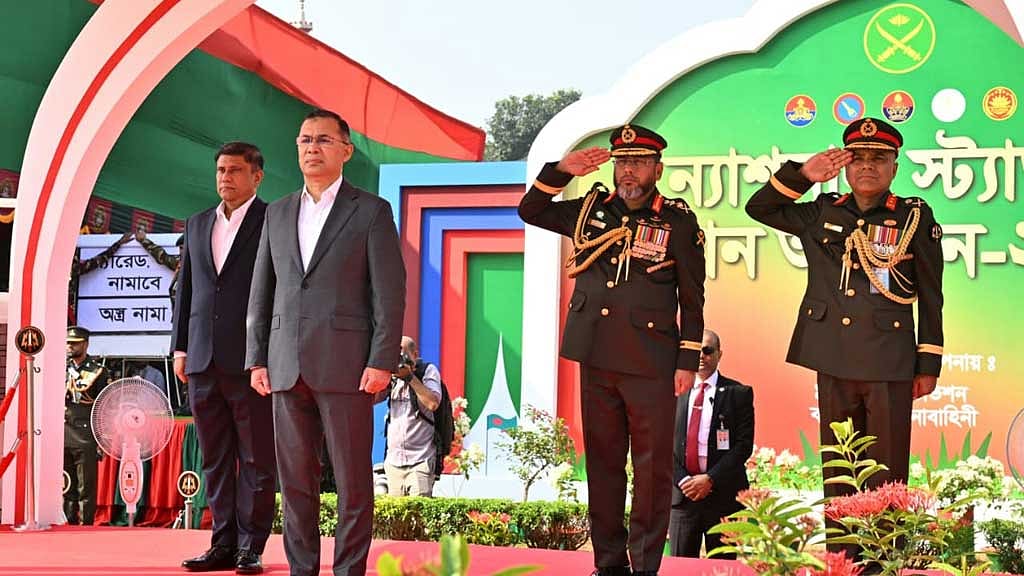
He made the pledge at a National Standard presentation ceremony at Savar Cantonment on Sunday morning.
“I want to say that protecting national interests, sovereignty and self-respect will be the core commitments of Bangladesh’s future, In Sha Allah,” he said.
“Bangladesh wants to strengthen friendship and cooperation with all countries on the basis of mutual respect and equality.”
The ceremony was held to present National Standards, or national flags, to seven battalions and regiments of the Bangladesh Army in recognition of their professional achievements.
The recipients were the President Guard Regiment; the 7th and 32nd Field Regiments Artillery; the 25th Air Defence Regiment; the 9th Engineer Battalion; and the 56th and 57th East Bengal regiments.
Congratulating the units on receiving the National Standards, the prime minister said the honour represented more than a flag.
“This National Standard is not just a flag. It is a symbol of a unit’s history, heritage, discipline, sacrifice, professionalism and commitment to the country. The glorious unfurling of the national flag constantly reminds us of our independence, sovereignty and the sacrifices of countless people. The national flag, a symbol of independence and sovereignty, has been entrusted to you,” he said.
He said receiving the National Standard meant taking a renewed pledge to discharge their responsibilities with greater dedication.
“Upholding the honour of the flag is a sacred duty of every soldier,” he said.
The prime minister was received at the venue by his defence affairs advisor, retired brigadier general AKM Shamsul Islam; Army Chief Gen Waker-Uz-Zaman; and Maj Gen SM Asadul Haque, general officer commanding of the 9th Infantry Division and area commander of Savar.
He later took the salute at the parade and inspected the procession
Modernising the Armed Forces
The prime minister said the strength of a modern armed force lay not only in its weapons, equipment or manpower, but also in discipline, competence, leadership, ethics, training, public trust and, above all, the chain of command.
“The current government continues to work towards making the armed forces more technology-driven, skilled, disciplined, professional and state-of-the-art,” he said.
He added that officers and soldiers at all levels of the armed forces were expected to remain steadfast in their commitment to the Constitution, the law, military rules and regulations, and humanitarian values while carrying out their duties.
“The public expects this of them,” he said.
Tarique said the global security environment was changing rapidly, along with the nature and tactics of warfare. In addition to land, sea and air, cyberspace, outer space, drones, artificial intelligence, electronic warfare and information-based capabilities had become important components of national security.
Against this backdrop, he said, efforts were under way to ensure that Bangladesh’s defence preparedness kept pace with changing times.
He said the government was prioritising the establishment of a domestic defence industry to manufacture essential weapons, ammunition and defence equipment in Bangladesh, alongside modernising the army in all areas.
“Technology can never replace human beings. We need to develop an integrated defence capability in which the technological capacity is strengthened while the army, navy and air force can work together in a coordinated manner whenever necessary,” he said.
The prime minister said the armed forces were responsible not only for defending the country but also played important roles during disasters, floods, cyclones, fires and other national emergencies.
He added that Bangladesh’s armed forces had also earned a good reputation through their service in peacekeeping missions abroad.
Welfare of Service Members
Tarique said the government was giving serious consideration to the welfare, housing, healthcare, education, training, career development and post-retirement social security of armed forces personnel.
He said salaries and allowances for members of the armed forces had already been increased by between 100 percent and 138 percent under the national pay scale.
The implementation of the “One Rank, One Pension” system was also being processed to further improve the living standards of army personnel, he said.
Home Minister Salahuddin Ahmed, Land State Minister Mir Helal, cabinet members, members of parliament, and serving and retired senior army officers were also present.