


Published : 25 Feb 2022, 08:56 AM
Updated : 03 Aug 2022, 11:34 AM


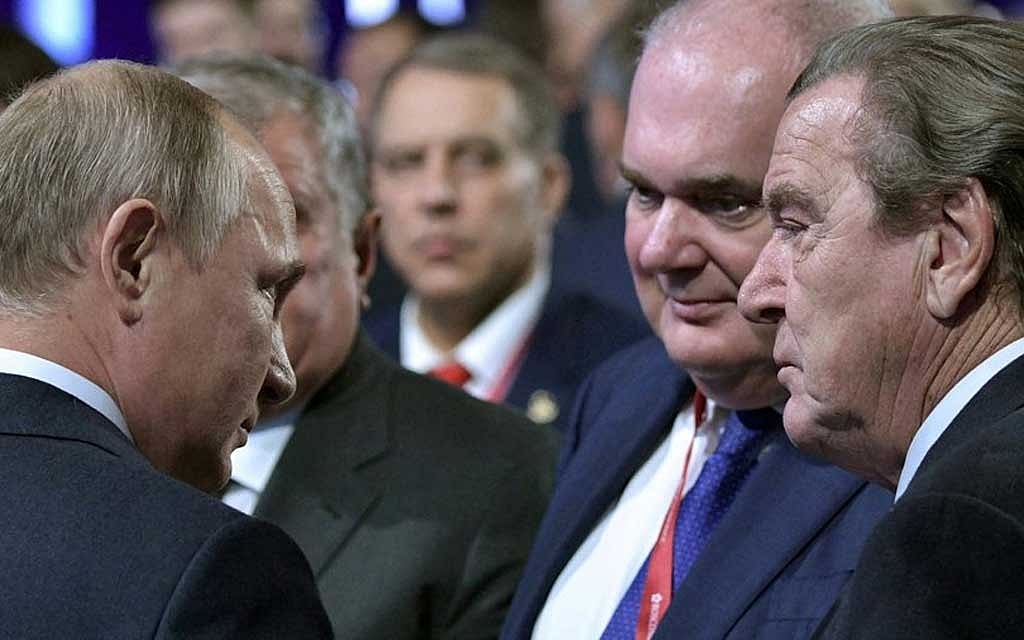
But former German Chancellor Gerhard Schröder was not among them.
Schröder, a friend of President Vladimir Putin of Russia, is a familiar face on the boards of some prominent companies, including Rosneft, the Russian oil giant. He is chair of the shareholders committee of Nord Stream 2, the company that owns the new Russia-to-Germany natural gas pipeline that Berlin said this week it would stop.
He has also been invited to sit on the board of Gazprom, the Russian gas behemoth that is the parent company of Nord Stream 2.
Schröder, 77, who was chancellor from 1998 to 2005, on Thursday called for an end to the war, writing in a post on his LinkedIn account.
But in contrast to those who responded with rebukes of Russia’s attack from European leaders, Schröder stressed the “missed opportunities between the West and Russia,” as well as the “many mistakes — on both sides.”
He said that “Russia’s security interests do not justify the use of military means” but cautioned European leaders against taking actions that “cut the remaining political, economic and civil society ties that exist between Europe and Russia.”
Others tied to Russian boardrooms felt compelled to step down after the invasion. Matteo Renzi, a former prime minister of Italy, resigned from the board of Delimobil, a Russian car-sharing service, his party said. Esko Aho, a former prime minister of Finland, told local media he had withdrawn from the board of Russia’s largest bank, Sberbank.
Former Austrian Chancellor Christian Kern, who led Austrian railway company ÖBB, resigned from the board of Russia’s state-owned railway company, RZD, saying he did not want to be a part of the war.
“Since last night, RZD is part of the logistics of war,” he told Austrian newspaper Der Standard. “I deeply regret this.”
But another ex-chancellor of Austria, Wolfgang Schüssel, appeared unmoved by the attack, saying he saw no reason to quit his position on the board of Lukoil, a Russian multinational company. And Karin Kneissl, a former Austrian foreign minister whose wedding party Putin crashed in 2018, also still sits on the board of Rosneft.
But as images of Ukrainians fleeing the capital, Kyiv, appeared all day on German screens Thursday, calls for Schröder to sever his ties with Russia intensified.
“This blatant purchase of a German ex-head of government by Putin can hardly be surpassed in terms of ignominy,” Christian Bangel wrote in an editorial in German weekly Die Zeit. “It damages not only Schröder himself, but also the office of chancellor.”
© 2022 The New York Times Company












