FT finds reasons to cheer on Bangladesh
The UK-based business daily in an analytical report says turmoil in the stock market does not necessarily mean that Bangladesh's economy is down
bdnews24.com News Service
bdnews24.com
Published :
01 Aug 2012, 04:08 AM
Updated :
09 Aug 2022, 04:04 PM
Dhaka, Aug 1 (bdnews24.Com) -- Despite turmoil in the country's stock market, Bangladesh has been able to maintain a stable economy with prospects of a better future, a London-based respected business daily has said.
Quoting experts from Bangladesh and outside, the Financial Times newspaper has forecast a good picture as the country has stayed at around 6 percent growth amid various challenges.
The newspaper says Bangladesh looks like the kind of frontier market that gives frontier markets a bad name. In 2010, the Dhaka stock market was one of the best performing in the world.
"It was doing $200m [turnover] per day," it has quoted Patrick Nelson, head of equities at Exotix, a frontier markets investment banking boutique, as saying in a July 29 report.
"For a frontier market, that's amazing," Nelson said.
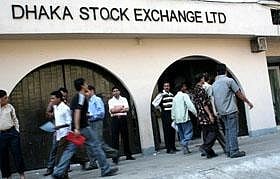
But in 2011, the Dhaka market plunged, wiping out 2010 gains. Photos of investors being contained by riot police outside the stock exchange paint a picture few would be in a rush to buy.
And yet, the turmoil is in some ways misleading, the daily says.
"The volatility of the stock market contrasts with the relative stability of the economy," Ifty Islam, managing partner at Asian Tiger Capital Partners, a local investment banking boutique, has told the newspaper.
Through the stock market turmoil, GDP growth in Bangladesh stayed at around 6 per cent, and the International Monetary Fund (IMF) predicts a growth rate of 5.9 per cent for 2012.
Considering that Bangladesh has a population of 160 million and counts among the 30 largest economies in the world if one includes the informal economy, according to Iraj Ispahani, chief executive of Ispahani Advisory, that adds up to a lot of potential.
Ispahani says Bangladesh's stock exchange is a very narrow indicator of investment in the country as "85-90 per cent of wealth in Bangladesh is held privately."
In fact, the Bangladeshi economy weathered the global economic crisis better than most countries in the region, while the stock market, however dizzyingly it may have see-sawed, has been a model of non-correlation.
"Bangladesh is one of the least correlated stock markets, both with the S&P500 and other frontier markets," says Islam. "It's a very attractive diversification play."
One reason for this is that investment in the Dhaka Stock Exchange is overwhelmingly local. Only 2-3 percent of the stock market is held by foreigners – down from about 30 percent in 1996-97.
"They missed the rally and they missed the crash," says Islam.
This strong local bias was part of the market's undoing in 2011, the report says.
In the boom years of 2007-10, Bangladeshi banks, which were allowed to invest 10 percent of their liabilities in the stock market (much more than the international norm), piled into local stocks. Mesmerised by resultant price rises and often not that financially literate, retail investors piled in too.
Retail stock market accounts rose from 500,000 in 2007 to 3.5m in 2010, according to Islam.
Cue rising inflation and central bank tightening, including stricter limits on stock market investment by banks. The banks had to scale back their investments, and daily trading plummeted.
"The retail people got burned," says Nelson.
Now there is some calm after the storm, the newspaper says.
Inflation has fallen from 12 percent last year to 9 percent and the currency has stabilised, says Stuart Culverhouse, chief economist at Exotix. Bangladesh has also secured a $987 million loan from the IMF to help it overcome macroeconomic pressures and build a reserve buffer.
"The IMF programme is reassuring a lot of foreign investors," says Culverhouse.
At the same time, the lot of ordinary Bangladeshis, particularly women, is, in broad terms, improving, creating a domestic driver of growth.
Women are the mainstay of the garment industry which accounts for about 80 percent of Bangladesh's exports, and rural women have benefited from microcredit.
"A substantial and entrepreneurial middle class is emerging," he says. "Employment is high, and there is unusually strong participation of women in the economy."
It is not all rosy, however.
The "China relocation effect" that Islam says will underpin investment opportunities over the next five to 10 years relies on extremely low wages – the minimum monthly wage for garment workers in Bangladesh is the lowest in the world for such work, according to trade unions.
So does the related "Walmart effect", whereby Bangladesh did not suffer as much from the global downturn as other countries in the region because its garment makers supply cheap retailers, such as Primark and H&M.
Ongoing diversification into industries such as pharmaceuticals, engineering and ship-building may help boost living standards as well as deepen the stock market, though Nelson notes that "we have yet to see land being appropriated by big international investors".
Planned infrastructure projects worth $35 billion, which cannot be financed internally, may also create investment opportunities.
Certainly, foreign investors, such as mutual funds, are starting to look more closely at Bangladesh, though as yet it is more of a trickle than a flood.
Last year, funds globally allocated $4.8 million to Bangladesh, according to EPFR Global, and they have allocated just $0.51 million so far this year.
Ispahani believes "the excitement about Myanmar" may help change that.
"The more people look at Myanmar, the more they will realise there is this neighbour [Bangladesh] that has a better macro environment and a better framework for investors," he says.
If they do, they will find only limited investment opportunities, particularly on the fixed income side, says Culverhouse.
Bangladesh has not yet come out with a sovereign eurobond, though Culverhouse believes such a product "would be well received".
But Islam expects this situation to change and fairly quickly.
"About 65 percent of corporate Bangladesh is not listed, but quite a few companies are thinking of an IPO," he tells the Financial Times.
"Appetite for risk capital is also growing, so there will be a lot more private equity opportunities."
The challenges are many and include a 2013 election in this "messy, confrontational democracy".
Islam nonetheless expects foreign investment on the Dhaka Stock Exchange to rise to 8-10 per cent over the next 18-24 months. This, along with rising investment by local asset managers, should both counterbalance reduced exposure to stocks by banks and provide some much-needed cool heads.
"The market is institutionalising," says Islam.
bdnews24.com/jr/0943h