Published : 13 Jul 2023, 03:18 PM
Updated : 13 Jul 2023, 07:22 PM


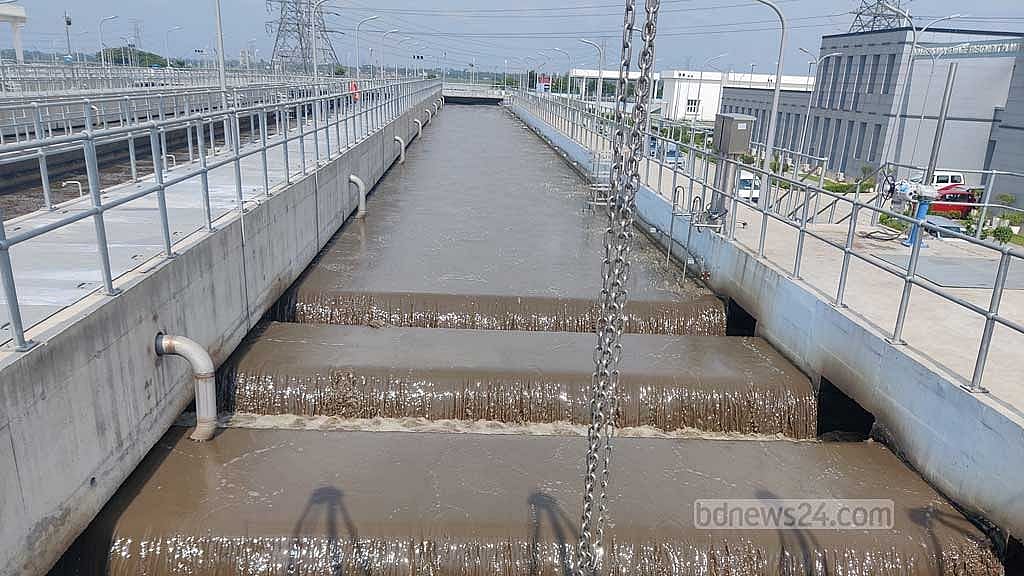
Prime Minister Sheikh Hasina has inaugurated the Dasherkandi Sewage Treatment Plant of Dhaka WASA, one of the largest such structure in South Asia, according to state news agency BSS.
The plant located in the Khilgaon area aims to treat the sewage in several of the capital’s neighbourhoods, including Gulshan, Banani, Baridhara, and Niketan.
The prime minister inaugurated the plant at an event at the Bangabandhu International Conference Centre on Thursday and also laid the foundation stone of the Pagla Sewage Treatment Plant.
The plant, constructed on 62.2 acres of land, was backed by China and cost Tk 34.82 billion. It can treat 5 million tonnes of sewage, equivalent to 20 to 25 percent of the total sewage in Dhaka. The government hopes it will play a major role in reducing the pollution of rivers surrounding Dhaka.
The Dasherkandi project was approved as part of a master plan by WASA to build five treatment plants in 2013. Construction began in 2017, and the deadline for the project was in February 2020. However, the deadline passed, and the date was extended to June 2022.
The government divided the Dhaka metropolitan area into five areas - Pagla, Dasherkandi, Uttara, Rayerbazar, and Mirpur in the master plan. Once the project is implemented, the residents of Dhaka will have a ‘hundred percent developed and sustainable sewage service,’ said Dhaka WASA MD Taqsem A Khan.
The Dasherkandi Sewage Treatment Plant will treat the sewage from Gulshan, Banani, Baridhara, DOHS, Bashundhara, Badda, Vatara, Banashree, Kuril, and Parliament area, Shukrabad, Farmgate, Tejgaon, Aftabnagar, Niketan, Satarkul and Hatirjheel and release them to the Balu River to prevent water and environmental pollution.
Besides, the project also aims to reduce the pollution of the Shitalakkhya River at the intake point of Phase-1 and Phase-2 of the Sayedabad Water Treatment Plant.
On the other hand, the Pagla Sewage Treatment Plant will treat the sewage coming from Kalabagan, Moghbazar, Shahbag, Eskaton, Arambag, Paltan, Sayedabad, Motijheel, Rampura, Taltala, Basabo, Golapbag, Ahmedbag. Shaheedbag, Goran, Begunbari, Khilgaon and West Nandipara.
“Dahaerkandi Sewage Treatment Plant is one of the five in the master plan. At least 500 million litres can be treated there every day. According to Chinese workers, such a plant does not exist even in China. The single plant has all facilities for sewage treatment, plant treatment and incineration. China may have bigger plants, but those do not have all three services in one,” said Dhaka WASA MD Taqsem.
He also said the construction of the Rayerbazar Sewage Treatment Plant has progressed further. “The biggest task for such projects is to acquire land. That has progressed. For the Uttara Sewage
Treatment Plant, land acquisition is almost complete. Construction of the Mirpur Sewage Treatment Plant is ongoing. The design has been drafted but not finalised yet.”
“In Dhaka, we can treat 15 to 18 percent of the sewage. Earlier, it used to be treated by the Pagla plant only. But that’s in a dilapidated state now. Once the Dasherkandi plant starts, we can treat almost 20 to 25 percent [of the sewage],” said Taqsem A Khan
“Once the Pagla plant is completed, we can minimise 35 percent of sewage impact. We aim to ensure that no untreated sewage goes into the water bodies surrounding Dhaka.”