Published : 06 Oct 2023, 04:24 PM
Updated : 06 Oct 2023, 11:34 PM


Prime Minister Sheikh Hasina has underlined her government's commitment to upholding the people's right to vote ahead of the 12th national election in Bangladesh.
With the election slated for early January, critics of the Awami League government, including the largest opposition group BNP, have raised questions about the integrity of the polls.
But Hasina cast doubt on the motives behind the BNP and its allies' constant clamour for fair and free elections.
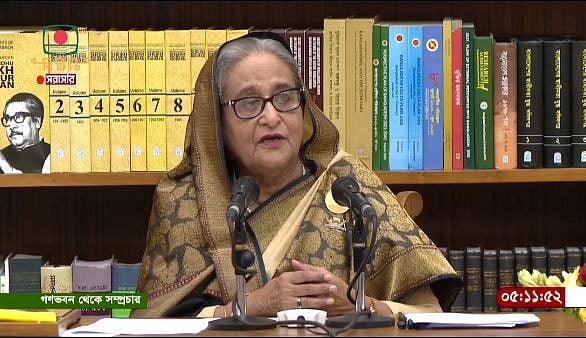
"Why are so many questions being raised about the elections now? The country is progressing rapidly and I believe the real motive is to thwart the election," she said while briefing the media on Friday about her trip to New York for the 78th UN General Assembly.
"Those who came to power illegally shouldn't lecture us on fair elections."
The upcoming election is also attracting international scrutiny, with some countries questioning the fairness of Bangladesh's electoral process.
Hasina recalled the Awami League's 'relentless fight' to restore the right to vote in the country after decades of military rule and highlighted the electoral reforms implemented by her administration.
"We initiated significant electoral reforms, including the introduction of voter lists with photos and transparent ballot boxes. We also passed laws to establish an independent Election Commission, which used to be entirely under the control of the Prime Minister's Office.”
"The movement and struggle for the people's right to vote in Bangladesh was led by the Awami League, and we successfully established a democratic system. It's because of this democratic process that the people have repeatedly elected us to power, and it's during our tenure that we've witnessed substantial economic development."
In the run-up to the election, the United States has also announced visa restrictions targeting Bangladeshis who undermine the democratic process.
Asked whether the visa policy has put a strain on the ties between Washington and Dhaka, Hasina said, "Our foreign policy is very clear, friendship to all and malice towards none. So, we are adhering to that and have a friendly relationship with everyone.”
Hasina returned home on Wednesday after her trip to the United States and the United Kingdom. She left Dhaka to attend the UNGA and other events in New York on Sept 17.
Hasina met US National Security Advisor Jake Sulivan, among others, during her visit. She said Sulivan and others did not raise the caretaker government issue.
She claimed no one other than the BNP wants the caretaker government system after seeing what the 2007-08 military-controlled administration did to the country and its politicians.
“And it is the BNP that ruined the caretaker government system.”
The prime minister said the BNP was free to protest against the Awami League government, but it will face obstacles “from the people” if it resorts to violence.
“And it’s good that the BNP is spending the money it stole from the people on the movement. People are getting back some of the money laundered by the BNP,” she said, calling for investigation by journalists into the source of the funds used in the opposition party’s programmes.
US ENVOY’S SECURITY
Hasina said she discussed with Sulivan security of Peter Haas, the American ambassador to Bangladesh, and the US sanction on the Rapid Action Battalion and its officials.
“I asked how it can be that they [US] will impose sanctions on our force and then seek security from them [RAB],” she said.
Hasina said she asked Muhammad Imran, the Bangladesh ambassador to the US who was present in the meeting with Sulivan, what kind of security he gets there.
“He [Imran] doesn’t get any type of personal security. Only the embassy has some sort of security,” she said, adding the Foreign Minister AK Abdul Momen mentioned in the meeting that Bangladesh had deployed 158 police officers for the security of the US Embassy in Dhaka.
“And the ambassador has a gunman in plainclothes. So, there is no lack of security here.”
Haas questioned security measures after Bangladesh had withdrawn some extra personnel used for the safety of the diplomats from some countries, including the US.
The government took the measure after other countries had started demanding extra security personnel, Hasina explained.
The prime minister alleged a lack of security in the US, not in Bangladesh.
“Shootings occur in schools, shopping malls, restaurants, homes [in the US] everyday. We fear for the safety of our citizens there. Many Bangladeshis also died. They [Americans] should solve their own problems first.”
‘HIGH RESERVES OR COMFORT’
Hasina defended the government’s decision to allow the use of dollars from the reserves for imports of fertilser or fuel for power generation and irrigation.
“Will we shut the power stations, irrigation and fertilser supply to save reserves by keeping the people in dark?” she asked.
“Is it more important to keep the reserves at a good level or to ensure the people’s comfort?”
Amid global economic headwinds, Bangladesh’s foreign currency reserves have fallen to $21 billion from over $40 billion in one and a half years.
Hasina said Bangladesh’s reserves had seen a boost because of a fall in imports during the coronavirus pandemic, but import costs increased afterwards for a hike in prices of raw materials and food globally amid the Russia-Ukraine war.
She mentioned that the reserves were less than $1 billion when the Awami League took charge in 2009.
Hasina slammed the critics of the falling reserves and the situation in the energy sector, saying it is the Awami League government that has developed Bangladesh after the rest of the world had underestimated the country for a long time.