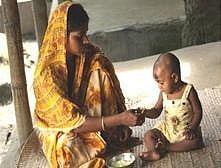
'Hand washing key to tackling infant infections'
Experts say a simple measure of washing hands with soap can significantly curb cases of diarrhoea and respiratory infections, Nurul Islam Hasib reports
bdnews24.com News Service
bdnews24.com
Published :
21 Apr 2012, 08:30 AM
Updated :
09 Aug 2022, 03:41 PM
Nurul Islam Hasib
bdnews24.com Public Health Correspondent
Dhaka, Apr 21 (bdnews24.com) – Many of the diarrhoea and respiratory infections of children under two in Bangladesh are preventable if mothers and caregivers wash their hands with soap before feeding babies homemade food after six months of age, experts say.
They say the government should go for a massive awareness campaign to deal with the menace.
Preliminary results of Bangladesh Demographic and Health Survey (BDHS) 2011 say only 21 percent of children between 6-23 months are being fed with complementary homemade food but cases of illness are higher during this period.
The report says while complementary feeding is important for kids but the practices are poor in Bangladesh, another reason that makes their kids more vulnerable when they are afflicted with diarrhoea and respiratory infections thanks largely to dirty hands.
As most of the mothers or caregivers do not know the link between their kids' infections and hand washing with soap, experts say, the government should target all nutrition programmes for the campaign.
"Over 80 percent mothers (of children under two) do not believe hand washing with soap before food preparation and feeding the child can check diarrhoea. Almost none knows the link between respiratory infections (cough, cold, pneumonia) and hand washing," said Sumitro Roy, deputy country director of global initiative Alive & Thrive.
Alive & Thrive and ICDDR,B has jointly carried out the research to find out the barriers to hand washing before feeding babies.
"Even the practice is only 20 percent among the rich families," he told bdnews24.com.
"There are social barriers too," he said.
He said 66 percent mothers of children aged below two reported that they do not see such practice in their neighbourhood.
"We also found they (mothers) do not get soap and water at convenient places, which we tried to address through simple measures," he said.
"If we really want to change it, we need to bring hand washing issue and complementary feeding issue in a single programme," he said.
Dr. Stephen P Luby, chief of infectious diseases unit, ICDDR,B said: "Infections stunt children's growth."
"Because of infections, children take less food that cause impaired nutrient absorption and increase metabolic requirements, but impaired transport to target tissue. Nutrient losses increase, malnutrition occurs.
"Similarly malnutrition impaired immune function and cause infections," he said.
He said most damages occur during complementary feeding age when mothers and caregivers start giving solid or semi-solid food.
"Infections go on peak in between 6-11 months of age."
According to Infant and Young Child Feeding (IYCF) guidelines, a breastfed child of age 6-8 months should receive two or three meals a day while it is three or four times for children 9-23 months.
For proper nutrition, which is critical to their long-term health and development, World Health Organisation suggests only breastfeeding until six months of age and then continue with homemade food until two years of age.
Prof Ekhlasur Rahman, director, Institute of Public Health and Nutrition (IPHN) said hand washing with soap is a low cost intervention that can curb diarrhoea and respiratory infections.
"There should have been integrated approach in this regard," he said adding they are planning to go for community level health facilities approach to address 'under-2 child' nutrition issues.
ICDDR,B and Alive & Thrive in a small trial in three districts – Dinajpur, Manikganj and Chittagong – found substantial change in behaviour practice in an integrated campaign of hand washing and complementary feeding.
With 36 percent children under-5 underweight and 41 percent stunting, according to BDHS, malnutrition is still high in Bangladesh like many developing countries.
bdnews24.com/nih/jr/sk/1420h