Published : 07 Nov 2022, 01:40 AM
Updated : 07 Nov 2022, 01:40 AM


In the last decades, Dhaka’s population has increased rapidly. The Population and Housing Census 2022 has revealed that more than 12 million people reside in the city. The number was 6.4 million in 1991.
The city has been growing in size too, especially since the turn of the century. New suburbs were added, especially in Uttara, Mirpur and Demra areas. Amenities in the gentrified parts of Dhaka are being added too - new shopping malls, eateries, coffee shops, essential markets, business enterprises and branches of banks.
A recent estimation puts the size of the city at 305 square km.
But it turns out the city is increasingly becoming a zone where culture comes to die.
Historically, especially since the partition in 1947, Dhaka has always been considered a major hub for cultural activities for Bengali speakers. Even before Bangladesh became independent, numerous drama clubs were actively staging shows weekly, and a good number of art galleries, and most importantly, cinema halls, showcasing one of the top forms of arts, were opened in different parts of Dhaka.
For theatre and art buffs, by 1991, the Baily Road area and Bangladesh Shilpakala Academy became the places to be in a city of 6.4 million, especially during the weekend.
Time froze after that, culturally speaking.
Fast forward to 2022, those two same places remain the hotspots for culture buffs living among a population of over 12 million.
Many of the city’s cinema halls had to shut its door, as owners opted for a different stream of revenues.
Dhaka’s hellish traffic made things worse.
For example, at least 1.5 million people live in Uttara suburbs alone and the area does not have a single cinema hall or theatre.
This means any culture buff living in Uttara needs to travel to the central parts of the city to enjoy the performance of a drama club.
The nearest cinema hall is at least 10 km away, in Jamuna Future Park.
Even in the early parts of the last decade, it used to take an hour to travel from Uttara to the
Ramna area.
Not anymore.
Dhaka is presently going through a massive infrastructure development boom, transportation-wise, which made travels from the suburbs to central Dhaka tiresome as gridlocks every day are keeping the city virtually standstill.
Celebrated theatre producer Ramendu Majumdar singled out the traffic situation as one of the major hurdles.
“The worrying traffic is making it impossible for people living in the suburbs to come to the Shilpakala Academy. Many told me that they want to, but the thought of wading through such horrendous traffic forces them to rethink,” he said.
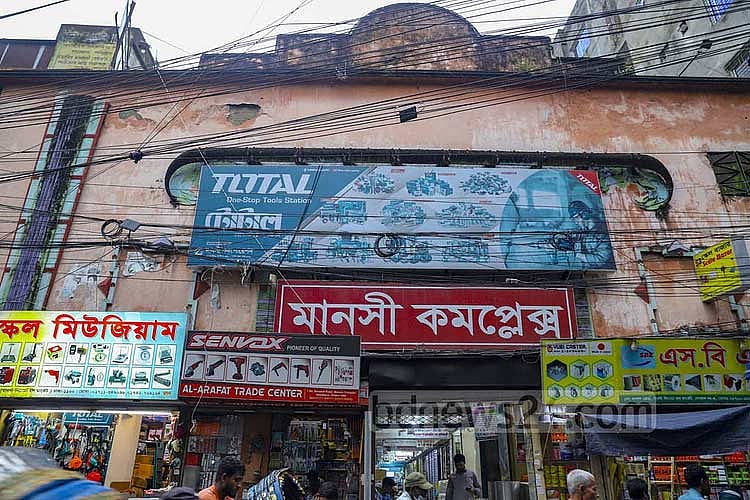
Urbanisation experts who were interviewed for this article posited that a city becomes wholesome when there are enough cultural spaces for the people. If not, future generations growing up in the city becomes culturally stunted.
A GENTRIFICATION PROCESS WITHOUT THE CULTURAL ELEMENT
Award-winning playwright Professor Ratan Siddiqui lives in Uttara.
He sounded exasperated while he was speaking about the lack of cultural amenities in the suburb,
“The area neither has a dedicated stage for drama, nor a public library. There is an auditorium, but it charges Tk 17,000 for each show. No drama group can afford it.”
Dhaka North City Corporation Mayor Md Atiqul Islam recently opened an amphitheatre called ‘Bangabandhu Mukto Moncho’ in Uttara’s sector 3, but Prof Ratan doesn’t believe it’s enough for a population of 1.5 million people living in the area.
“We do organise some cultural programmes there. But the fact is it’s simply not enough,” he said.
Prof Ratan also alleged that the custodian of the amphitheatre is not enough “culturally minded,” he said.
bdnews24 could not independently verify the allegation.
Other areas close by that gentrified massively in the last three decades are Kuril, Badda and Rampura, especially with the inclusion of the gigantic Bashundhara, Banasree and Aftabnagar suburbs.
The area does not have a single theatre stage. There is only one cinema hall in the area, a multiplex called the Blockbuster in the Jamuna Future park mall in Kuril.
In the eastern part of Dhaka, new areas are being developed from Jatrabari to Demra as hundreds of residential buildings have been built in the last three decades, but not a single theatre stage.
In the older parts, the city is expanding to Kamrangichar, but the situation there is more or less the same.
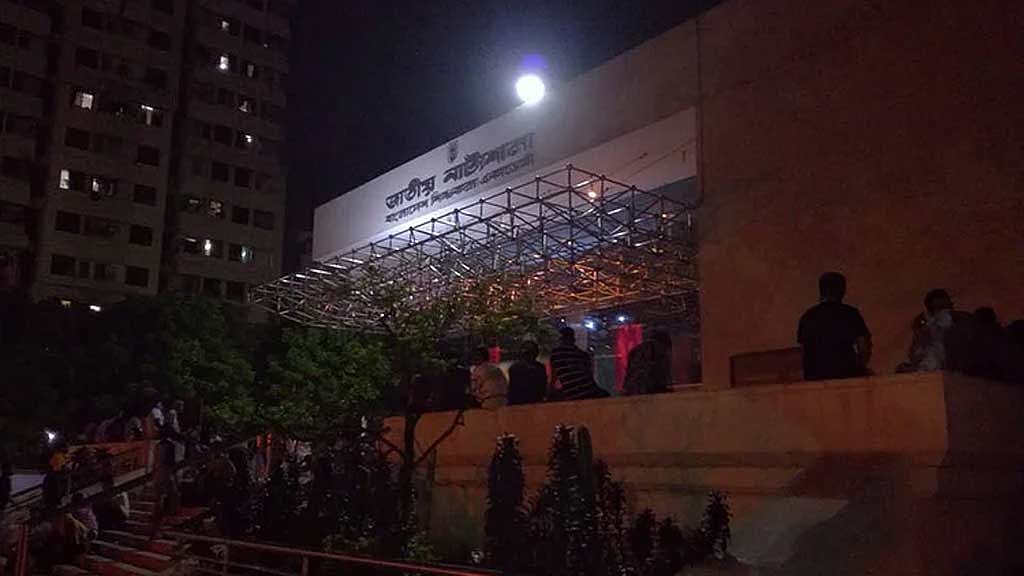
An auditorium named ‘Mahanagar Nattyamancho’ for staging dramas was opened in Gulistan with massive fanfare, but it failed to serve the purpose as stakeholders alleged that the auditorium did not have enough facilities to organise a show.
The auditorium is now being used by political parties to hold indoor rallies.
On the western front, the city expanded to the banks of the Turag river, but there are only two cinema halls there, one in Dhanmondi’s Shimanto Square mall and the other one, Mukti cinema hall, is in Rayer Bazar, one of the oldest in Bangladesh.
Not a single auditorium was built for staging drama in this area in the last three decades.
Mirpur is considered one of the largest parts of Dhaka.
The area had six cinema halls once upon a time, but most of them closed their doors permanently.
A town hall was there for organising dramas and cultural programmes, but city authorities were forced to demolish it in 2003 as the structure of the building was deemed unstable.
The town hall was never rebuilt in the last 19 years.
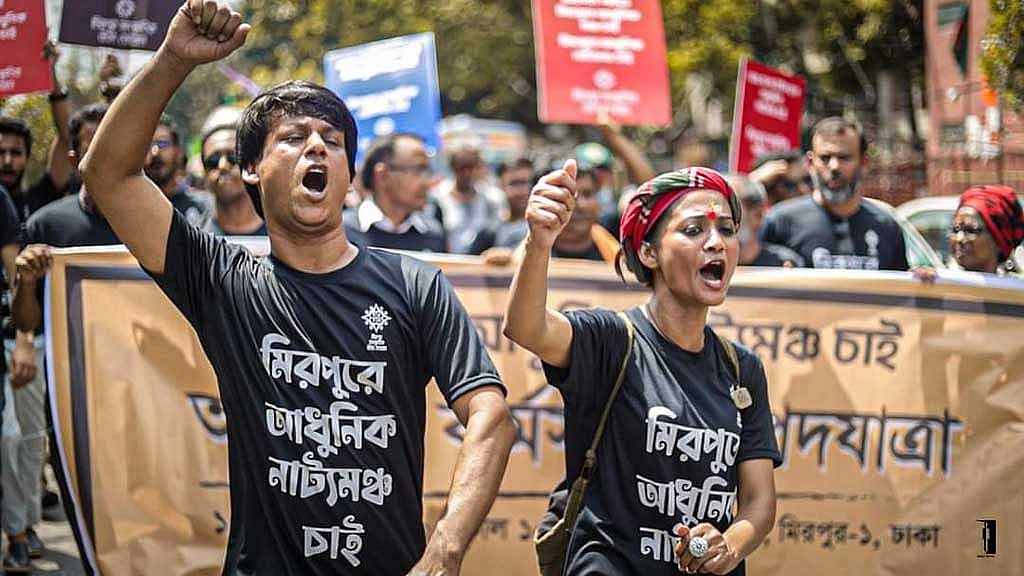
Mirpur Sangskritik Oikya Forum, a platform for Mirpur-based cultural activists, has been demanding the authorities build it back for a long time.
“The movement is about reinstalling the soul of Mirpur. We are asking for a full-fledged cultural centre which will have public libraries, art galleries, and a state-of-the-art auditorium,” said Mahabub Alam Shahin, the general secretary of the platform.
When Selim Reza, the chief executive officer of Dhaka North City Corporation, was approached about the matter, he said the city is currently reassessing the paperwork of the town hall.
IS DHAKA’S ‘IMPERFECT’ STATUS BECOMING A PERMANENT THING?
Independent urbanisation experts and cultural personalities have categorically blamed the city authorities for the shrinking of the city’s cultural space.
Iqbal Habib, a noted architect and urban planner, believes the policymakers were more focused on infrastructure building and less interested in creating cultural spaces.
“I did not find city policymakers remotely interested in building a new cultural centre, let alone expanding a cultural space for the city in the last 30 years,” he said.
He urged the city corporations and the Ministry of Cultural Affairs to take up the matter seriously.

“Otherwise, our future generations will become culturally underdeveloped,” he said.
Ramendu Majumdar stressed the necessity of creating a cultural circle centring Dhaka.
“A cultural circle which will expand through Mirpur, Uttara, Dhanmondi, Banasree, Badda, older parts, Kamrangichar and Bosila should be planned,” he said.
AUTHORITIES PLAN NEW ENDEAVOURS
Cultural activists in the city have been doing their best to bring the issues to the policymakers’ attention.
Ahkam Ullah, general secretary of the cultural platform Sammilito Sangskritik Jote, said the city authorities have already assured them about some new projects.
“Both mayors of the city corporations have sat with us. They have assured that eight new auditoriums for staging dramas will be built across the city,” he said.
Officials at the communications department of Bangladesh Shilpakala Academy confirmed that a piece of land was allocated in Mirpur to build a new centre for Dhaka district Shilpakala Academy, which will have an auditorium, rehearsal halls etc.
Dhaka North City Corporation’s CEO Selim Reza, the chief executive officer of Dhaka North City Corporation, said his department has recently undertaken many new projects to create new cultural space.
“The reality is it’s a bit difficult to get an allocation for a piece to build a cultural centre. Still, we are doing our best,” he said.
Mayor Atiqul said he issued a department-wide instruction to include a plan to build a cultural centre in every place the city is going to build malls and essential markets.
“Personally, I am cultural-minded and actively participated in open dramas in Mirpur. I have already asked my staff to plan for new cultural centres in every area where we will be building malls and kitchen markets,” he said.
[Writing in English by Adil Mahmood; editing by Biswadip Das]