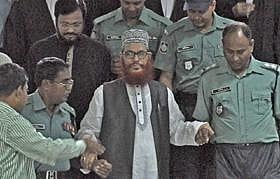
Defence to grill 1st witness again Thursday
The war crimes tribunal asks Sayedee's counsels to 'come to the point' now that cross-examination of the witness has been going on for three days Updates 3
bdnews24.com News Service
bdnews24.com
Published :
14 Dec 2011, 07:53 AM
Updated :
10 Aug 2022, 05:56 PM
Dhaka, Dec 14 (bdnews24.com) — Jamaat-e-Islami leader Delwar Hossain Sayedee's defence will continue to question the first prosecution witness for the fourth day on Thursday at the war crimes tribunal.
Counsel Mohammed Kafil Uddin Chowdhury, who had taken over from Mizanul Islam on Tuesday, resumed his cross-examination on Wednesday trying to discredit and question Mahbubul Alam Howladar's veracity as a witness.
Manjur Ahmed Ansari had taken over from Kafil Uddin and began questioning after lunch, painstakingly taking Howladar through the names and particulars of his neighbours, establishing the location of his house in his village and its general topography.
An executive council member and former MP of a Pirojpur constituency, Sayedee has been indicted on 20 counts of crimes against humanity at the International Crimes Tribunal set up deal with such offences during Bangladesh's Liberation War of 1971. His alleged crimes include murder, rape, loot and arson.
When by the end of the day the counsel still did not seem anywhere near an evident conclusion nor did he make an obvious headway with the questioning, the tribunal chairman Justice Nizamul Huq wondered when the defence would come to the point.
Despite his earlier warning to the defence saying that they would only get until 4:15pm Wednesday for examining the first witness, Huq softened his position by the close of the day's proceedings.
Addressing the defence he said, "You have been conducting cross-examination of the witness for three days. And now you say that you are only coming to the point?"
Tajul Islam stuck to his earlier point saying that the defence had to be given enough time and opportunity to properly contest all the points since there were 18 counts involving this single witness.
Justice A T M Fazle Kabir said, "Not at all. You can't just pull numbers out of your hat like that!"
Tajul Islam replied, "Well there are at least six or seven then."
Huq told Tajul Islam that it takes a toll on the witness being grilled by senior lawyers for hours on end. "God forbid, if you were ever to take the witness stand and if you were grilled like this, you would perhaps understand."
Tajul Islam replied: "Your honour, if I lied incessantly and if I made so many false statements, it would perhaps be natural that I am questioned for such a long time.
Judge A K M Zaheer Ahmed pointed out that three counsels had conducted cross-examination by turn. "You see one lawyer has taken his turn then another came in and once he tired, a third one came in. The witness goes through similar sufferings. You should keep that in mind."
Justice Nizamul Huq: "All I am saying is that you should ask yourselves where you are if you are only coming to the point after three days of cross-examination."
Tajul Islam: "But we have not asked a single unwarranted question. And you will see that all our questions had a point."
Justice Huq responded: "We are not questioning your line of questioning, although we could. We have not said for a single time what is the point of a certain question, or why you are asking a certain question. I am only asking you to look within yourself.
Earlier, before lunch Kafil Uddin Chowdhury suggested that Howladar was not at all a freedom fighter as he had claimed, nor did he have any relation with Major Ziauddin Ahmed, a sub-sector commander who had a camp inside the Sundarbans.
Kafil Uddin also suggested that contrary to his claims, Howladar had never been given any responsibility to gather intelligence for the freedom fighters. Howladar, however, denied the suggestions and held that the counsel's contention was false.
The court adjourned the hearing soon after the cross examination started and set Thursday for further hearing.
Kafil Uddin Chowdhury picked up from Tuesday when he was asking Howladar about how much time it would take him to visit the Major Ziauddin's camp inside the Sundarbans.
Howladar had earlier said that he had visited the camp at least 50 times during the war but could not say how much time it had taken him since there were obstacles and dangers on the way. "It would vary depending on the situation," he had answered.
Kafil Uddin began on Wednesday asking how far inside the Sundarbans this camp was located. Howladar said he did not know. "I generally contacted at the Sharankhola camp."
Kafil Uddin enquired about the details of that camp, its structure, the sub-sector commander's office and so on. Howladar said the office was located in a structure that previously housed forest office. However, he had not seen any board with the names of commanders in that sub-sector, nor had he seen a typist or personal secretary working for Ziauddin during his visits.
Kafil Uddin asked how long it would take Howladar after the war, during normal times to get to the camp. "It would take the better part of a day," Howladar said.
Howladar then added that on Tuesday he had stated visiting the camp about 50 times, which was perhaps inaccurate. It would be closer to 20, he mentioned.
It was barely half an hour since the questioning had begun around 10:40am, when Mizanul Islam stood up despite much difficulty (the counsel generally moves in a wheel chair and conducts cross-examination sitting down with permission of the court) to register an objection.
"It has been 25 minutes that we have begun cross-examination and the prosecution has interrupted every single question."
Several prosecutors immediately spoke up countering his objection and questioning the defence's line of cross-examination.
Judge A K M Zaheer Ahmed, who appears to have taken on the responsibility of explaining the defence questions in an easier language for the benefit of the court as well as the witness, replied, "Why don't we take a half-hour recess, and you fight it out?" he said indicating both the prosecution and the defence.
At this point, Sayedee stood up in the dock and requested permission to address the court. At first he requested permission for his brother to enter the court, who was apparently held back by security.
The tribunal chief Justice Nizamul Huq said people would not be allowed after proceedings began. However, he granted Sayedee's request.
The second point that the accused wanted to make was also about the repeated interruption of the prosecution during cross-examination of the witness. "If such disturbances continue then the image of this court would be tarnished."
Nizamul Huq replied, "We will hopefully be able to do just that, rest assured."
Kafil Uddin then proceeded to ask Howladar about the structure of Ziauddin's command. He asked how many commanders there were under him. To this, Huq said, "I don't understand this question. Major Ziauddin was a sub-sector commander himself. How can there be commanders under him?"
The counsel replied that he fully understood the question and took full responsibility for his line of cross-examination.
Kafil Uddin then dropped several names and asked if Howladar knew the persons named Paritosh Kumar Paul or Babul Gazi. The witness could not recall being acquainted with such persons and said he would not be able to tell without further details.
The counsel also asked Howladar about two books on the Liberation War — one memoirs of Major Ziauddin and another by the Pirojpur District Council — that the witness said he had not read and did not know about. Kafil Uddin said, "You are denying the existence of these books because they do not mention you."
Kafil Uddin then asked about two applications by Howladar dating back to 2004 and 2005 where he had asked for help from the government and from the local Freedom Fighters Command Council. When asked if both of these were recommended by Delwar Hossain Sayedee, Howladar said, "He had provided the recommendation as the sitting MP, not as an individual."
"Subsequently during the current regime," Kafil Uddin told Howladar, "Your freedom fighter's allowance was verbally cancelled by the current MP since you had been enlisted during Khaleda Zia's regime and had sought help with Sayedee's recommendation."
The witness said it was not true. He also denied Kafil Uddin's contention that local people had submitted an application to the ruling MP challenging his being a freedom fighter. Howladar replied that such applications have been there in case of other people. "But not in my case."
At this point, when the defence objected rather strongly to the prosecution prompting answers for the witness, judge Zaheer Ahmed took an uncharacteristically stiff face and said, "Henceforth, if there is any such prompting from the prosecution, the records will show that the answer was 'led by the prosecution' in brackets."
"I am trying to explain every single question in easy Bengali so that the witness understands it well. Should there be further queries or questions, please raise your hand."
Sayedee is the first to face prosecution for his alleged war crimes against humanity.
The prosecution on Sept 4 proposed the framing of charges against Sayedee on 31 counts for crimes against humanity and genocide in ICT Case-1/2011. The tribunal indicted Sayedee on 20 counts on Oct 3.
Apart from Sayedee, Jamaat chief Matiur Rahman Nizami, secretary general Ali Ahsan Mohammad Mojaheed and assistant secretaries general Mohammad Kamaruzzaman and Abdul Quader Molla, and Bangladesh Nationalist Party's standing committee member Salahuddin Quader Chowdhury, also a lawmaker, have been detained, along with others, on charges of committing war crimes.
The tribunal is expected to take charges against the other Jamaat leaders into cognisance on Dec 18.
The tribunal, however, on March 31 granted conditional bail to former BNP MP and minister Abdul Alim.
bdnews24.com/ta/bd/1925h