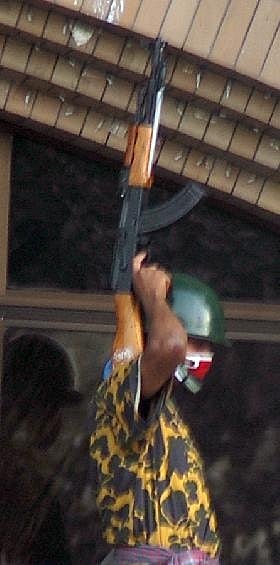
Special courts formed to try BDR mutineers
The government has formed six special courts to try some 3,500 border guards for the bloody February mutiny at the Bangladesh Rifles' Peelkhana headquarters. UPDATES
bdnews24.com News Service
bdnews24.com
Published :
15 Nov 2009, 12:13 PM
Updated :
12 Aug 2022, 02:04 PM
Dhaka, Nov 15 (bdnews24.com)--The government has formed six special courts to try some 3,500 border guards for the bloody February mutiny at the Bangladesh Rifles' Peelkhana headquarters.
The BDR in a press statement on Sunday said that the courts--two at Dhaka and four outside--had been formed.
The special courts will only judge the mutiny cases, the statement added.
BDR director general Maj Gen Moinul Islam on Sunday told bdnews24.com by phone, "The six special courts have been formed today.
"The procedure for trial of the BDR carnage has started with the constitution of the courts."
The three-strong courts, headed by the paramilitary force's chief, will also include two officials from the lieutenant colonel and major ranks.
The BDR chief will head the courts.
Trial of the border guards under Khulna, Rajshahi and Kushtia sectors and the battalions or establishments under them will be held in the Special Court-1.
Special Court-2 will try those from Dinajpur and Rangpur sectors and battalions and installations under those sectors.
Paramilitary troopers of Sylhet, Comilla and Mymensingh sectors and battalions and installations under them will be tried in Special Court-3.
The border guards from Chittagong, Rangamati and Khagrachhari sectors, the adjoining battalions and Rifles Training Centre and School, Baitul Izzat in Chittagong will face the Special Court-4.
Special Court-5 will try the BDR men under Dhaka sector and its battalions.
Establishments under the headquarters, signals sector, Sadar Rifles Battalion, BDR hospital and the Rifles Security Unit will come under the Special Court-6.
Moreover, the special court will also function on the mutiny spots or in the nearby sector, battalion or establishment.
A representative nominated by the attorney general will assist the special court. According to the BDR Act, an accused can defend himself where he can take help from a BDR official or a lawyer
The mutiny took place on Feb 25-26 this year at the BDR headquarters and some other places, leaving at least 73 people, 57 of them army officers including its chief Major General Shakil Ahmed deputed to the force, killed.
About 3,500 border guards will stand trial for the mutiny, home minister Sahra Khatun said earlier.
Police captured some 2,500 BDR personnel on charges of killing and other crimes. Nearly 7,000 were questioned.
The regular cabinet meeting on Nov 9, presided over by prime minister Sheikh Hasina, directed the home ministry to update the BDR Act of 1972 for the trial.
Law minister Shafique Ahmed said on Oct 21 that the mutiny trial would be held this month after the constitution of special courts by the border guards' chief.
However, the trial for more serious charges like murder, arson is to be held after the receipt of Criminal Investigation Department (CID) report.
He said the trial will be concluded in 135 days.
The minister also said those accused of mutiny would be allowed to appoint lawyers, but the lawyers would not be able to participate in arguments and can only provide suggestions to the defendants.
President Zillur Rahman sent a reference to the Supreme Court on Aug 17 seeking directives on the trial process, specifically whether the trial of the BDR mutineers could be held under the Army Act 1952.
The court appointed 10 senior lawyers as amici curiae, literally 'friends of the court', to advise on the reference. The court began hearing their opinions on the reference on Aug 25 and ended on Sept 3.
The majority of the amici curiae opined that trial of BDR personnel could not be held under the Army Act, 1952 even by notification
bdnews24.com/lh/pk/bd/1758h.