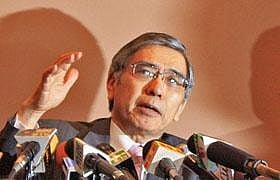
ADB warns of '2nd round' recession effects, pledges more aid
Bangladesh has not felt the initial impact of the global recession as hard as some Asian countries, but prolonged effects could hit Bangladeshi exports, especially RMG and textiles, said visiting ADB president Haruhiko Kuroda on Thursday as he pledged more annual assistance as well as support from an ADB recession fund. FULL STORY
bdnews24.com News Service
bdnews24.com
Published :
23 Jul 2009, 01:39 PM
Updated :
12 Aug 2022, 01:30 PM
Dhaka, July 23 (bdnews24.com)—Bangladesh has not felt the initial impact of the global recession as hard as some Asian countries, but prolonged effects could hit Bangladeshi exports, especially RMG and textiles, said visiting ADB president Haruhiko Kuroda on Thursday as he pledged more annual assistance as well as support from an ADB recession fund.
"Bangladesh has not been hit as hard by the global financial crisis as most economies in the Asia and Pacific region, partly due to its long tract record of prudent macroeconomic management," said Kuroda, who arrived in Dhaka earlier in the day on a two-day visit.
"However, it has begun to feel the second round effects of the global slowdown through slower growth of exports, worker remittances and government revenues, along with declining imports," Kuroda told a press briefing in the Pan Pacific Sonargaon Hotel.
He said the worst hit would be Bangladesh's main exports, ready-made garments and textiles.
ADB pledges more annually, and recession fund
Kuroda, after meetings with prime minister Sheikh Hasina and finance minister AMA Muhith earlier in the day, pledged to increase the Asian Development Bank's annual contribution to Bangladesh by $200m, from $600m to $800m.
Muhith, after his meeting with the ADB chief, said Bangladesh was seeking $500m in 'emergency aid' from a fund for developing countries in Asia hit by the world recession.
ADB has raised a fund of $3 billion to assist developing nations to overcome the effects of the global economic recession.
"We have requested $500 million from the fund on an emergency basis," said Muhith.
Kuroda said he was pleased to announce Bangladesh would get support from the new recession fund in addition to the increase in its annual assistance package.
He said it would allow the Bangladesh government to scale up development programmes in response to the global financial crisis, particularly infra-structure investment, while strengthening social safety nets to cushion the impacts on the poor and vulnerable.
Regional cooperation
Kuroda also urged Bangladesh to strengthen regional links, working with India and Nepal in particular on shared communications and power projects.
Bangladesh is currently concerned about India's hydropower plans, in particular the proposed Tipaimukh dam project, that could divert precious water resources from shared rivers.
Kuroda suggested a regional power grid could greatly ease power crises faced by most countries in the region.
"I also urge South Asia to enhance sub-regional cooperation to capture economies of scale, build on complementarity among neighbouring countries, and ensure regional economic and financial stability."
"These measures will also help Bangladesh draw much needed private sector investment," he said.
Mainstreaming climate
Responding to another crisis, Kuroda said, Bangladesh, was "on the front lines in dealing with the impacts of climate change."
"Therefore, all ADB projects in Bangladesh are designed to mainstream climate change."
"We have also prepared the Bangladesh Climate Change Implementation Plan, and are providing a $2million grant to support a variety of related initiatives."
Governance
The ADB president asked the government to take strong measures to improve governance and law and order.
"Unless these aspects are strengthened, they will become obstacles to private investment, both domestic and foreign, which is critical for sustaining and increasing economic growth and reducing poverty."
He expressed satisfaction over an active policy of private sector development through public-private partnerships in the FY2010 budget.
bdnews24.com/arh/zr/rah/1950h