


Published : 24 Sep 2019, 11:22 PM
Updated : 17 Oct 2022, 11:46 AM


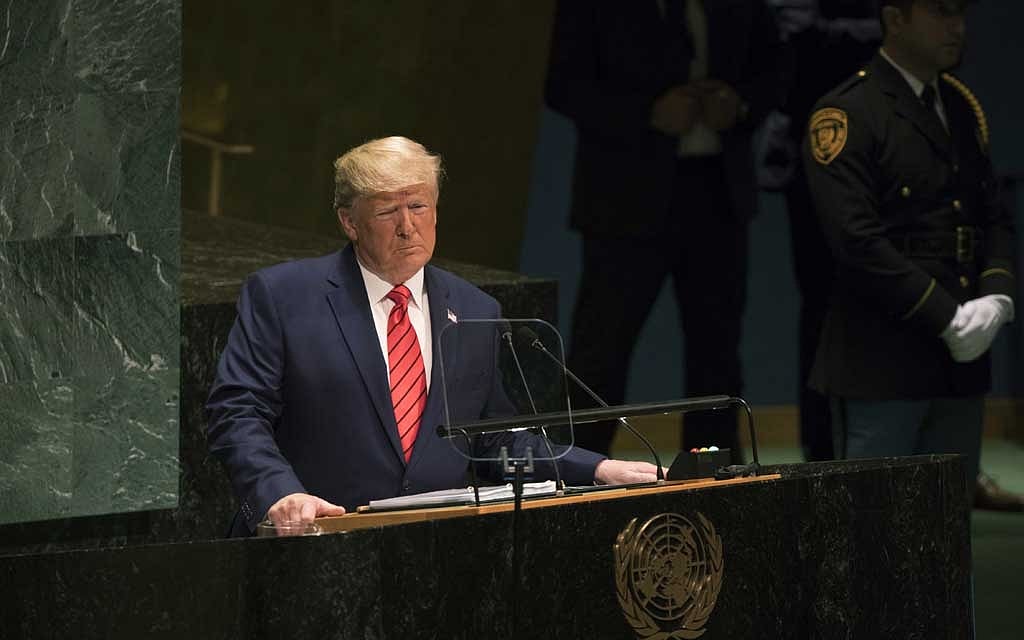
“If you want freedom, hold on to your sovereignty, and if you want peace, love your nation,” he said. “The future does not belong to globalists. The future belongs to patriots. The future belongs to sovereign and independent nations.”
He devoted much of his speech to disparaging China, Iran and Venezuela, and warned Chinese authorities in Beijing, “We are carefully monitoring the situation in Hong Kong,” where months of anti-Beijing protests have raised fears of a Chinese crackdown.
Trump defended his decision to abandon the nuclear agreement with Iran and accused Iranian authorities of “a fanatical quest for nuclear weapons and the means to deliver them.” At the same time, he said, “America is ready to embrace friendship to those who genuinely accept it.”
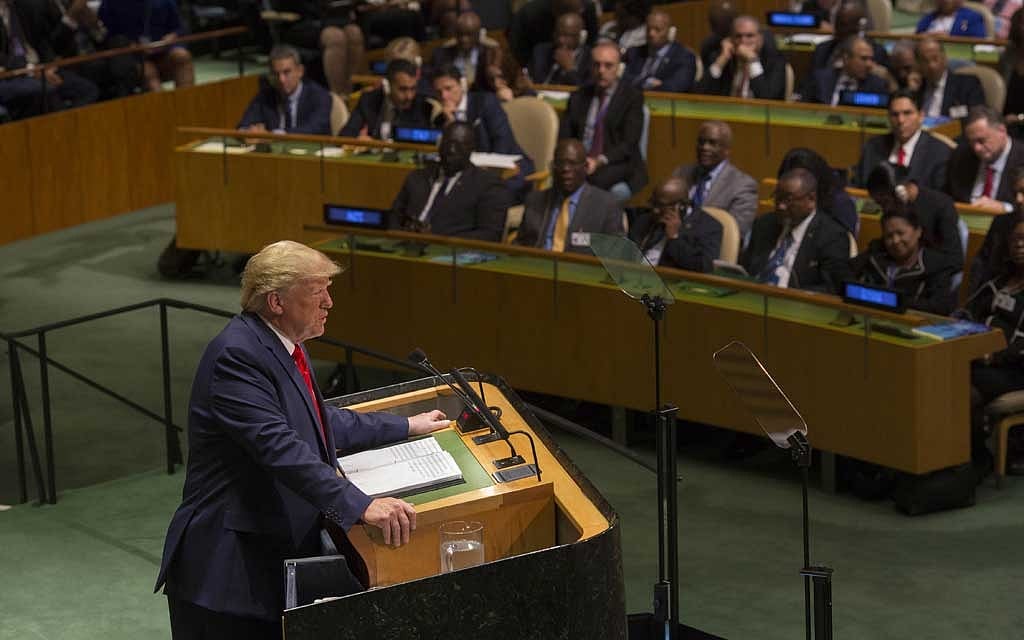
President Donald Trump addresses the United Nations General Assembly at the UN headquarters in New York, on Tuesday, Sept. 24, 2019. (Dave Sanders/The New York Times)
Trump was surrounded by like-minded company when the speeches began in the cavernous UN General Assembly hall on Manhattan’s East Side. He was preceded by President Jair Bolsonaro of Brazil, sometimes called the mini-Trump, a polarising figure at home who, like Trump, dismisses fears about climate change and disparages critics on Twitter.
After Trump comes President Abdel-Fattah el-Sissi of Egypt, the former general who has come to symbolise the repression of the Arab Spring revolutions — although his appearance was thrown into doubt last weekend as protests erupted at home. Then comes President Recep Tayyip Erdogan of Turkey, an autocrat who has bullied critics and whose government is a leading jailer of journalists.
Twenty-one leaders are speaking Tuesday alone, and the final one scheduled is Boris Johnson, making his United Nations debut as Britain’s prime minister. His visit came as the country’s top court delivered a stinging rebuke to Johnson, ruling he had acted unconstitutionally in suspending Parliament, an action taken as he tries to take his country of the European Union by Oct 31.
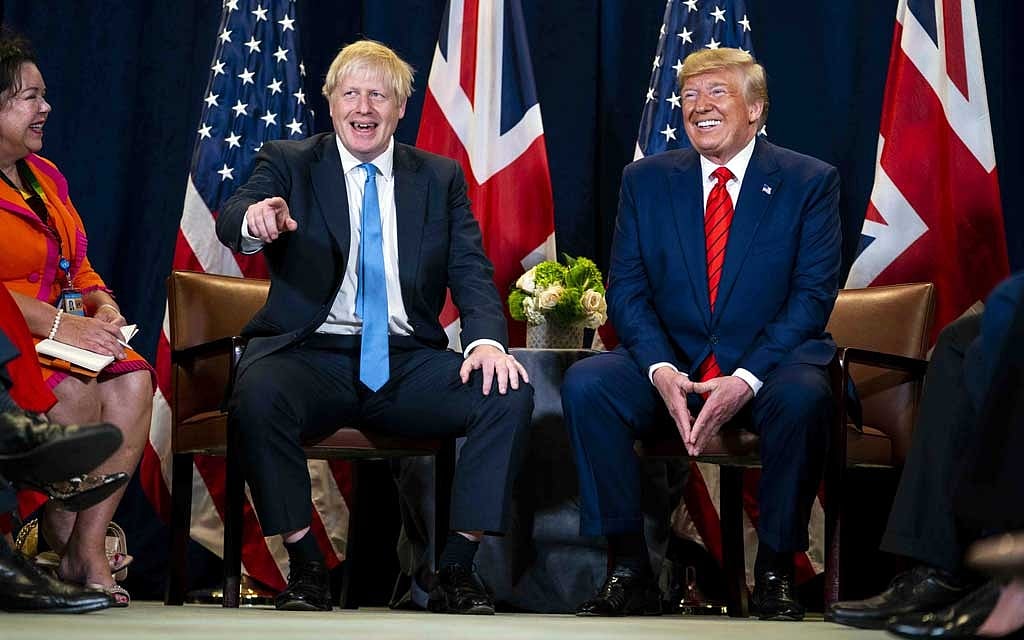
From left, Prime Minister Boris Johnson of Britain meets with President Donald Trump during the United Nations General Assembly at UN headquarters in New York on Tuesday, Sept. 24, 2019. The two leaders are facing gathering political clouds back home in their capitals. (Doug Mills/The New York Times)
Trump and Prime Minister Boris Johnson of Britain have always shared a certain affinity and style of politics, but as they shared the world stage at the UN Tuesday, each was also facing stark domestic troubles at home.
Trump and Johnson were both speaking at the General Assembly and scheduled to meet on the sidelines of the session for their second in-person meeting since the British leader took office in July. In each case, though, at least one eye was focused on gathering political clouds back in their capitals.
In Washington, Speaker Nancy Pelosi, D-Calif., was convening a meeting with the entire House Democratic caucus amid rising momentum for impeachment, after revelations that Trump pressed Ukraine’s president for dirt on his leading Democratic rival, former Vice President Joe Biden, while blocking US aid to Kyiv.
Trump has acknowledged raising Biden and corruption questions with Ukraine’s new president, Volodymyr Zelenskiy, in a July 25 telephone call. He also personally ordered his staff to freeze more than $391 million in aid to Ukraine in the days before he pressed Zelenskiy to investigate Biden.
The timing of the decision to block the aid and Trump’s personal involvement, which were first reported by The Washington Post, added new factors to the intense debate over the president’s effort to persuade Ukraine to examine unsubstantiated corruption accusations involving Biden and his son Hunter Biden.
In London, Britain’s Supreme Court ruled unanimously that Johnson acted illegally when he suspended Parliament amid the roiling debate over Britain’s plans to withdraw from the European Union. The ruling was a striking rebuke of the prime minister that means lawmakers will return to session three weeks earlier than he had scheduled.
Johnson has suffered an extraordinary series of legal political defeats since becoming prime minister, including losing his majority in the House of Commons. Britain faces an Oct 31 withdrawal deadline to leave the European Union.
— Peter Baker
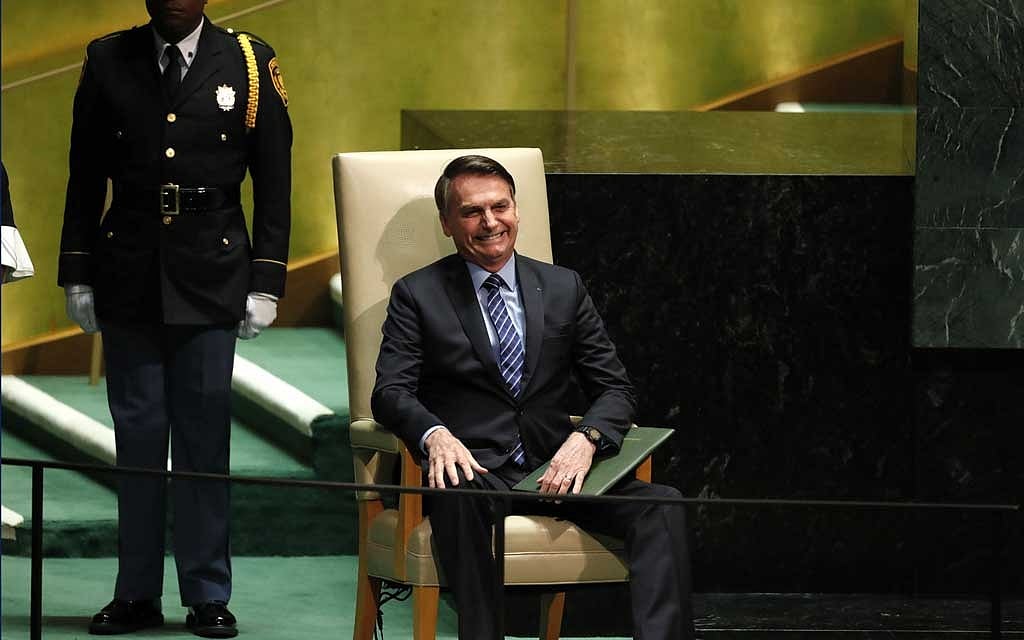
Brazil's President Jair Bolsonaro sits in a chair reserved for heads of state before his address to the 74th session of the United Nations General Assembly at UN headquarters in New York City, New York, US, September 24, 2019. Reuters
Bolsonaro devoted part of his speech to denounce critics who accuse him of allowing rampant deforestation of the Amazon rainforest by people burning it to clear land for farming and other uses.
“We all know that all countries have problems,” Bolsonaro said. “The sensationalist attacks we have suffered due to fire outbreaks have aroused our patriotic sentiment.”
Brazil’s National Institute of Space Research agency identified 40,341 fires in the Amazon region in the first eight months of this year, about 35% higher than the average for the first eight months of each year since 2010.
He said that Brazil has a “zero tolerance policy” toward crime, including environmental crimes, but added, “The Amazon is not being devastated, nor is it being consumed by fire as the media misleadingly says.”
Bolsonaro also denounced “the politically correct,” which he said had “become a constant in public debate to expel common sense.”
“Ideology has invaded the human soul itself to expel God and the dignity which he has endowed us,” he said, before alluding to an attack he suffered while campaigning for president in 2018.
“I was cowardly stabbed because of a left-wing activist, and I only survived by a miracle,” he said.
In the hallways, on guard for awkward encounters.
While Trump will not be seeing the presidents of China, Russia and Venezuela, who are skipping the General Assembly this year, the potential is large for awkwardness between leaders who may inadvertently see each other in the halls and conference rooms.
Diplomats who just a few weeks ago had foreseen a meeting between Trump and President Hassan Rouhani of Iran say that it is now unlikely, given the rising tensions between the two countries. Nor is a meeting predicted between Secretary of State Mike Pompeo and his Iranian counterpart, Mohammad Javad Zarif, who are not known to even talk to each other.
Other potential unpleasantness may loom should Bolsonaro of Brazil encounter President Emmanuel Macron of France, who exchanged mutual insults last month via social media over Bolsonaro’s handling of fires and deforestation in the Amazon rainforest.
Deteriorating relations between Prime Minister Shinzo Abe of Japan and President Moon Jae-in of South Korea have lowered expectations for any warming at the United Nations, even if Trump seeks to bring them together. And the prime minister of Pakistan, Imran Khan, is still furious with Prime Minister Narendra Modi of India over the Indian crackdown last month in the disputed territory of Kashmir.
c.2019 The New York Times Company












