


Published : 02 Jun 2020, 02:33 AM
Updated : 17 Oct 2022, 11:08 AM


Trump told the governors “you have to dominate” and said if they failed to take a strong hand, the protesters were “going to run over you; you’re going to look like a bunch of jerks.” In blunt remarks rarely heard from an American president, he prodded the chief executives not to be “too careful.”
“Someone throwing a rock is like shooting a gun,” Trump told them. “You have to do retribution.”
The tirade, delivered on a private conference call and captured on audio obtained by The New York Times, showed the depth of Trump’s anger over protests and riots that have bubbled up in more than 100 US cities after the death of a black man under the knee of a white police officer in Minneapolis. For days, Trump has hunkered in the White House, expressing himself largely on Twitter.
But his call with the governors showed how Trump is not taking a moment of deep national crisis to appeal for reconciliation but is instead solely pressing the governors to use force. He struck that tone even though aides spent the better part of the weekend trying to convince him that the unrest was about a deeper issue.
“You’re making yourself look like fools,” he told the governors, chiding them for not all calling out the National Guard.
Taking over a call that was supposed to feature Vice President Mike Pence, who has been praised in his efforts to forge relationships with governors during the coronavirus pandemic, Trump said that Minnesota had become “a laughingstock all over the world.” The president had just spoken with President Vladimir Putin of Russia before addressing the governors.
Alluding to television footage of violence and looting, Trump called the people committing those acts “scum” and demanded of the governors: “Why aren’t you prosecuting them?” Gov. J.B. Pritzker of Illinois used the call to confront the president, stating that Trump had used “inflammatory” language. “We have to call for calm,” said Pritzker, whose state was hit with a wave of looting over the weekend, adding that “the rhetoric that’s coming out of the White House is making it worse.” Trump, who has rarely been so directly criticised during his coronavirus-related conference calls with the governors, swiped back. “I don’t like your rhetoric much either,” he said. He told Pritzker he could do “a much better job.”
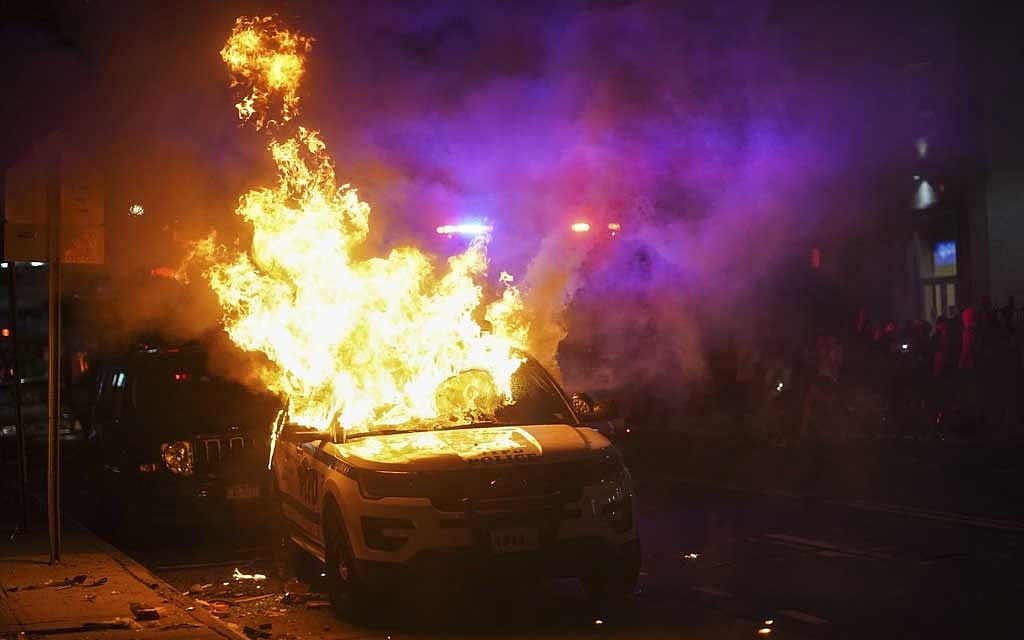
A police vehicle burns in Brooklyn, May 30, 2020. Demonstrators returned to the nation’s streets in sweeping fashion on Saturday in a show of national anger and sorrow over the death of George Floyd, a black man who died Monday in the custody of the Minneapolis police. (Chang W. Lee/The New York Times)
The president said, “we’ll look into that,” before firing back that he expected “a tremendous crowd of people showing up,” predicting that “most of them are very favourable.”
“They like their president,” Trump said. Trump, who has not formally addressed the nation since the unrest began, said he was putting Gen. Mark A. Milley, chairman of the Joint Chiefs of Staff, “in charge” but did not immediately specify what that meant or if he would deploy the military to quell the violence in the nation’s cities.
The president also zeroed in on unrest in New York City, reminding the governors that he maintained a residence there and suggesting that police should be able to do their jobs.
“I don’t know what’s happening in Manhattan, but it’s terrible,” Trump said. “New York is going to have to toughen up. We’ll send you National Guard if you want.” Again stoking conflict, he said New York police officers had “to be allowed maybe to do their jobs.”
Trump often sounded as much like an angry bystander as the nation’s president, repeatedly recalling his reaction to televised footage of the unrest.
“They just walked right down the street, knocking them out with tear gas, tear gas,” he said of the National Guard’s handling of the riots in Minneapolis. “These guys, they were running.” And without evidence, Trump asserted that after the crackdown in the Twin Cities the protesters had left to create mayhem in other localities. ”They’re all looking for weak spots,” he said of the protesters. “Now what they’re going to do is search out perhaps smaller cities.”
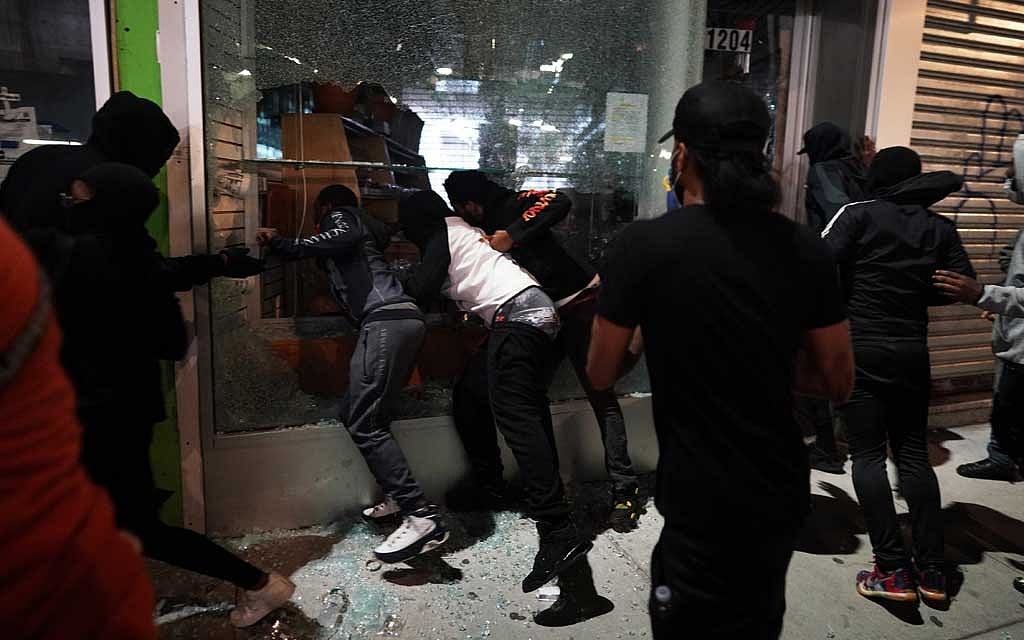
Protests in New York, on Sunday, May 31, 2020, reach inside a broken window. The death of George Floyd, an African-American man, in police custody, has ignited protests across the country. (Chang W. Lee/The New York Times)
Trump has long used language common to authoritarians than to democratically elected leaders to speak about protesters. In 1990, Trump told Playboy magazine that Beijing showed “the power of strength” when it used deadly military force to quell the student-led demonstrations at Tiananmen Square the year before.
“When the students poured into Tiananmen Square, the Chinese government almost blew it,” Trump said. “Then they were vicious; they were horrible, but they put it down with strength. That shows you the power of strength. Our country is right now perceived as weak.”
In 2016, Trump said the comments were not an endorsement before calling the students “rioters” and reiterating that a “strong, powerful government” stopped the protests. And even as president, he has openly nudged law enforcement officers to treat those apprehended with harsh tactics.
“When you see these thugs being thrown into the back of a paddy wagon, you just see them thrown in, rough — I said, ‘Please don’t be too nice,’ ” Trump said to applause from Long Island, New York, police officers in a 2017 speech.
©2020 The New York Times Company












