


Published : 02 Apr 2022, 12:59 PM
Updated : 03 Aug 2022, 11:41 AM


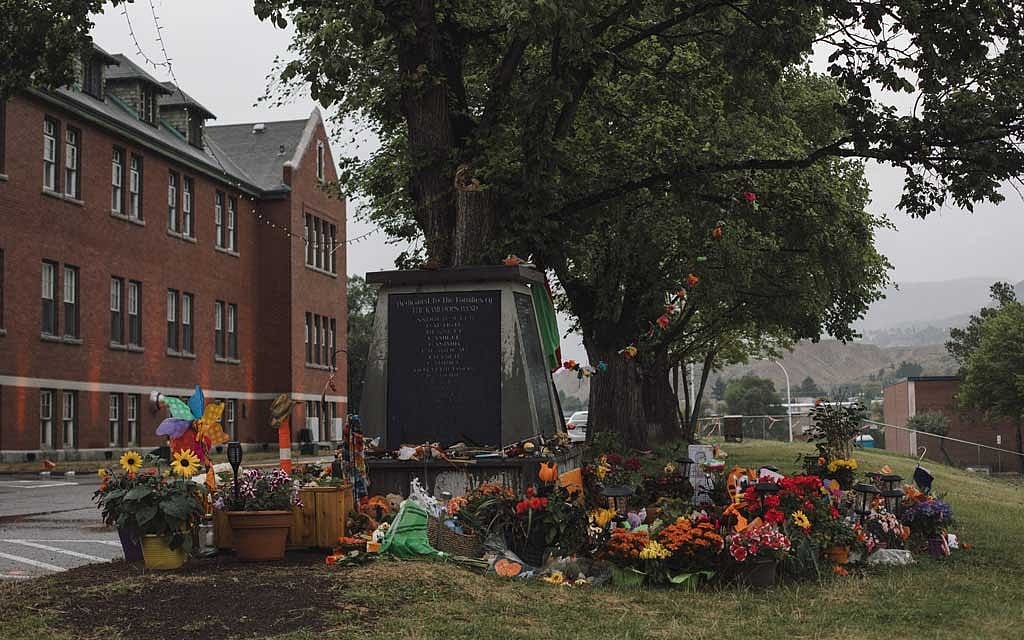
His apology comes after Canada was jolted last year by the discovery of evidence that more than 1,000 people, most of them children, were buried in unmarked graves on the grounds of some of the former schools.
“I feel shame — sorrow and shame — for the role” that Catholics played “in the abuses you suffered and in the lack of respect shown for your identity, your culture and even your spiritual values,” Francis said.
Francis spoke during an audience at the Apostolic Palace with dozens of delegates from Canada’s three largest Indigenous groups, who had travelled to the Vatican in the hope that he would apologise to survivors in Canada. This was the first apology to the Indigenous people of Canada from a pope and was a reversal of Francis’ earlier position.
“I ask for God’s forgiveness and I want to say to you with all my heart: I am very sorry,” Francis said, adding that he joined with Canadian bishops “in asking your pardon.”
From the 1880s to the 1990s, the Canadian government ran a system of compulsory boarding schools that a National Truth and Reconciliation Commission called a form of “cultural genocide.” The Catholic Church operated about 70% of the schools in the system.
About 150,000 Indigenous children were separated from their families and sent to these residential schools, where abuse, both physical and sexual, was widespread, along with neglect and disease. Murray Sinclair, the former judge who headed the commission, estimates that at least 6,000 children went missing.
Whether the Vatican knew about the extent of abuses at the schools while they were open is unclear. The Catholic orders that operated them have been slow to open their records to the National Centre for Truth and Reconciliation, a Canadian archive and research body.
In a statement, Stephanie Scott, the centre’s executive director, said she expected it to receive full access to the records of the Missionary Oblates of Mary Immaculate, an order that ran most of the Catholic schools, next month. Those documents are now largely in Rome.
“We will then be able to uncover more of what the church knew and understood during the operation of the residential schools,” she said.
The Canadian government and the Protestant churches that ran just under a third of the schools long ago apologised and fulfilled their obligation to pay reparations under a 2006 class-action settlement. About 4.7 billion Canadian dollars (about $3.75 billion), most of it from the government, has been paid to survivors and spent on projects, including the commission.
But the Catholic Church, through the Canadian bishops’ conference, failed to pay most of its share of the reparations, including 25 million Canadian dollars in cash compensation. In September, the Canadian bishops’ conference apologised for the church’s role in the residential school system and pledged a new effort to raise 30 million dollars for reparations.
Given the church’s decades of refusal to apologise and failure to honour its financial commitments, some Indigenous people, particularly those who are not practicing Catholics, see little value in a papal apology.
But for others, Friday’s audience, which began with prayers in the languages of various Indigenous groups, ended an emotionally gratifying — and at times painful — weeklong encounter at the Vatican.
“For 40 years plus, I’ve been on this walk to Rome,” Wilton Littlechild, the former grand chief of the Confederacy of Treaty Six First Nations in Alberta and Saskatchewan, said at a media briefing Thursday.
In private sessions earlier this week with Métis, Inuit and First Nations delegates, Francis heard story after painful story of the abuse suffered at the hands of Catholic educators at the schools. Delegates — including survivors, leaders, elders, youth and spiritual advisers from various nations — said the pope had listened attentively and had expressed his sorrow. The delegates said this week that they believed the pope’s commitment to healing open wounds was sincere.
Immediately after Friday’s meeting, delegates said they were overjoyed and somewhat surprised by the papal apology and that they looked forward to greeting the pope in Canada, where he would be able to apologise directly to survivors and their families.
“The pope’s words today were historic, to be sure. They were necessary, and I appreciate them deeply,” said Cassidy Caron, president of the Métis National Council. “And I now look forward to the pope’s visit to Canada, where he can offer those sincere words of apology directly to our survivors and their families whose acceptance and healing ultimately matters the most.”
Natan Obed, president of Inuit Tapiriit Kanatami, the national Inuit organisation, said his group was looking forward to “working with the Canadian Council of Bishops and the Vatican to not only plan for this message to be brought to Canada” but also “see action that really will be the hallmark of this reconciliation journey with the church.”
“Today is a day that we’ve been waiting for, certainly one that will be uplifted in our history,” said Gerald Antoine, the Dene national chief, adding that the apology had been “long overdue.”
“It’s a historical first step, however, only a first step. More needs to be done,” he said.
In addition to asking Francis to come to Canada to apologise to survivors and their families, the delegates asked Francis to repatriate artifacts in the collections of Vatican Museums and open the Vatican archives so researchers could comb through records and documents regarding the residential school system.
The delegates also asked Francis to revoke a 1493 papal bull issued by Pope Alexander VI that gave Spain authority over the newly discovered lands of the Americas, allowing the Spanish to colonise and enslave the Indigenous peoples and convert them to Catholicism. The papal bull, which informed the “doctrine of discovery,” was “used for centuries to expropriate Indigenous lands and facilitate their transfer to colonising or dominating nations,” according to the United Nations.
Indigenous groups in Canada say that while the theories of racial superiority that underlie the doctrine have long been discredited, it continued to surface in legal disputes over land until 2014. The Supreme Court of Canada ruled that year, without naming the papal bull, that the idea that no one owned land until it was claimed by Europeans “never applied in Canada.”
Bishop William T McGrattan, vice president of the Canadian Conference of Bishops, said Friday afternoon that Canadian bishops had refuted the doctrine, and in 2016 offered a pastoral letter denouncing it. Discussions were ongoing about the issue among various bishops conferences around the world, he added, and the Vatican was “studying those particular responses.”
Phil Fontaine, another delegate and former residential-school student who, as national chief of the Assembly of the First Nations, first travelled to the Vatican in 2009 to ask for an apology from Pope Benedict XVI, said this visit had been decidedly different. There appeared to be real commitment on the part of Francis “to fix things to better the lives of our people," he said.
The apology will not heal every survivor, but it will open a door, Caron said.
“Survivors are at different stages of the healing journey,” she said. “Some turned away from the church and they say they don’t need an apology to heal, but for others, it was very much necessary.
“It changes the direction we continue to move forward,” Caron added.
The church softened its stance on apologising last year after three Indigenous groups announced that ground-penetrating radar had discovered signs of many hundreds of unmarked graves containing human remains, mostly those of children.
Antoine said the Indigenous people of Canada were looking forward to the pope’s visit and that he hoped they would be “active partners” in planning it and in determining the sites Francis would travel to.
“Why? Because it’s our home,” he said. “And our family needs to be involved in it.”
© 2022 The New York Times Company













