


Published : 11 Sep 2021, 11:20 PM
Updated : 14 Oct 2022, 06:58 PM


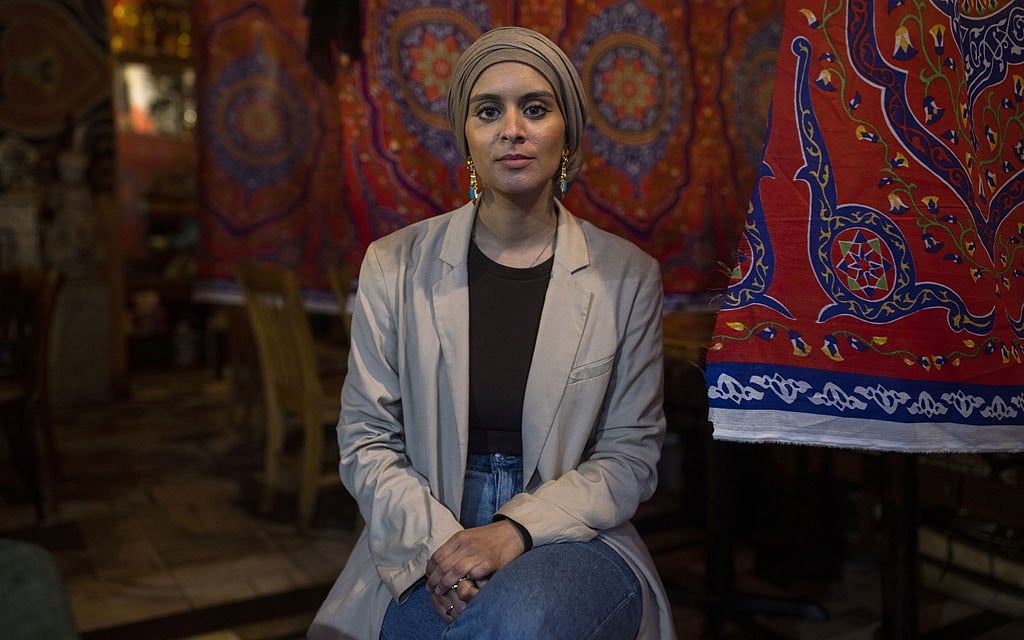
“One of the first questions we asked each other was, ‘Can the president help us?’” said Hanif, who was born and raised in Kensington, Brooklyn, the home of many Bangladeshi American families like her own. “The president was the most powerful person who could send this mass message to the American people that this incident happened and it shouldn’t reflect how we think about Muslims across America.”
Bush did not write back. And in the following decade, few local leaders spoke out against the New York Police Department’s stop-and-frisk policy, which enabled profiling and discrimination, or what many perceived to be the department’s surveillance of Muslims, which only became public knowledge in 2011, or the wave of deportations enacted by the newly formed Department of Homeland Security.
Hanif and her Muslim peers who came of age during that time would witness their communities deeply affected by these measures.
“What we realized and had to grapple with from a very young age was fighting for a more democratic city, fighting for equity without even knowing these terms,” Hanif said. “We needed to grow up in a way to become the warriors of our communities.”
Hanif, now 30, is trying to do just that. She is on track to be elected the first Muslim woman to serve on New York’s City Council, representing Brooklyn’s 39th District, which encompasses the Kensington neighborhood where she grew up. For Hanif, the fallout from Sept. 11 became a driving force in her pursuit of politics. And she is not alone: Other Muslims from her generation are entering New York’s electoral ranks, too.
“It’s a hugely important moment,” said Mohammad Khan, 35, president of the Muslim Democratic Club of New York. “I think it shows the increasing relevance and power of Muslim New Yorkers,” he continued, citing the legacy and ongoing influence of Black Muslim leaders like state Sen. Robert Jackson and Councilman I. Daneek Miller of Queens, the only Muslims who have served on the City Council so far.
On Sept. 11, Khan was a junior at Stuyvesant High School, just blocks from the World Trade Center. Like Hanif, he also sensed a shift in public perceptions toward Muslim Americans after the attacks. “Being Muslim felt like it became a lot more politicized as an identity,” he said. “I think for some people, there is a choice to either back away from that identity and try to make yourself less Muslim — whatever that means — or lean into that identity.”
But not everyone has the privilege to make that choice, Khan acknowledged, especially not Muslim women in hijabs, whose visibility can make them targets. Without the option to hide, many female Muslim leaders have decided to do what Khan mentioned above and lean into their identities.
But it has not been easy. For example, 12 years ago, Rana Abdelhamid, a teenager from Astoria, Queens, was assaulted by a man who tried to forcibly remove her hijab. She had a black belt in karate and managed to escape. But the experience stayed with her; she spent the next decade developing a nonprofit that trained women in self-defense, then entered politics. Now the 28-year-old community organizer is taking on Rep. Carolyn Maloney, the longtime incumbent, to represent New York’s 12th District in Congress.
As Abdelhamid strives to make women safe and empowered, she must confront Western stereotypes that define Muslim women as oppressed.
“The reality is, all women experience the patriarchy; all women experience gender oppression,” she said. The stereotyping, she said, is “very frustrating because it does harm to gender movements within Muslim spaces, and that impacts Muslim women.”
In August, as the Taliban took over Afghanistan, Abdelhamid shared an image on Twitter of Maloney wearing a burqa on the House floor. The image was taken from 2001 during a speech in which the congresswoman denounced the treatment of women in Afghanistan as grounds for supporting Bush’s decision to invade the country.
“I was 9 years old when I watched my congresswoman wear a burqa in Congress to justify the invasion of Afghanistan,” Abdelhamid wrote. “For the rest of my life, I knew that, as a Muslim woman, my identity would be weaponized to justify American wars. 20 years of war later, what did we accomplish?”
(Maloney responded that she has been working directly with Afghan women whose lives have been threatened by the Taliban. “My focus is getting as many women’s right activists as possible out of Afghanistan and into safety,” she said. “As for wearing a burqa, it should be a woman’s right to choose what clothes to wear and to get an education.”)
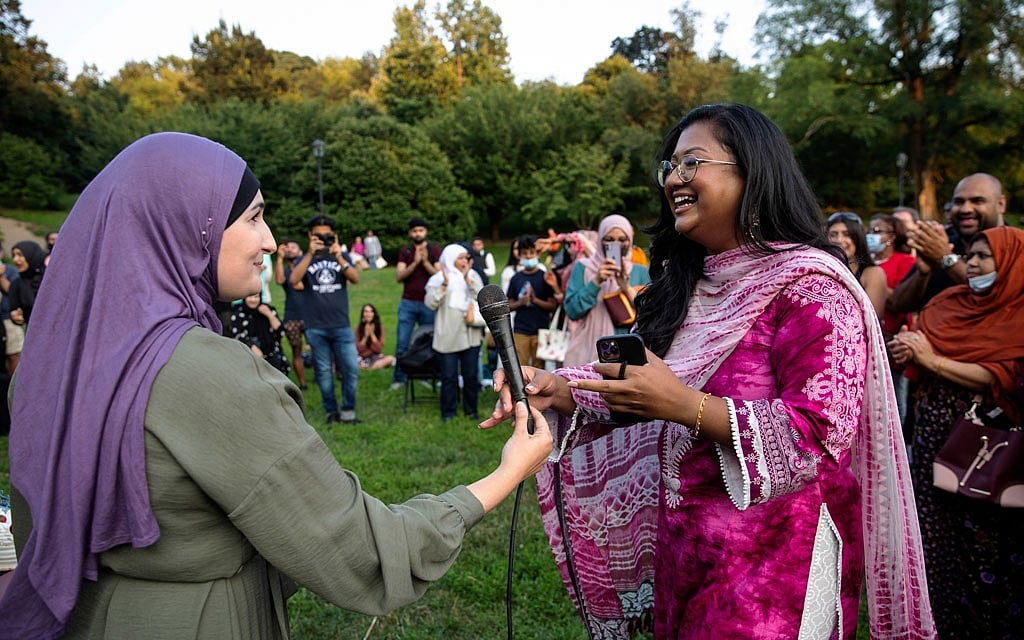
Activist Linda Sarsour, left, introduces Shahana Hanif, a candidate for New York City Council, at a celebration of her victory in the Democratic primary, at Prospect Park, in Brooklyn, July 31, 2021. Hanif and her peers who came of age after 9/11, were witnesses to how their communities were deeply affected by profiling, discrimination and surveillance of Muslims. (Holly Pickett/The New York Times)












