


Published : 04 Jun 2019, 03:10 PM
Updated : 17 Oct 2022, 11:41 AM


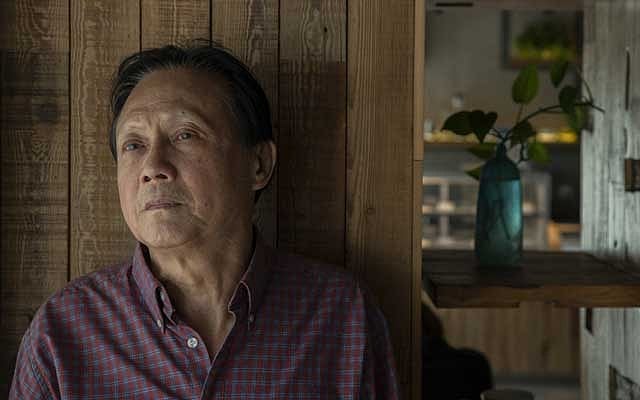
The soldiers had already shot wildly at incensed crowds when they stormed into Beijing that night under orders to clear the square by morning, and Zhou hoped to negotiate a path out for the demonstrators, many of them students. Zhou swallowed his fear and told a People’s Liberation Army officer: “Enough blood has flowed; there must not be any more.”
Zhou was one of four young intellectuals who helped save lives by negotiating the evacuation of protesters from the square. Thirty years later, Zhou, 72, is among the few prominent actors from the protests who remain in China and continue to defend the hopes of the 1989 movement, even while agonizing over its lessons.
Zhou often ponders the choices he made that culminated in the escape from Tiananmen Square. His life, closely watched by the state security officers, has become a difficult vigil for the democratic ideals that electrified the protests 30 years ago, he said.
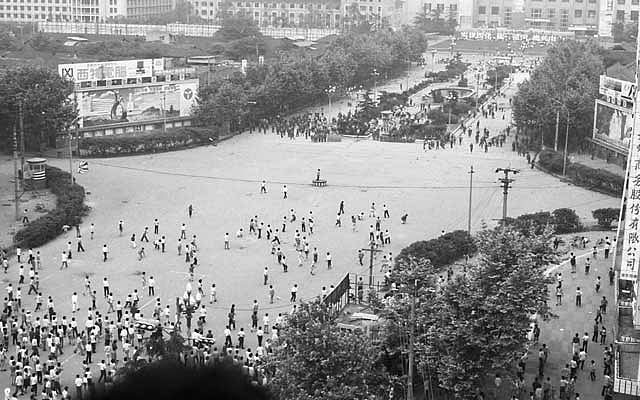
An undated photo provided by Andy Levin shows protesters squaring off with members of the People’s Armed Police in the southwestern Chinese city of Chengdu in the spring of 1989. On June 4, a government crackdown started in that city, as it had in Beijing and elsewhere. As a student, Rep. Andy Levin of Michigan experienced firsthand the bloody crackdown against pro-democracy demonstrators. (Andy Levin via The New York Times)
“I’ve felt increasingly isolated,” Zhou said in an interview in Beijing before the 30th anniversary of the Tiananmen crackdown. “Not many people care about June 4; young people don’t even know about it.” He was speaking in a cafe in north Beijing where other customers, eyes often fixed on their phones, seemed a world away from the talk of demonstrations and bloodshed.
Zhou’s daily reality is a stark reminder of how successfully China’s ruling Communist Party has married economic growth with authoritarian rule over the past three decades, resoundingly rejecting calls for greater political freedom.
But even more unexpected to Zhou were the troubles in Western countries that he admired as models of liberal democracy. The political divisions under President Donald Trump and Britain’s Brexit shambles showed that even mature democracies could fall prey to dangerous populism and demagoguery, Zhou said.
“Taking it all in, you don’t see any bright spots,” he said.
In 1989, Zhou was part of the “Four Gentlemen of Tiananmen,” a nickname for the group who went on a hunger strike during the demonstrations and later helped evacuate the square.
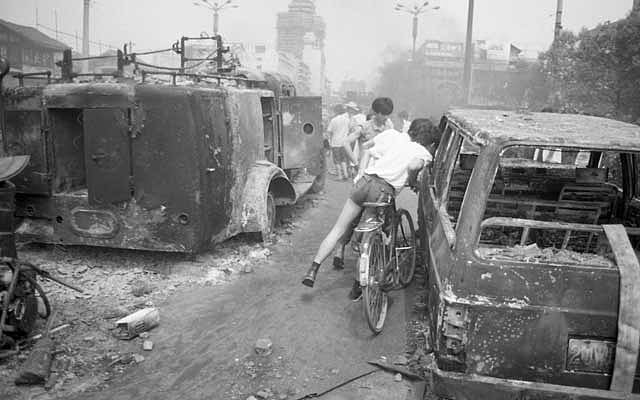
An undated photo provided by Andy Levin shows burned cars after protests and a police crackdown in the southwestern Chinese city of Chengdu in the spring of 1989. On June 4, a government crackdown started in that city, as it had in Beijing and elsewhere. As a student, Rep. Andy Levin of Michigan experienced firsthand the bloody crackdown against pro-democracy demonstrators. (Andy Levin via The New York Times)
Zhou spent nearly a year in detention after the 1989 crackdown, but even after his release, he is closely watched. “Now I wonder if I’ll have to live in this big prison indefinitely,” Zhou said before security police spirited him away for the anniversary.
In recent weeks, police have taken away or put under house arrest dozens of dissidents and political activists, according to human rights groups. Among them are the organizers of Tiananmen Mothers, a group of family members of people killed or maimed in the crackdown, which issued 23 video statements from relatives who urged the Chinese government to seek forgiveness for the killings.
“Thirty years have passed, and I feel that this brutal atrocity that took place under the gaze of the entire world should have been addressed long ago,” Zhang Xianling, whose teenage son, Wang Nan, was shot dead near Tiananmen Square, said in one of the videos. “This was a crime of the state.”
The Tiananmen protests erupted in April 1989, when students gathered to mourn the death of Hu Yaobang, a reform-minded Communist Party leader. Their commemorations grew into a six-week-long movement, with hundreds of thousands pouring onto the square to demand greater political freedoms and an end to corruption.
Zhou knew how brutal China’s politics could be. His family suffered persecution under Mao. But he also had a lot at stake in China’s future. He had worked with a famed sociologist at Peking University and then moved to a management job with an innovative Beijing electronics firm.
Zhou served as an intermediary between protest leaders and moderate party officials trying to coax the students to leave the square. He formed an unlikely bond with Liu, the future Nobel Prize winner, who back then was a combative literary academic and an ardent supporter of the students. Zhou was less sure.
“From start to finish, I felt conflicted, unsure about the right thing to do,” Zhou said of the protests.
Then, on the night of June 3, the People’s Liberation Army swarmed into the city, and word of mass carnage reached Tiananmen Square. Time was pressing; the troops had orders to reclaim the square in hours. Zhou and his three friends tried to organize the remaining protesters to leave, but getting out was dangerous, and some wanted to stay and fight.
Zhou and Hou, the musician, approached the soldiers to negotiate. Zhou begged for time and a passage to allow the protesters to leave safely. An officer agreed. Near dawn, thousands of students and residents filed off the square, some in tears, some singing or shouting defiant slogans.
“A river of blood was about to flow on the square,” Zhou wrote in his memoir. “If this wasn’t a miracle, what was?”
After his year in detention following the crackdown, he tried his hand at philanthropy, but authorities made it impossible for him to keep running a charity to support poor rural teachers.
Over the past three decades, Zhou has traveled abroad, including as a visiting scholar at Harvard. But the police restrictions he faced in China cut off the chances of a new career in business or teaching. Occasionally, he would weigh in on discussions about the lessons of Tiananmen.
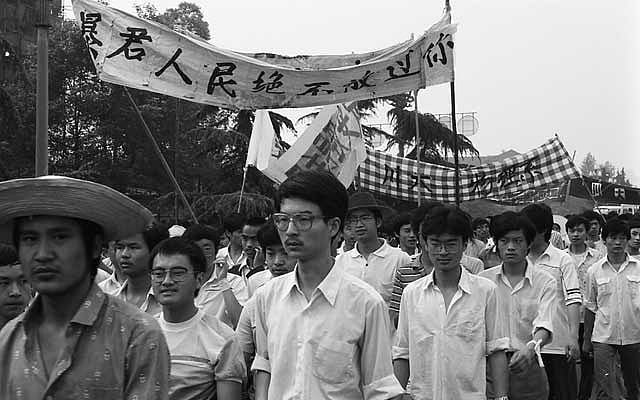
An undated photo provided by Andy Levin shows demonstrators carrying a banner that reads: “Tyrant, the people will not let you get away with this,” in the southwestern Chinese city of Chengdu in the spring of 1989. On June 4, a government crackdown started in that city, as it had in Beijing and elsewhere. As a student, Rep. Andy Levin of Michigan experienced firsthand the bloody crackdown against pro-democracy demonstrators. (Andy Levin via The New York Times)
With age, he has become more cautious about the pathway for democracy in China.
China’s middle class has grown and many wealthier people travel abroad, but that has not brought the tilt against party control that many liberals hoped for. China’s business and intellectual elites were too compromised to challenge the party, Zhou said.
“There are no domestic forces that can keep in check the Communist Party,” he said. “Its powers of control and repression, and now with the internet, high-tech, big data, artificial intelligence, facial recognition — well, the future looks more like 1984.”
Zhou thinks China should pursue gradual political change leading to legal limits on power and greater political diversity. When citizens are better off and politically mature, the country will be ready to evolve into a liberal democracy, he said.
“Even if a revolution overthrows the Chinese Communist Party and establishes a liberal democratic order, could it work?” he said. “It will certainly be a tortuous, slow and difficult process.”












