


Published : 28 Oct 2019, 09:09 AM
Updated : 08 Apr 2022, 02:28 PM


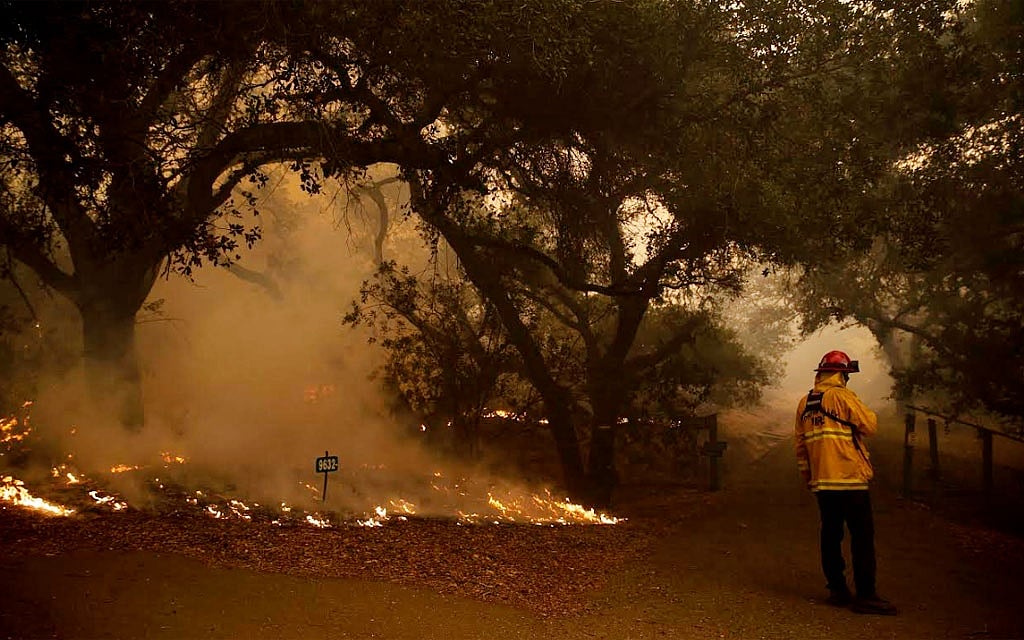
The Kincade Fire, the largest of more than a dozen wildfires now active up and down the state, has burned more than 30,000 acres since Wednesday night in Sonoma County, north of San Francisco, and was only 10% contained Sunday morning. Local authorities have ordered more than 180,000 people to evacuate.
“We are deploying every resource available and are coordinating with numerous agencies as we continue to respond to these fires,” Newsom said, noting that more than 3,000 firefighters were battling the Kincade Fire alone.
Nearly 1,000 more firefighters are working to contain the Tick Fire in Southern California, which burned more than 4,600 acres Sunday morning and threatened thousands of homes in Los Angeles County.
At least two new vegetation fires were sparked Sunday, one covering 600 acres in Tehama County, 100 miles north of the Kincade Fire, and one affecting 100 acres near the northern tip of Contra Costa County in the San Francisco Bay Area.
Californians far beyond the immediate areas of the fires are being affected, as one of the state’s main power utilities, Pacific Gas and Electric, shuts off power to nearly 1 million homes and businesses to prevent its lines and equipment from sparking new fires in the dry, windy conditions. Many people who fled the Kincade Fire were leaving behind dark houses where the electricity had already been shut off.
“It is critical that people in evacuation zones heed the warnings from officials and first responders, and have the local and state resources they need as we fight these fires,” Newsom said.
About 180,000 people have been ordered to evacuate.
Emergency responders greatly expanded the mandatory evacuation zone Sunday morning, more than doubling the number of residents who have been told to flee the Kincade Fire north of San Francisco.
The expanded evacuation zone now covers about 180,000 people, the Sonoma County Sheriff’s Office said. “This is the largest evacuation that any of us at the Sheriff’s Office can remember,” the office wrote on Twitter. All residents who had previously been under an evacuation warning have now been ordered to flee.
The wind continues to plague firefighters who are trying to beat back the raging blaze. Winds gusting higher than 80 mph are sending embers up to 1 mile away, leading to spot fires that can quickly grow if they are not extinguished, especially in extremely dry conditions, officials said. A gust was clocked at 93 mph in Sonoma County.
“We’ve got rates of spread that are extremely dangerous at this point, with erratic fire behaviour,” said Stephen Volmer, a fire behavior analyst at Cal Fire.
The possibility that the fire could jump across US Highway 101 and rapidly move west is a growing fear for firefighters, given that there is more fuel and less recent experience with wildfires on that side of the highway, making the fire’s course more difficult to predict.
“That area hasn’t seen any fire history since the 1940s,” Volmer said, adding that the vegetation in that area is extremely dense, old and dry.
The Kincade Fire, which began late Wednesday night, has destroyed 79 buildings, including 31 homes, and damaged 14 more. No serious injuries have been reported.
About 90-95% of people in the mandatory evacuation zones are fleeing, said Sgt Spencer Crum of the Sonoma County Sheriff’s Office. He said deputies would not force people out of their homes or arrest them if they refused to follow the evacuation order but that “they will be on their own in the event of an emergency.”
Power shut-offs have begun that could affect nearly 3 million.
The number of customers who will have their power cut off preventively by PG&E keeps rising. On Sunday morning, the utility said it had cut power to 940,000 homes and businesses across Northern California to keep the company’s lines and equipment from sparking additional fires, and that 20,000 more would have their power cut in the coming days. That would leave nearly 3 million people intentionally without power, in the largest planned blackout to prevent wildfires in California’s history.
The company was also dealing with unplanned outages caused by high winds but said it did not have a tally of how many customers were affected by those problems.
PG&E has faced heavy criticism from lawmakers and citizens, who said the company’s infrastructure ought to be able to handle California’s windy weather and continue providing electricity to paying customers without causing fires.
Paul Doherty, a PG&E spokesman, urged customers not to take out their frustrations on field workers, at least one of whom reported that his vehicle had been shot at by someone with a pellet gun.
“We understand it’s difficult,” Doherty said. “We just ask for our customers and general public to be kind. We just ask their continued patience.”
He said workers from as far away as Florida and Canada had responded to the company’s request for 1,000 extra utility workers to assist with its growing fire prevention effort.
Authorities in several counties implored residents not to call 911 when their lights go out. The sheriff’s office in Marin, where 99% of residents were expected to lose electricity, said the county’s emergency dispatch system was already flooded with calls.
Public safety officials warned residents that it could take up to five days to restore power in Marin County and that cellular phone service could be affected by the shutdown.
“Though the weather event will end Monday, power restoration could take several days,” the sheriff’s office said.
‘Red-flag’ warnings are up for at least 30 counties.
The National Weather Service issued what is called a red-flag warning Sunday morning, saying that a combination of powerful winds and low humidity could create what it called a “historic” weather event, with a high risk of fires across all or part of at least 30 Northern California counties.
Gusts of up to 80 mph are expected in some area Sunday, making firefighting work much more difficult. Besides fanning the flames, the winds can carry burning embers beyond fire lines to new areas that are ripe for ignition because of dry conditions. Near Healdsburg, gusts as powerful as 93 mph have been recorded.
The weather service said the conditions could lead to the strongest blazes since the 2017 Wine Country fires. The deadliest of those blazes was the Tubbs Fire, which grew to 35,000 acres as it destroyed more than 5,600 buildings and killed 22 people.
Thick smoke has shut part of a major California highway.
Wind-buffeted traffic cameras captured images of fleeing Californians caught up in lengthy traffic jams on the main freeway, US Highway 101, near Petaluma in the southern portion of Sonoma County. Residents with their cars stuffed with belongings and supplies have been trying to reach relatives, evacuation centres and places that still have electric power. Most are headed south, toward Marin County and the Bay Area, but a trickle of drivers were headed north, toward the fire.
Late in the morning, the California Highway Patrol said suffocating smoke had made driving nearly impossible on a roughly 10-mile stretch of highway near the towns of Windsor and Healdsburg in Sonoma County, an area that was ordered evacuated Saturday. The agency closed that section to traffic.
Videos on social media showed terrified and frustrated drivers lined up for miles as plumes of smoke billowed over surrounding areas, with some evacuees saying on Twitter that it was taking more than two hours to drive out of the mandatory evacuation zones. Tim Noyes, an assistant chief with the highway patrol, said given the volume of traffic, it was lucky that there had been no major crashes during the evacuation.
“We still have a heavy flow this morning going southbound,” Noyes said at a news conference. He warned that traffic lights at many intersections were not working because of the power shut-offs and reminded drivers to approach those intersections as if there were all-way stop signs posted instead.
c.2019 The New York Times Company












