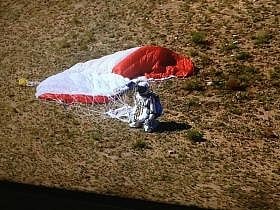
Daredevil breaks skydive record
Austrian daredevil Felix Baumgartner lands on Earth after supersonic leap from the edge of space in a dramatic, daring feat
bdnews24.com News Service
bdnews24.com
Published :
14 Oct 2012, 07:13 PM
Updated :
09 Aug 2022, 04:22 PM
Roswell, New Mexico, Oct 15 (bdnews24.com/Reuters)—Austrian skydiver Felix Baumgartner broke the record for the highest manned balloon flight on Sunday after his craft rose 23 miles (37 km) above New Mexico, project sponsors said.
The 43-year-old daredevil was inside a capsule tethered to the massive but extremely delicate helium balloon high above Roswell, New Mexico.
He aimed to set four world records, including jumping from the capsule to become the first person to break the speed of sound in a skydiving freefall.
Cheers broke out as the craft carrying Felix Baumgartner took flight at 1530 GMT (9:30 Bangladesh Standard Time). An enormous balloon rose into the air, pulling after it an 11-by-8-foot (3.3-by-2.4 metre) fiberglass and acrylic capsule.
His mother wept as she watched the launch, which had been scrapped several times during the previous week by high winds.
"We practiced a lot and now it's paying off," Baumgartner radioed from the rising capsule to his contact on the ground, project adviser Joe Kittinger, holder of a 19-mile high altitude parachute jump record that Baumgartner hopes to smash.
Checking through an equipment list from his seat in the pressurised capsule, Baumgartner, 43, expressed concern that his astronaut-like helmet was not heating properly.
"This is very serious, Joe," said Baumgartner as the capsule, designed to remain at 55 degrees Fahrenheit ascended in skies where temperatures were expected to plunge below -91.8 F (-67.8 C), according to the project's website. "Sometimes it's getting foggy when I exhale. ... I do not feel heat."
Baumgartner's ascent into the stratosphere took 2 1/2 to three hours. The descent lasted just 15 to 20 minutes, more than half of it beneath the relative safety of his parachute's canopy.
The 30 million-cubic-foot (850,000-cubic-metre) plastic balloon, is about one-tenth the thickness of a Ziploc bag, or roughly as thin as a dry cleaner bag.
Baumgartner aimed to break a high altitude parachute jump record set in 1960 when Kittinger, 84, now a retired US Air Force colonel, jumped from a balloon flying 102,800 feet (31,333 metres) and fell for 4 minutes and 36 seconds before opening his parachute.
Baumgartner hoped to top that with a jump from 120,000 feet and freefall for 5 minutes and 35 seconds.
There is so little air in the upper reaches of the atmosphere that after about 30 seconds of freefall, Baumgartner needed to be moving faster than the speed of sound, which is roughly 690 mph (1,110 kph) at that altitude.
Among the risks Baumgartner faced is the chance that his supersonic body will trigger shock waves that could collide with the force of an explosion. But Baumgartner's medical team did not believe this situation is very likely because the air in the stratosphere would be too thin to carry the waves.
Baumgartner stayed supersonic for about a minute before hitting a thicker part of the atmosphere, slowing his fall.
No human had previously broken the sound barrier during freefall, at least not intentionally. On Jan. 25, 1966, Bill Weaver, a US test pilot aboard an SR-71 Blackbird aircraft, was ejected from his damaged plane at Mach 3.18 — more than three times faster than the speed of sound — and survived.
"It goes to show there are still challenges to overcome and you should never lose sight of trying to achieve them," Baumgartner said in an interview posted on the project's website .
Energy drink manufacturer Red Bull is sponsoring the skydive. The firm declined to disclose how much the project or its advertising campaign would cost.
Besides breaking several records, including highest-altitude freefall, longest freefall and highest manned balloon flight, Baumgartner and his team hoped the jump will help engineers working on spacesuits for NASA and the budding commercial space tourism industry.
One company, Virgin Galactic, an offshoot of Richard Branson's London-based Virgin Group, expects to begin passenger suborbital spaceflights in late 2013 or 2014. SpaceShipTwo, the first of Virgin's planned fleet, is undergoing testing in Mojave, California, and is expected to make its first foray beyond the atmosphere before the end of the year.
When Baumgartner jumped from a capsule beneath the balloon, the position of his body was crucial, since there was no air in which he could reposition himself. If he fell in a way that put him into a rapid spin, Baumgartner could have pass out and damaged his eyes, brain and cardiovascular system.
Baumgartner's safety gear included a custom spacesuit to protect him from the low pressure and the extreme cold.
Temperatures were expected to be as low as about minus-70 degrees Fahrenheit (minus 57 degrees Celsius). The near-vacuum put him at risk of ebullism, a potentially lethal condition in which fluids in the body turn to gas - literally blood boiling. Severe lung damage could have occurred within minutes.
bdnews24.com/bd/0048h