


Published : 16 Jan 2021, 09:23 PM
Updated : 08 Apr 2022, 12:43 PM


A survey by The New York Times of all 50 states found at least 10 — California, Oregon, Michigan, Wisconsin, North Carolina, Washington, Kentucky, Maine, Illinois and Florida — that are activating National Guard troops in their capital cities. Texas, Virginia and Kentucky are among states planning to close their Capitol grounds at different points in the coming days.
Some states where legislatures are preparing to convene, such as New Mexico, have placed protective fencing around their Capitols. Michigan and Indiana took the extraordinary step of cancelling their legislative activities next week because of the possibility of violence.
The moves by state officials point to the growing fear over continuing violence around the country in the aftermath of the mob attack last week on the US Capitol in which assailants supporting President Donald Trump’s efforts to overturn the presidential election forced their way inside the building.
“If you’re planning to come here or up to Washington with ill intent in your heart, you need to turn around right now and go home,” Ralph Northam, governor of Virginia, said at a news conference Thursday. “You are not welcome here, and you’re not welcome in our nation’s capital. And if you come here and act out, Virginia will be ready.”
Virginia officials took the unusual step of closing the grounds of the Capitol Square on Monday in Richmond, where an event called Lobby Day is held each year to allow people to meet with elected representatives. An estimated 22,000 attended the event last year, many of them gun-rights activists. This year, in addition to closing Capitol Square, authorities canceled permits for the planned Lobby Day gatherings.
An example of how volatile the situation has become emerged Friday in Florida, where the FBI arrested a former US Army Airborne infantryman, Daniel Alan Baker, 33, of Tallahassee, the state capital. Baker “specifically called for others to join him in encircling any protestors and confining them to the Capitol complex using firearms,” the FBI said in an arrest report.
John Dailey, mayor of Tallahassee, called Friday for Gov. Ron DeSantis of Florida to activate the National Guard in preparation for the protests this weekend. Not long after, DeSantis, a Republican, announced that he was activating the Guard “in response to reports of potential civil unrest.”
Concerns are particularly high in Michigan, where Gov. Gretchen Whitmer activated the Michigan National Guard to help with security around the state Capitol in Lansing. The move followed the flooding of Michigan’s Capitol last year by armed extremists protesting the state’s coronavirus restrictions.
Fourteen people were charged in Michigan on terrorism, conspiracy and weapons charges. At least six of them, officials said, had hatched a detailed plan to kidnap Whitmer, a Democrat who became a focal point of anti-government views and anger over coronavirus control measures.
In Lansing, a 6-foot high fence has been erected around the state Capitol and windows of state office buildings boarded up to guard against potentially violent protests that are expected Sunday and Wednesday.
The state Legislature, which just had its first session of the year and had been scheduled to meet several times next week, cancelled those sessions after hearing about “credible threats” received by Michigan State Police.
The increased law enforcement presence will continue through at least mid-February, said the Michigan State Police director, Col. Joe Gasper. He declined to reveal how many more police and National Guard members would be in place to guard against violence.
Still, not every state sees the need for increased security. In North Dakota, for instance, Kim Koppelman, a Republican who is the speaker of the state’s House of Representatives, said, “Suffice it to say that security is in place and adequate to meet any challenges anticipated.
“No major changes have been implemented in response to riots, property damage and attacks around the nation last year, nor in response to violence at the US Capitol last week,” Koppelman said.
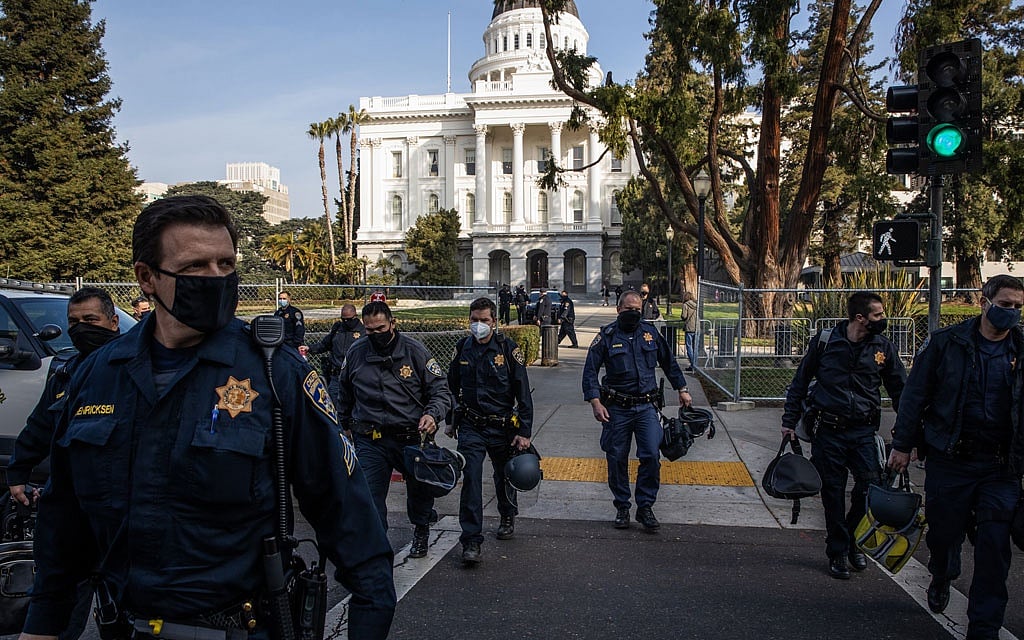
But other states are taking different steps. Gov. Gavin Newsom of California on Thursday authorised the deployment of 1,000 National Guard troops and surrounded the state Capitol grounds in Sacramento with a 6-foot, covered chain-link fence to “prepare for and respond to credible threats.”
In Illinois, Gov. J.B. Pritzker has activated 250 members of the National Guard in response to warnings issued by the FBI about the potential armed protests, in addition to the 300 Illinois troops already activated in support of the inauguration in Washington.
Illinois officials said their aim was for soldiers to help local authorities in enforcing street closures and designated perimeters.
“Our soldiers and airmen come from every community across Illinois, and each has sworn to protect their communities, their state and their nation,” said Maj. Gen. Rich Neely, adjutant general of Illinois and commander of the Illinois National Guard.
©2021 The New York Times Company












