


Published : 27 Feb 2022, 11:00 AM
Updated : 21 Oct 2022, 03:37 PM


For many Americans, Russian President Vladimir Putin’s invasion of Ukraine this past week was appalling but abstract: a violent but far-off clash whose heart-rending images and geopolitical implications could be made to disappear with the closing of a screen or the click of a remote.
But others across the United States watched with an intimate sense of foreboding. Their families and friends, memories and hopes are bound up in different ways with the country whose capital was being rocked by missile strikes Friday.
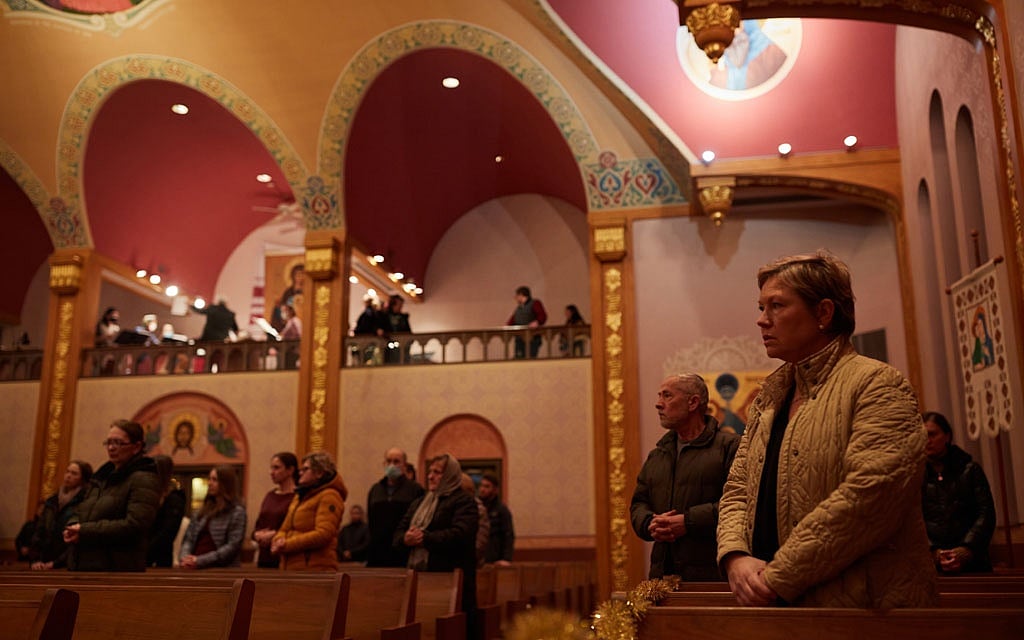
In Parma, Ohio, it is the first thing the Very Rev John Nakonachny thinks of each morning, he said. He recalled a young woman attending services at his church, St Vladimir Ukrainian Orthodox Cathedral, who was in such shock and sadness for her parents in Ukraine that she could barely speak.
He remains appalled by the idea of Orthodox Christians being forced into battle against one another.
“These soldiers lying in the snow, I bet all of them had a crucifix around their necks,” he said. “Brothers killing brothers, Christians killing Christians.”
Other vantage points awakened strains of unease: A Taiwanese American family in Atlanta felt anxious about what the invasion meant for their future. A North Carolina father wondered about the fate of his adopted daughter’s unknown siblings. And a 100-year-old Holocaust survivor in Texas was transported back to her own ordeal fleeing Poland.
‘I HURT FOR THEM’
Ruth Salton, 100, who watches CNN and reads the newspaper every morning on her iPad, has watched with alarm as familiar images appear on the screens: civilians fleeing their homes, separating from their families, running in the streets.
Salton, who is Jewish, fled her home in Poland in 1939 and eventually landed in a remote labour camp in Siberia, where she performed hard labour for a year. After the war, she joined an underground movement to help Jewish Holocaust survivors escape to what is now Israel. She made her way to the United States and now lives in suburban Dallas with her daughter’s family.
“I feel for them, I hurt for them, and I exactly know how they feel,” Salton said. “We were running, we were on trains, it was the same thing. You do not know how it feels when you have to run and to be afraid. The worst thing in life is not death; it’s being frightened.”
Putin has pledged to “denazify” Ukraine, a move that has been criticized as an attempt to justify his attack on Ukraine’s democratically elected government. Ukrainian President Volodymyr Zelenskyy is Jewish and has relatives who were killed by Nazis in the Holocaust.
Salton’s daughter is the founding president of Congregation Beth Israel, the synagogue in Colleyville, Texas, where a gunman took four hostages last month. Salton was not in the synagogue that day but attended services on the eve of her 100th birthday — less than a week after the hostage situation.
“I think the whole world should stand up and fight for freedom,” she said. “If we don’t help them, who will?”
‘I haven’t met one Russian that is for war.’
Michael Von Shats, known as Misha, was worried Friday evening as he sat in the upstairs lounge of the Russian Samovar, the landmark restaurant in Manhattan that his family has run since 1986.
The elaborately decorated restaurant was once a haven for people fleeing the Soviet Union.
On Friday, a Ukrainian flag was taped to the front door, and a printed sign read, “Stand by Ukraine — NO WAR.”
His mother is Russian, from St Petersburg, while his father is Ukrainian, from Odessa. The 31-year-old grew up in the restaurant, which employs many people from the former Soviet Union, including Ukrainians worried about the safety of family members back home.
“Right now we’re showing solidarity — no war, we want peace,” he said. “I haven’t met one Russian that is for war.”
He recently removed a bust of Putin from the dining room since it was upsetting to some who saw it, he said.
But he is also concerned that people will vilify all Russians when, he said, the restaurant brings together people from all over the former Soviet Union. He was waiting to see if business would be down over the weekend, if people would reflexively avoid anything Russian.
‘WE'VE ALWAYS WONDERED'
In North Carolina, Glenn Jonas recalled the emotional three weeks he spent in Kyiv, the Ukrainian capital, and Odessa in 2001, when he and his wife and their 5-year-old daughter traveled to the country to adopt their younger daughter, Gracie. The infant was living in an orphanage and weighed only about 7 pounds at 3 months old, he said.
The orphanage director placed the little girl in Jonas’ arms first, and it was “love at first sight,” he said. “I’m not a person who believes in destiny, but I do have a sense of God’s plan.”
Although the Jonases have never traveled back to Ukraine as a family, Glenn Jonas follows the news closely and feels connected to the country through his daughter. He knows almost nothing about her birth family.
“We’ve always wondered if she had siblings,” he said. “If she had siblings and if they were boys, they would be in the military right now. You think about these things. This has impacted us more deeply than I would have thought.”
His daughter is 21 and a college student at Campbell University in Buies Creek, North Carolina, where Jonas is a professor of religion and an associate dean. He is also the interim pastor at a small Baptist church, where congregants have been praying for the soldiers from nearby Fort Bragg who have recently been deployed to Poland. His daughter’s boyfriend, a member of the US Army’s 82nd Airborne Division, is among them.
‘What would the US do now?’
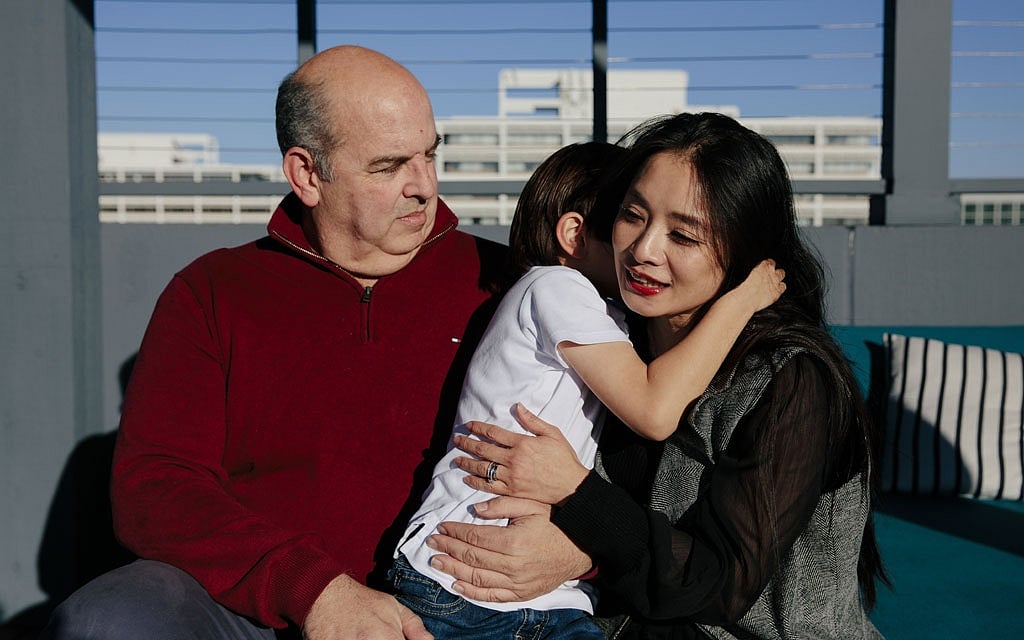
From Atlanta, Sheryl Chen and Doug Weinstein have watched with disbelief as Russian troops advanced on Ukraine. They feel for innocent Ukrainians swept up in a senseless war, they said. But they are also troubled by the incursion for another reason: Putin’s military aggression toward Ukraine could embolden his ally, President Xi Jinping of China, to invade Taiwan, where is Chen is from.
The couple had planned to spend the summer in Taiwan so that their 6-year-old son, Daniel, could practice Mandarin while enjoying his grandparents’ company.
“What happens if we are over there and China decides to invade?” said Weinstein, who is a lawyer.
Instead, they are considering for the first time whether they should help Chen’s parents, who have a successful business in Taiwan, immigrate to the United States.
For now, they are closely watching how far the United States will go to defend Ukraine, and what signal that might send to Xi, who has asserted that it is a foreign policy imperative for China to regain control of Taiwan, which it claims is part of a unified nation.
Chen wondered whether President Joe Biden would deploy battleships to international waters near Taiwan like former President Bill Clinton did before the self-governing island held its first direct presidential election in 1996. The US response came after China held military exercises and fired missiles near Taiwan.
“China is more powerful economically and militarily than ever,” Chen said. “What would the US do now? I am scared for my friends and relatives.”
‘YOU WAKE UP, YOU CHECK’
In Evanston, Illinois, when the notification popped up on his phone Wednesday that Russia was invading Ukraine, Alex Telischak, 42, rushed to turn on the news and then quickly called his wife’s parents. They live in the western Ukrainian city of Ternopil, and he and his wife worried they might not be able to contact them again for an unknown amount of time if phone lines or internet service failed.
“That’s emotionally difficult for both parties,” he said. “You are not saying goodbye, but it is almost like that, because you don’t know when the conversation might continue.”
His wife’s parents are among the 130,000 Jehovah’s Witnesses in Ukraine. In 2017, Russia banned the denomination, whose members believe in nonviolence and refuse to take up arms in war; Russia called it an extremist group. Since then, some 1,700 Witnesses’ homes in Russia have been raided, and about 320 Witnesses have been imprisoned, including a crackdown in Crimea, according to the denomination’s statistics. Telischak did not dare to venture a guess as to what could happen in Ukraine.
The couple tried to not watch too much news to avoid getting too upset, he said. When it was time to sleep, they kept looking at Viber, the messaging app they use to communicate with their family.
“You go to bed, you check. You wake up, you check,” he said. “We told them, ‘Anything, you text, you call, whatever the time is.’”
On Thursday afternoon, his wife got a message that an air raid siren had gone off and that her parents fled their old concrete-style building. Outside, a member of their Jehovah’s Witness congregation was drove by, and they piled into his car. Men from their congregation had been checking on them and others for weeks, making sure everyone had a go-bag, flashlights, water and a plan.
If the parents had to leave the country as refugees, Telischak trusted other Witnesses would take them in.
“Having a community, or a religion that is borderless, that is a tremendous comfort to us,” he said.
He has been finding comfort in the Gospel of Matthew, in which Jesus told his disciples not to fear when there would be wars and rumors of wars, when nation would rise against nation.
“We also understand the Bible foretells a time when all this goes away, when there won’t be these wars anymore, there won’t be these conflicts between nations, and enmity and strife,” he said. “The disciples weren’t asking because they wanted to know when things would get really bad. They wanted to know, when was the solution, when was the fix going to come.”
© 2022 The New York Times Company












