


Published : 23 Aug 2020, 11:52 PM
Updated : 27 Jul 2022, 02:08 PM


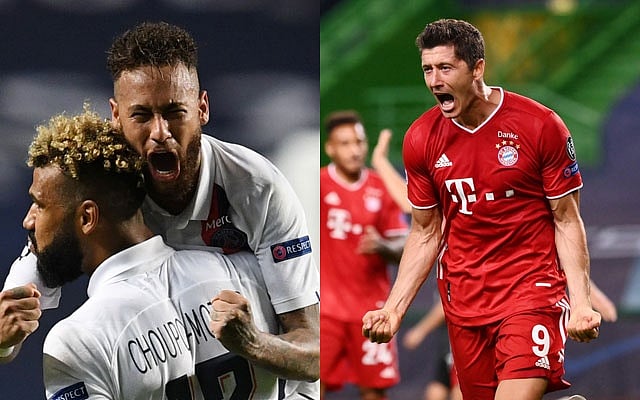
Bayern is chasing its sixth Champions League title, but its first since 2013. PSG is appearing in the final for the first time and is hoping to become only the second French club — after Olympique Marseille in 1993 — to lift the trophy.
“This is exactly why I came here,” PSG’s French striker Kylian Mbappé told reporters Saturday. “I have always said that I wanted to make history for my country. This is a chance.”
The final will be played at Benfica’s Estádio da Luz in Lisbon, which, along with Sporting’s stadium in the city, has been the home base of this month’s pandemic-condensed Champions League knockout round.
Bayern Munich has already thumped Barcelona and another French club, Lyon, in Lisbon. PSG’s star-studded, Qatari-financed team advanced with a late rally against Italy’s Atalanta and a comprehensive dismissal of Germany’s second-best entry, RB Leipzig.
Here’s what you need to know ahead of Sunday’s match.
How can I watch?
Sunday’s game will be broadcast in the United States on the CBS Sports Network and, in Spanish, on Univision. Television coverage begins at 2:30 p.m. Eastern but — and this may be important as you schedule your day — kickoff is at 3 p.m.
How did the teams get here?
Sunday’s game is a throwback of sorts: the first meeting in the final since 1998 of teams who entered the tournament as domestic champions.
That is, of course, how it used to be in the days of the old European Cup, when you had to win your home league just to gain entry to the competition. The creation of the Champions League in 1992 changed all of that, opening the door to extra teams (from the big leagues, mostly) and extra revenues but also setting the stage for all-Italian, all-German, all-Spanish and all-English finals.
Tradition is still a powerful force — PSG has won seven straight French titles, and Bayern Munich eight in a row in Germany — but you take your nostalgia where you can.
Bayern Munich emerged from the group stage an easy winner over Tottenham, Olympiakos and Red Star Belgrade. In the knockouts, it easily dispatched Chelsea (7-1 on aggregate), Barcelona (8-2 — ouch!) and Lyon (3-0). Bayern is 10-0 in this year’s competition.
PSG also cruised out of the group stage, producing five wins and a draw in a group that included Real Madrid, Club Brugge and Galatasaray. It overcame a first-leg deficit to oust Dortmund in the round of 16 and then rallied — with two goals after the 90th minute — to beat Atalanta, 2-1, in its quarterfinal in Lisbon. RB Leipzig went much easier (3-0) in the semifinals Tuesday.
Unlike Bayern, which can field a handful of players who were present when it won the competition in 2013, PSG has never played in the Champions League final before this season.
Help me look smart when I’m with my friends later.
The Times’ chief football correspondent, Rory Smith, can help you with that. Here’s his preview:
There is no such thing as a bad Champions League final. This is the culmination of the European season, after all, the single biggest club game of the year (and possibly the biggest annual sporting event on the planet, Super Bowl included). When the stakes are that high, the drama and the tension are inherent.
But that doesn’t mean all Champions League finals are good. Some are overwhelmed by their own significance, and the game itself is dour and cautious and inhibited: Think 2003, when AC Milan and Juventus produced 120 minutes of football so bad that both teams should have been disqualified, or even last year’s effort between Liverpool and Tottenham.
Many turn into exhibitions, where one team is so obviously superior to the other that the outcome starts to feel preordained: Barcelona, say, in 2009, 2011 and 2015, or Real Madrid in 2017 and 2018.
The true classics are the exceptions: In recent years, perhaps only Liverpool’s extraordinary win in 2005, Chelsea’s remarkable resistance in 2012 and Bayern’s most recent victory, in 2013, could justify that description.
Despite the eeriness of an empty stadium and the fact that it is August, there are reasons to believe that 2020 might earn a place in the canon. Both Bayern and PSG have star quality: Lewandowski and Davies, Neymar and Mbappé. And the two teams have many other similarities: Both are national champions who play on the front foot, and both are as happy in possession as they are dangerous on the counterpunch. Also, both have very little recent experience of losing, boast fearsome attacks and, certainly in Bayern’s case, have slightly questionable defences. PSG has been built to win this tournament; Bayern is on the cusp of a domestic and European treble.
Bayern’s imperious form — particularly that dismantling of Barcelona — has been enough for most to assume the German team is the favourite, but PSG will have seen the chances created by Lyon in the semifinals (and even by Barcelona before its collapse) and will have taken heart. Neither team is without its flaws. Both teams have an abundance of strengths. That is precisely how a Champions League final should be poised. There is never a bad one. This should clear that bar with ease.
Isn’t this game usually played in the spring?
Yes. But like so many things this year, the coronavirus pandemic changed that.
The Champions League final was originally scheduled for May 30 in Istanbul, but when the tournament ground to a halt in March, halfway through the round of 16, tournament organisers had to draw up a new plan. After some intense lobbying, Turkey was out (Istanbul will get next year’s final) and Portugal was in. Two weeks in Lisbon would decide the biggest prize in European football.
In fact, as Tariq Panja and Smith of The Times reported this month, the entire format was scrapped and reshaped to suit new needs: isolation, testing, speed and — perhaps most of all — TV. There were rules about where to stay and how many bottles of water would be provided and even where players could warm up, and where they absolutely, definitely could not.
“The entire knockout round, in fact, is an abrupt break from history,” they wrote, “and not one UEFA — the competition’s organiser, and European football’s governing body — is eager to repeat.”
Instead of months of travel and matches, the eight quarterfinalists gathered in Lisbon for two weeks of knockout games. Four clubs went home within days, and while UEFA seemed to have a policy in place for any possibility — including positive tests — it appears to have navigated the schedule without incident.
©2020 The New York Times Company












