Published : 26 Sep 2026, 01:51 AM
Updated : 26 Sep 2026, 01:51 AM


Bangladesh is no longer facing only the trafficking of its citizens into cyber scam centres abroad. It is also at risk of becoming a hub for the international networks running the fraud.
That warning emerges from a regional report by the United Nations Office on Drugs and Crime, or UNODC, released in Dhaka last Wednesday in partnership with the Ministry of Home Affairs.
The report, titled “Trafficked to Scam: South Asian Responses to Trafficking in Persons for the Purpose of Forced Criminality in Scam Operations”, examines the situation in five South Asian countries, including Bangladesh.
It was published under the European Union-funded project “Preventing and Addressing Trafficking in Human Beings and Smuggling of Migrants in South Asia (2024–2027)”.
According to the report, Bangladesh, Bhutan, the Maldives, Nepal, and Sri Lanka are all now affected by this emerging form of human trafficking.
The findings are based on research and information provided by 103 victims.
UNODC says Bangladesh, Nepal, and Sri Lanka are no longer merely major source countries for people trafficked into cybercrime operations. They are also at risk of developing into new centres, or “hubs”, for the networks themselves.
Two ‘Rings’ Busted in One Month
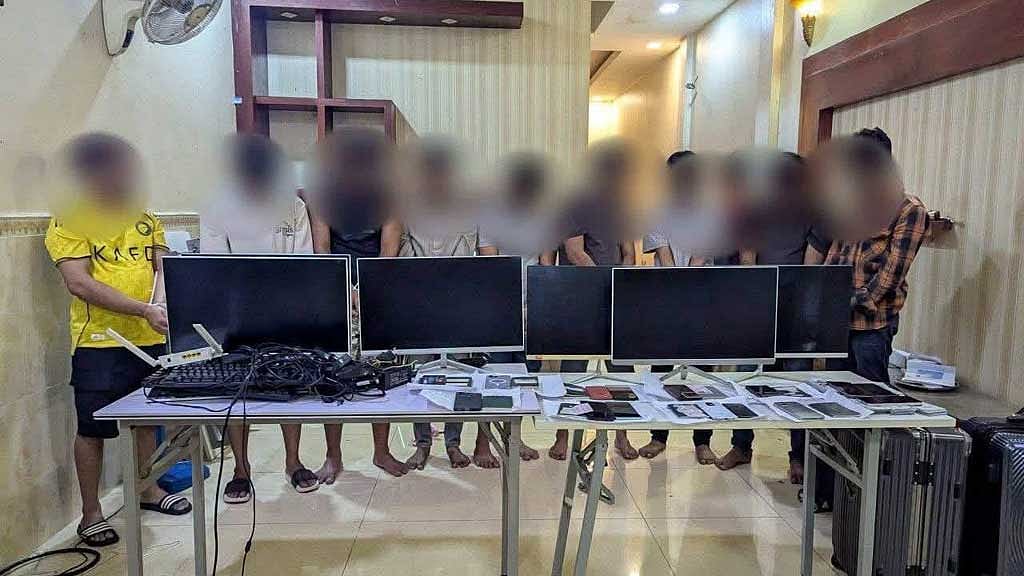
Police have detained members of two alleged international cybercrime networks in Cox’s Bazar and Chattogram this month alone.
On Sept 10, they raided a seven-storey building in the Krishnachura residential area of Chattogram’s Khulshi and arrested 63 foreign nationals, including 20 women.
Those detained were citizens of China, Pakistan, Laos, Nepal and Vietnam.
Police said the group had been setting up “online fraud” operations targeting people globally.
Investigators say the network selected Bangladesh because it regarded the country as a “convenient” base.
Several police officers involved in the raid and subsequent investigation told bdnews24.com that preliminary evidence suggested the group had been opening various websites and using online marketing as a cover for fraud.
Investigators also suspect they were operating schemes resembling “honey traps”.
Police said one method involved taking orders through online shopping sites, then either supplying poor-quality products or taking customers’ money without delivering anything.
Investigators also found evidence suggesting the group had been preparing to hack websites and apps, with various devices installed in apartments in the building.
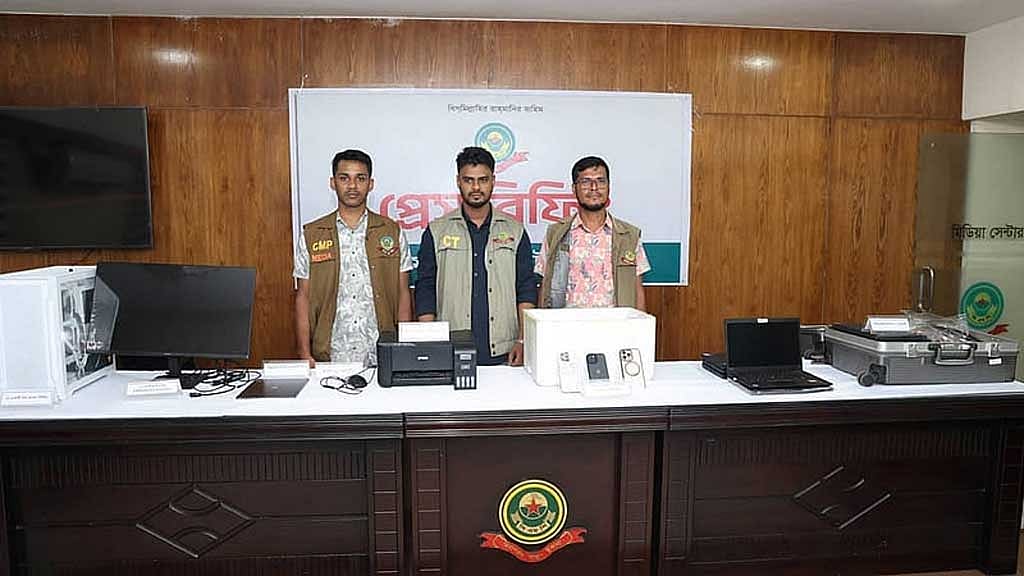
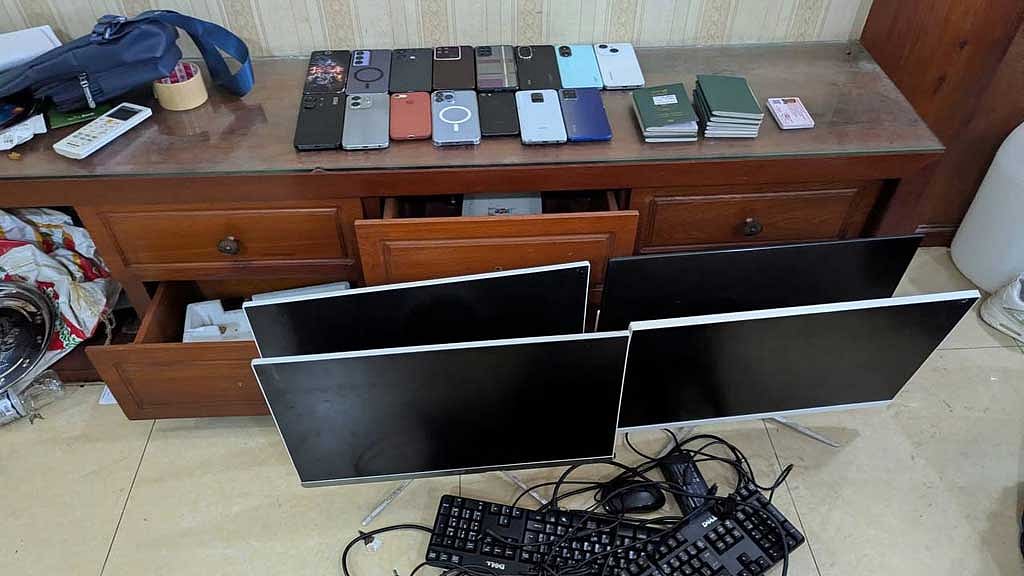
Police seized 134 mobile phones, 57 laptops, an Apple tablet, CPUs, monitors, pen drives, SIM cards, and a large quantity of other digital equipment allegedly used for fraud.
Three Pakistani national identity cards and one Cambodian identity card were also seized.
A week earlier, between the night of Sept 3 and the following morning, police raided Hotel Sea-Palace in Cox’s Bazar and arrested six Chinese nationals.
The raid recovered 1,938 iPhones, 40 laptops and communications equipment. The six were arrested in a case alleging online fraud.
The initial complaint in relation to the Chinese group in Cox’s Bazar had been filed with Ramu Police Station.
Md Monirul Islam Bhuiyan, an inspector at the police station, told bdnews24.com that the Criminal Investigation Department (CID) in Dhaka was now handling the investigation.
“The group was arrested after someone filed a complaint with the police station alleging that they were operating a cyber scam centre.”
What Does the UN Report Say?
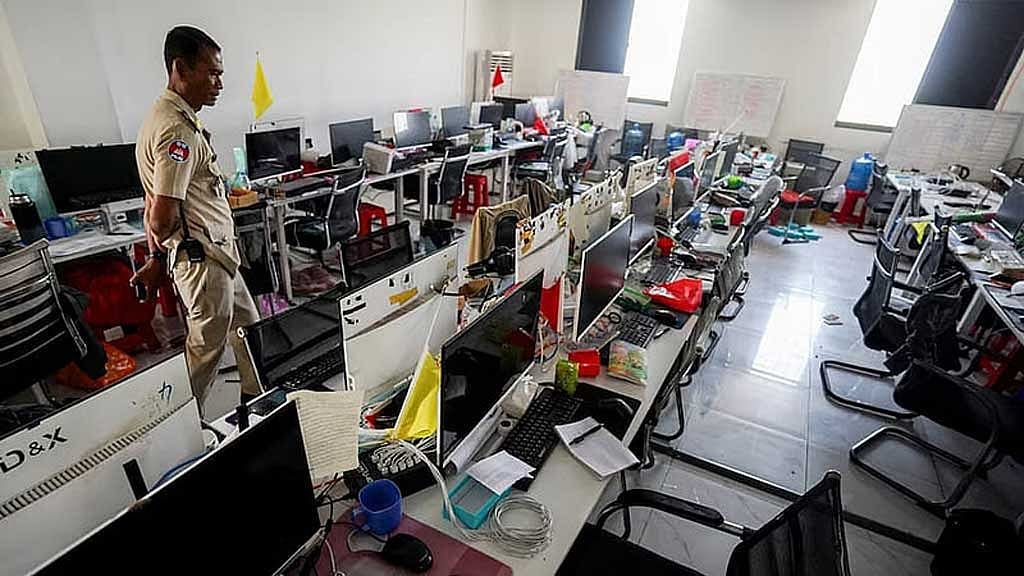
The UNODC report says young Bangladeshis are being lured to Thailand and Cambodia with promises of highly paid jobs in the information technology sector, including positions in data entry, IT support, and customer service.
One of the newer recruitment methods involves informal brokers approaching potential victims through social media and arranging for them to travel abroad on tourist visas.
Once they arrive, their passports are confiscated and they are confined in heavily guarded “scam compounds”, where they are forced to operate international cryptocurrency scams and romance fraud schemes.
UNODC says Bangladeshi victims have been identified in scam centres across Southeast Asia since 2022.
Recruitment often takes place through social media, licensed agencies or local brokers, with salaries of between $800 and $1,500 a month promised.
Families sometimes mortgage land to raise between $2,000 and $5,000 in recruitment fees.
While victims from some other countries are often highly educated, the Bangladeshis most frequently targeted tend to be less educated young men between 18 and 35 from villages and smaller towns.
Some are told they are travelling to Thailand, Canada, Australia or the United Arab Emirates, only to be taken instead to Cambodia.
The report also identifies cases in which Bangladeshi migrant workers already employed in West Asia were tempted by offers of higher salaries and later trafficked into scam centres.
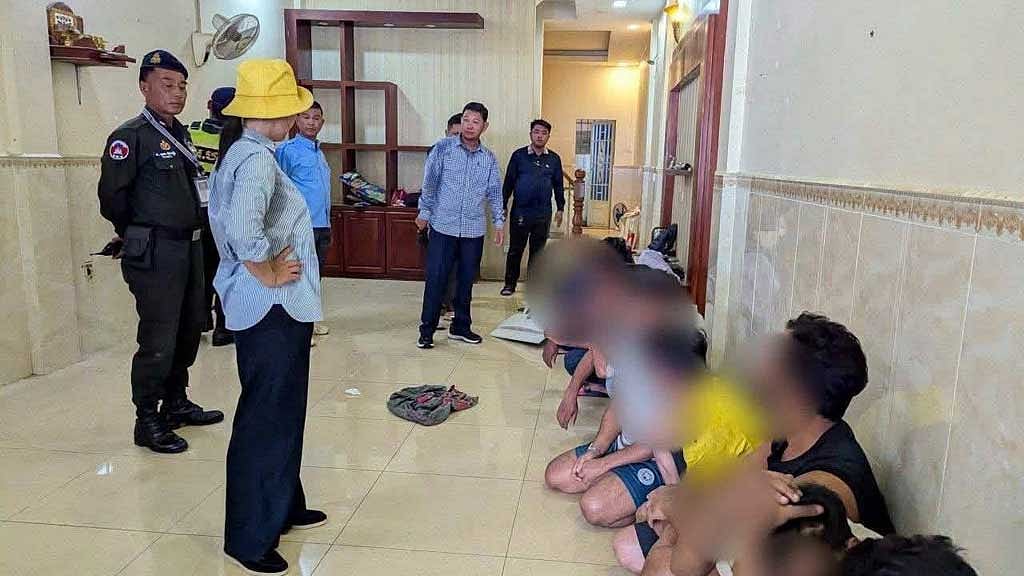
Last Saturday, reports emerged that nine Bangladeshis had been detained at a cyber scam centre in Phnom Penh, Cambodia.
Computers and other evidence were also seized there.
Meanwhile, Laos announced this week that it was suspending visas and work permits for Bangladeshis.

Young Man ‘Sold’ for $3,000
A case study involving a Bangladeshi victim included in the UNODC report illustrates the brutality behind the business.
The young man was promised an attractive job in Cambodia as a data-entry operator and IT specialist.
He travelled on a tourist visa after paying a broker $3,000. His passport was confiscated almost immediately after he arrived.
Over the next four months, he was sold to three different scam compounds.
The report, citing the victim, says he was forced to sit in front of a computer or mobile phone for 14 to 16 hours a day.
His job was to deceive people overseas, either by posing as a romantic partner or persuading them to invest in fraudulent cryptocurrency schemes.
Workers were given targets. Failure to meet them, or refusing orders, could bring severe punishment.
The victim said punishments included beatings, electric shocks and being held under water.
Scam Centre Types across Asia
UNODC identifies significant differences between how cybercrime operations are organised in Southeast Asia and how they are beginning to appear in South Asia.
In Cambodia, Myanmar, and Laos, scam operations worth billions of dollars are often run from huge compounds or special economic zones protected by armed guards, barbed wire and electrified fencing.
In South Asia, including Bangladesh, the networks tend to operate differently.
Instead of concentrating their activities inside one large compound, criminals disperse into smaller locations and operate under cover.
Scam centres and illegal online gambling networks can be hidden inside residential hotels, rented flats, private villas or even legally registered IT companies.
UNODC has also found evidence of unusually high rents being paid to landlords in exchange for secrecy.
That makes it much harder for law-enforcing agencies to identify the networks and to find trafficking victims being held inside them.
The building in Khulshi where police arrested the foreign nationals is owned by an expatriate.
The group had rented it around six weeks before the raid.
A man identified with a single name Mohsin arranged the rental, according to investigators, and police say he had links with Chinese nationals.
Shamim Hossain, deputy commissioner of the Chattogram Metropolitan Police's Counter Terrorism Unit, said investigators had established that Mohsin rented the building through another man named only as Rakib.
“We have confirmed that Mohsin rented the building through Rakib,” he told bdnews24.com.
“However, no copy of the rental agreement between the landlord and the tenants or their representative was submitted to the police station.”
Criminal or Victim?
UNODC says 74 percent of people trafficked worldwide for cyber scam operations between 2020 and 2025 were taken to Southeast Asia.
A large proportion was men aged between 18 and 40 with technological or language skills.
But the report makes an important distinction - not everyone found working inside a scam centre should automatically be regarded as a criminal.
Many are forced into online crime after being deceived, threatened and physically abused.
They may appear to be participating in criminal activity, but are in fact victims of human trafficking.
UNODC identifies a series of legal and strategic problems in addressing this form of trafficking in Bangladesh and elsewhere in South Asia.
One important principle of international human rights law is that people forced to commit crimes should be identified as victims rather than punished for offences they were compelled to carry out.
In practice, the report says, that principle is often not applied.
When law-enforcing agencies raid scam centres, people found inside can be treated immediately as offenders.
Existing anti-trafficking systems were largely designed around women and children.
As a result, adult men forced to commit cyber fraud often fall outside established legal and rehabilitation support systems.
Investigations also rely too heavily on victims’ verbal testimony, allowing the organisers behind the operations to escape.
The report points to limited expertise in tracing cryptocurrency transactions, identifying digital evidence and monitoring the online footprints of criminal networks.
Information-sharing between the Ministry of Home Affairs, cybercrime units, immigration authorities and anti-trafficking cells also falls short of what is needed, according to UNODC.
Bangladesh’s legal framework has changed.
A new law enacted in 2026 includes being forced to commit crimes within the definition of human trafficking.
But UNODC says serious weaknesses remain in investigations.
Law-enforcing agencies often stop after arresting local brokers, while the international organisers remain beyond reach.
Investigators also lack sufficient capacity to collect digital and financial evidence. Lengthy court proceedings can push victims into accepting money and settling cases outside court.
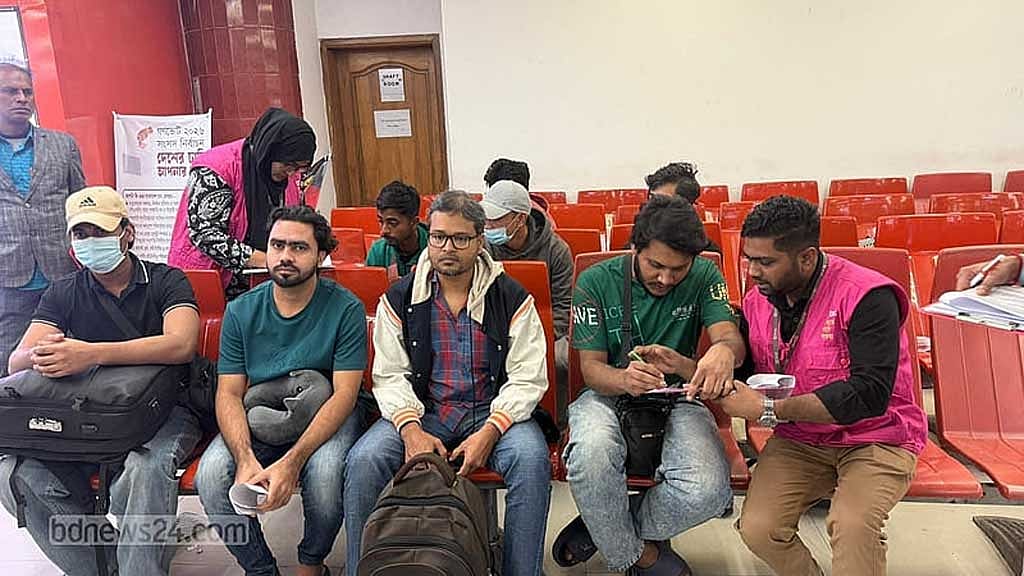
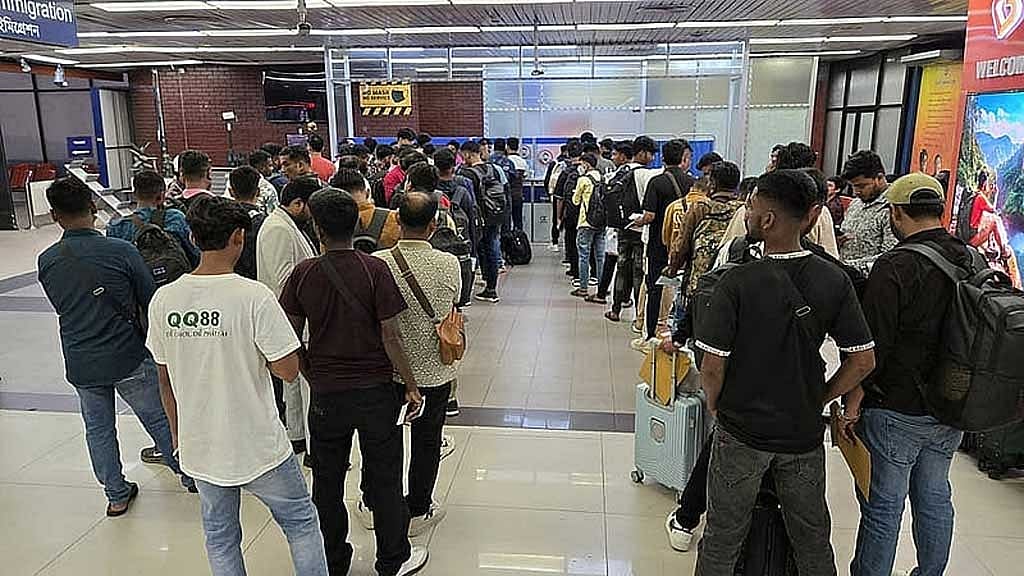
Bangladeshis returning from abroad are also not routinely screened at immigration to determine whether they were trafficking victims.
Government financial assistance is available only to regular migrants, meaning people who travelled through irregular channels may have to pay for their own return.
That can push already indebted victims deeper into debt and increase the risk that they are trafficked again.
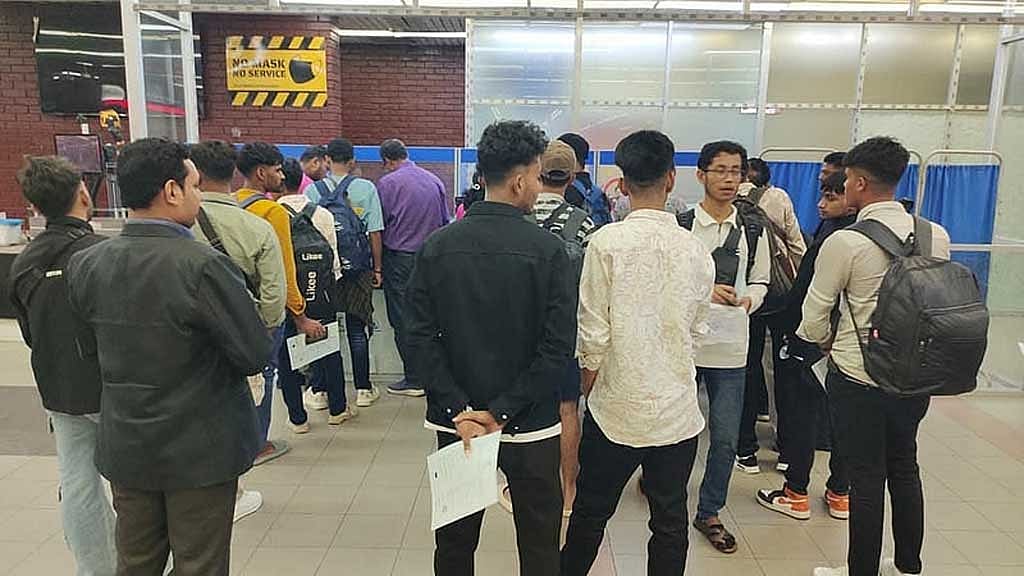
Although the law contains provisions intended to protect victims who were forced to commit crimes, the absence of an effective process means some victims can themselves end up facing criminal cases.
One of those whose life has been devastated by a Cambodia-based trafficking and cyber scam network is Ibrahim Khalilullah from Sonargaon in Narayanganj.
Ibrahim told bdnews24.com that he and his cousin-in-law Fahim Molla travelled to Cambodia in December 2025 after being promised good jobs in a restaurant.
A broker named Rabbi Hasan offered them what appeared to be attractive employment and benefits.
To make the journey, Ibrahim borrowed Tk 400,000 from a bank and another Tk 200,000 from his father-in-law, paying a total of Tk 600,000.
But after reaching Cambodia, he said, there was no restaurant job. Instead, they were confined inside a cyber scam centre and held hostage.
After almost three months of severe hardship, they returned to Bangladesh on Sept 3 after paying substantial amounts for tickets and accommodation.
Coming home did not end Ibrahim’s ordeal. While he was abroad, one of his children, aged 13, died. Another child was recently born.
With interest accumulating on his bank loan, Ibrahim says his debts have now climbed beyond about Tk 450,000.
Pressure from creditors has left him facing what he describes as an acute psychological and social crisis.
He also alleges that when he sought legal redress after returning from Cambodia, he encountered further harassment.
‘A Very Difficult Situation’
Tasneem Siddiqui, executive director of the Refugee and Migratory Movements Research Unit (RMMRU), has called for urgent action to stop irregular migration driven by cyber scam recruitment and fraudulent online job offers.
“This is taking us into an extremely difficult situation,” she told bdnews24.com.
Tasneem said Bangladesh needed a strong public information campaign across television, radio and other media warning jobseekers not to accept overseas employment offers without verification by the Bureau of Manpower, Employment and Training (BMET) and the relevant ministry.
She said even jobs found online or arranged privately outside the conventional BMET clearance system should require prior authorisation from a designated government body, such as the foreign or education ministry.
“Even where a job is secured individually or online outside the conventional BMET clearance system, prior approval or clearance from a designated government authority should be made mandatory,” she said.
Tasneem Siddiqui also called for bilateral talks with Southeast Asian countries where scam centres operate, alongside action through international forums to jointly identify those responsible and hold them accountable.
She drew a comparison with an earlier trafficking disaster in the region.
“In 2014, trafficking by sea towards the Thailand-Malaysia border led to the discovery of mass graves,” she said.
“These digital scams are a modern form of similar trafficking, this time targeting more educated people. The issue therefore needs to be raised urgently and seriously in global forums.”
UNODC also makes several recommendations.
It calls for real-time information-sharing between South and Southeast Asian countries through BIMSTEC — the seven-member regional economic cooperation grouping around the Bay of Bengal — and Interpol.
It recommends targeted campaigns warning migrants about fraudulent overseas recruitment advertisements.
And it urges for greater use of digital and financial intelligence to disrupt informal money-transfer networks and cryptocurrency channels used by the criminal groups.
What is the Government Doing?
Recent cases have exposed online gambling, digital financial fraud and Telegram-based scam operations inside Bangladesh, with several people, including Chinese nationals, arrested.
But the government does not have specific information showing whether trafficking victims are being used in scam centres operating inside the country.
UNODC notes that Bangladesh is expanding its number of economic zones and high-tech parks.
Criminal organisations have used such economic zones as safe bases in Southeast Asia, but the risk is considered lower in Bangladesh.
There is, however, a potential vulnerability.
Because these zones operate under special legal arrangements, routine monitoring by law enforcement agencies and labour inspectors can be limited.
The two groups uncovered in Cox’s Bazar and Chattogram were reported to have been running, or preparing to run, scam-centre operations from inside Bangladesh.
Asked about the emerging threat, Home Secretary Monjur Morshed Chowdhury said the government had specific plans and programmes, with UNODC support, to prevent young people from being deceived by international criminal networks and to combat cyber scams.
“Various awareness programmes are being conducted jointly towards that goal,” he told bdnews24.com.

Responding to questions over weaknesses in immigration monitoring, Morshed Chowdhury said immigration police and agencies responsible for border security regularly tried to screen people travelling through ports.
But traffickers exploit gaps in apparently legitimate paperwork.
“Fraud networks get through by exploiting loopholes in documents such as valid BMET clearances or certificates, which makes it difficult for immigration officials to stop them,” he said.
In his words, prevention depends heavily on awareness.
“To stop this kind of fraud completely, the most important thing is to increase awareness among young people travelling abroad and those who could potentially become victims,” he said.
“To counter these fraudulent campaigns and warn citizens, cooperation from all sides, including the media, is necessary.”
He said the government planned to launch larger awareness campaigns with UNODC in future.
Ziauddin Ahmed, additional secretary at the home ministry’s emigration wing, said the authorities were alert to the threat.
“We are aware of the issue and are trying to destroy it at the root,” he said. “This report has been useful to us in that effort.”