Published : 25 Sep 2026, 12:03 PM
Updated : 25 Sep 2026, 12:28 PM


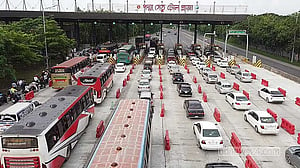
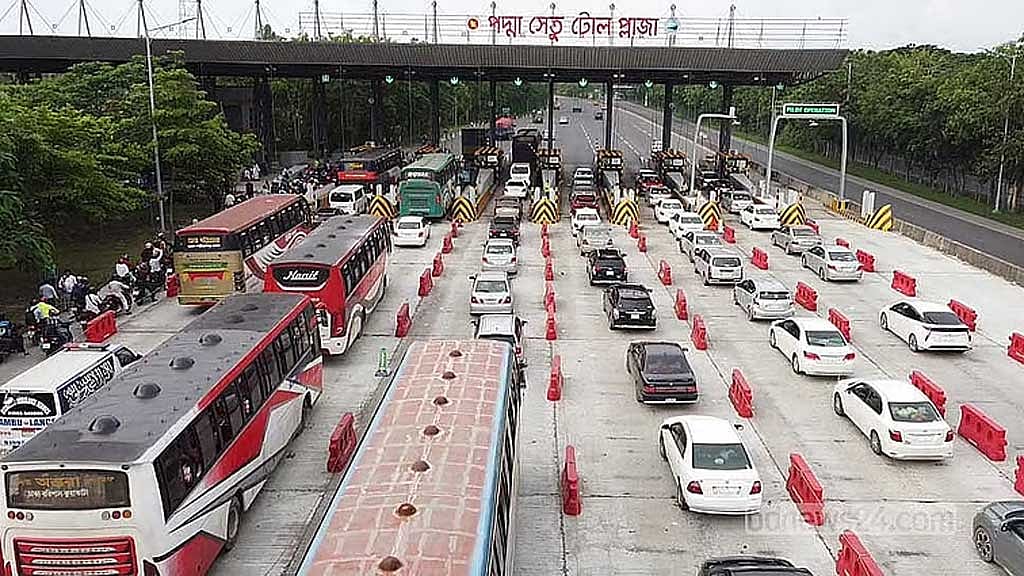
Every day, drivers and passengers crossing bridges and highways across Bangladesh face the same frustrating ritual: stopping at toll plazas, paying cash to unknown contractors, and receiving little or no explanation of where that money goes.
The recent events at Balipara Bridge in Mymensingh's Trishal are not a one-off.
They are a symptom of a much deeper illness in Bangladesh's toll collection system -- a system that has been amended twice, in 2014 and 2024, yet remains stubbornly opaque, politically captured, and fundamentally unfair to ordinary people.
The incidents at Balipara Bridge tell a familiar story. Local residents and transport drivers blocked the Trishal-Nandail road on Sept 17, protesting what they said was illegal toll collection that had been imposed without transparency or accountability.
The prompt intervention of State Minister for Information and Broadcasting Yasser Khan Choudhury calmed the situation and brought relief to the protesters. He directed that all toll collection activities be halted completely.
Subsequently, the Roads and Highways Department (RHD) executive engineer of the respective area admitted the toll was illegal and promised action. But why did it take a public protest to stop something that was never legal in the first place?
The answer lies in a system that has been allowed to operate without oversight, where toll collection contracts have become a form of political patronage rather than a public service.
Bangladesh's toll policy, revised in July 2024, was designed with a simple premise: bridges longer than 200 meters should collect tolls to cover maintenance costs. On paper, this makes sense.
In practice, it has created a sprawling network of toll points -- 67 bridges and four roads under the Roads and Highways Department alone -- many of which have already recovered their construction costs several times over.
In addition, tolls are also collected from two large mega structures like the Padma Bridge and Jamuna Bridge (Bangabandhu Bridge) under the Bangladesh Bridge Authority.
According to reports, the RHD earns over Tk 10 billion annually in tolls from these 67 bridges and four roads while spending only about Tk 2 billion on contractors and lessees.
State agencies make public the toll amounts collected from mega bridges but do not publish regular toll figures for the other bridges. For transparency, the relevant authorities must publish daily toll statements on their websites.
The 2014 toll policy set base tolls ranging from Tk 100 to Tk 400, with increases based on vehicle type and bridge length.
Crucially, it imposed no time limit on toll collection. This means bridges can continue charging users indefinitely, long after construction costs have been recovered.
The math is clear: the public is paying far more than what is needed to maintain these bridges. The 2024 revision did not fix this fundamental flaw. It also did not address the most corrosive element of the system: the political capture of toll collection contracts.
During the 15-year rule of the previous government, a large portion of toll collection contracts reportedly went to local party leaders, their family members and relatives.
In some cases, contractors with reported links to ministers, MPs and other influential political figures secured toll collection contracts.
The result was predictable: a system vulnerable to embezzlement, underreporting of revenue and private profiteering from public infrastructure.
The Anti-Corruption Commission's recent case against a former prime minister and others over irregularities in a bridge toll contract is a stark reminder of how deeply this corruption runs.
Bangladesh does not have to look too far to find better models.
India, Pakistan, and China have all taken significant steps toward more transparent and efficient toll systems, and their experiences offer valuable lessons.
India's transformation of toll collection is perhaps the most relevant example. The country has implemented FASTag, an electronic toll collection system that uses radio frequency identification technology.
As of 2026, over 98 percent of user fee collection on India's national highways takes place through FASTag.
Every transaction is recorded in a central repository, and the deducted amount is communicated to the user.
This creates a transparent, auditable trail that makes it difficult for revenue to disappear into private pockets.
India has also introduced an annual pass for eligible non-commercial vehicles, offering up to 200 trips or one year's use, whichever comes first, for a fixed fee to reduce the burden on regular commuters.
The system is not perfect, but it has dramatically reduced cash handling and the opportunities for corruption that come with it.
Pakistan has taken a different but equally instructive approach.
The National Highway Authority uses e-bidding and open auctions for toll collection contracts, with procurement rules intended to encourage competition and improve transparency in revenue collection.
In Punjab province, the government has decided to digitise all 41 toll plazas, equipping them with M-Tag facilities to eliminate overcharging and ensure transparent payments. Pakistan's experience shows that even in challenging political environments, incremental reforms -- particularly the shift to electronic payment systems -- can make a real difference.
China offers a longer-term perspective. The country has been revising its highway law to improve the management of toll roads, with a focus on public consultation and transparent pricing.
A key provision in the draft revision would require provincial governments to review and approve toll rates, rather than leaving this to transportation departments and pricing authorities.
China has also been grappling with the question of what happens when toll roads reach the end of their concession periods.
A draft amendment to the country's Highway Law proposes that once repayment or operating periods expire, highways should come under government management, with tolls collected only if necessary and with rates subject to provincial approval.
This is a crucial principle: tolls should be a temporary mechanism for cost recovery, not a permanent tax on road users.
Beyond Asia, countries like Kenya and Indonesia have also made transparency a central pillar of their toll policies.
Kenya's proposed National Tolling Policy explicitly states that the tolling system should be transparent, with clear information provided to users about how toll rates are set, collected, and where revenues are allocated.
Indonesia's 2024 toll road regulation emphasises transparent, accountable, and fair toll road management.
In South Africa, the national roads agency publishes audited toll revenue figures, while independent monitoring systems provide oversight of traffic volumes and toll collection.
These examples demonstrate that transparency is not a luxury -- it is a fundamental requirement for public trust.
Bangladesh's toll system needs more than cosmetic changes. It needs a fundamental reorientation away from revenue extraction and toward public service. Here are several steps that could make a real difference.
First, digitise the entire toll collection system. Bangladesh is already a global leader in mobile financial services, with platforms like bKash and Nagad used by millions of people.
Integrating these systems into toll collection is not only feasible but overdue. Every transaction would be recorded digitally, creating a real-time, auditable trail of revenue.
Authorities could monitor collections centrally, identify discrepancies, and minimise revenue leakage. More importantly, aggregated data could be made publicly available through dashboards, allowing citizens to see how much is being collected and where it is being spent.
Second, end the practice of awarding toll collection contracts to political cronies. The e-bidding system introduced in Pakistan offers a useful model.
Contracts should be awarded through open, competitive tenders, with clear criteria and public disclosure of the winning bidders.
The ACC's Meghna-Gomti case shows what happens when this principle is ignored.
The government should also consider directly managing toll collection through a dedicated, professionally managed agency, rather than outsourcing it to private contractors whose primary motivation is profit.
Third, introduce time limits on toll collection. Bridges that have recovered their construction costs should be made toll-free. The 2024 revised guidelines' failure to specify a time limit has allowed tolls to continue indefinitely, long after the original investment has been repaid.
A clear sunset clause -- for example, tolls should be collected for a maximum of 15 years after construction, or until construction costs plus a reasonable return are recovered -- would ensure that the public does not continue paying for infrastructure that has already been paid for.
Fourth, protect the poor. Tolls are regressive: they take a larger share of income from poor households than from wealthy ones.
The government should consider exempting local residents who use bridges regularly or charging them only nominal fees.
It could also explore the possibility of collecting additional taxes from wealthy individuals and businesses that benefit disproportionately from improved infrastructure.
The existing policy allows the government to reduce, increase, or waive toll rates by gazette notification, taking into account the location of the installation.
This provision should be used more aggressively to ease the burden on poor communities.
The protests at Balipara Bridge are a warning sign. When people take to the streets to protest illegal toll collection, it means the system has lost all legitimacy.
Bangladesh cannot afford to continue taxing its citizens for infrastructure that should serve them.
The country has the technology, the expertise, and the examples from other nations to build a better system. What it needs now is the political will to put the public interest ahead of private profit.
A transparent, accountable, and fair toll system is not just good governance -- it is a matter of basic economic justice.
[Naim-Ul-Karim Sanchaya is a journalist]