Published : 04 Oct 2026, 09:25 PM
Updated : 04 Oct 2026, 09:25 PM


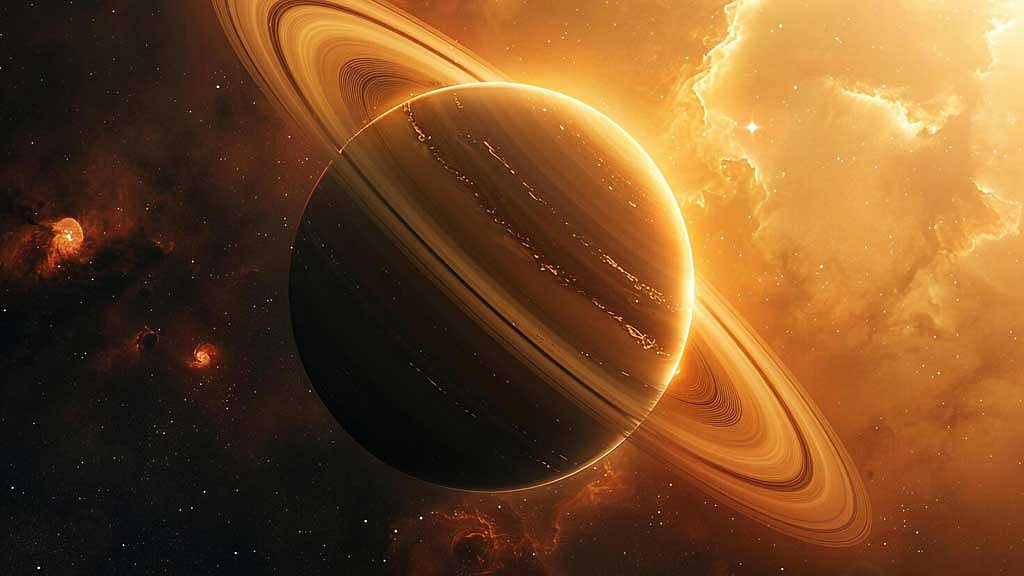
Saturn has reached opposition on Oct 4, giving skywatchers an opportunity to observe the ringed planet throughout the night, according to Astronomy.
The planet reached opposition at 8am EDT (6pm Bangladesh time), when Earth passed between Saturn and the Sun, making the planet appear particularly prominent in the night sky.
Astronomy reported that Saturn is now visible from around sunset until sunrise in the constellation Cetus, near the northern boundary with Pisces.
At magnitude 0.3, Saturn is the brightest point of light in that part of the sky, the astronomy publication noted. Around midnight, it appears high above the southern horizon, below the Great Square of Pegasus and to the upper left of Fomalhaut.
Saturn's disk currently spans about 20 arcseconds, while its rings stretch nearly 45 arcseconds from end to end. The southern side of the rings and the planet's south pole are visible because Saturn is tilted about 7 degrees towards Earth's line of sight, said the space news website.
The planet's largest moon, Titan, remains visible to the east of Saturn, while Tethys, Rhea and Dione can also be observed with a telescope. According to Astronomy, Tethys will reappear from behind Saturn's southeastern edge at about 8:20pm EDT (6:20am BST on Oct 5) after an occultation.
According to Astronomy, Rhea will move south of Saturn between about 1am and 3am EDT (11am and 1pm BST), while Dione will disappear behind the planet at about 6:40am MDT (6:40pm Bangladesh time).
The latter event is expected to be most suitable for observers on the US West Coast, where darkness may still prevail.
The report also highlighted another sky event on Oct 5, when the Moon will pass about 1.2 degrees north of Mars at around 2am EDT (12pm BST). Mars, currently shining at magnitude 1.1, will appear in Cancer alongside the waning crescent Moon.
Astronomy added the Moon will also pass through the outskirts of the Beehive Cluster, or M44, with the event beginning around 5am EDT (3pm BST).
The Moon will take about four hours to cross the northern part of the cluster, with binoculars or a telescope offering the best chance of seeing stars disappear and reappear along its edge.