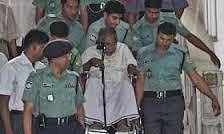
Witness ties Alim to young men's killing
The prosecution witness testifies before the second war crimes tribunal
bdnews24.com News Service
bdnews24.com
Published :
04 Sep 2012, 11:13 AM
Updated :
09 Aug 2022, 04:12 PM
Dhaka, Sep 4 (bdnews24.com) — A prosecution witness has given detailed descriptions of former BNP minister Abdul Alim's involvement with the execution of young men during the 1971 Liberation War.
Testifying as the second witness, a former Defence Ministry employee told the second war crimes tribunal about several incidents where he put the former BNP leader as a key player in his native Joypurhat.
The three-judge International Crimes Tribunal – 2, set up to expedite the war crimes trials, indicted Abdul Alim for 17 war crimes charges on Jun 11.
The retired government employee, 67-year Syedur Rahman, said Alim was instrumental in founding the Peace Committee of Joypurhat around mid-April. "He then ordered formation of peace committees under all other upazilas of the district."
Subsequently, Abdul Alim also founded the local Razakar unit. "He used to recruit members at the ground floor of his house."
The Razakars, a vigilante militia group, are alleged to have played a significant role collaborating with the Pakistani Army and thwarting the liberation efforts. They are also widely held responsible for many atrocities across Bangladesh during the war.
The witness said that Abdul Alim had also secured offices for the Razakars and Peace Committee in Joypurhat. He had also arranged for accommodating an army camp and living quarters for the local commander one Major Afzal Beg.
The witness hailing from Akkilpur, said when a group of about 13-14 people tried to flee to India, they were lured by the local chairman, an ally of Alim.
"Syed Ali, the local union Chairman lured them to his house saying that it had already become dark and they could stay the night at his house."
But once these men were inside, the Chairman locked them and sent for Alim. The next day on May 8, 1971, Abdul Alim arrived with a group of Pakistani soldiers.
They handed over three to the Pak troops and another 10 were taken to the local railway station and confined in the waiting room.
"I sneaked up from behind and spoke to one of those 10 through a back window," said the witness.
Abdus Salam, a childhood friend of the witness, described the events till that point in much detail.
"The trio that had been handed over to the Pakistani Army were taken to Khanjanpur's Kuthibari Ghat and shot at the behest of Abdul Alim," said Syedur Rahman.
The remaining 10 were later also handed over to the Pakistani soldiers. They were lined up and shot beside a nearby pond. "But one of them survived. He was wounded though."
"And do you know who he is?" asked tribunal member Justice Obaidul Hassan.
The witness said, "Probably Mofazzal Hossain."
In another incident, 15 youths were ties with trees and beaten severely. They were then made to dig their graves and shot dead, all of this at the insistence of Abdul Alim, said the witness.
Syedur Rahman also saw 26 young men rounded up near the Joypurhat railway station ticket counter when he went to the town towards end of June in 1971.
He said he had seen Abdul Alim and Major Afzal take a picture with their prisoners. This photo had apparently been taken by owner of a local photo studio, one Mottasir Billa.
It was at his point that the photograph, seized by the case investigator in his presence, was made an exhibit.
Syedur Rahman described another incident of Oct 8 where three young men with their faces blackened, for attempting to join the war, were taken on rounds around the town at the order of Abdul Alim. This came with the caution that people attempting to join the war would suffer the same fate.
The three were later executed. "One of them was Fazlul Karim, from Akkilpur."
When asked by the tribunal whether had seen these incidents, Syedur Rahman said, "Some I have seen, some I heard."
This was followed by a brief cross-examination by Munshi Ahsan Kabir, with the Alim's regular trial lawyer Abu Yousuf Mohammad Khalilur Rahman absent due to a family crisis.
At the first war crimes tribunal, the first prosecution witness against Jamaat-e-Islami chief Motiur Rahman Nizami faced the defence counsel for the third time, and it is set to resume on Sep 16.
BNP MP Salauddin Quader Chowdhury's counsel completed cross-examination of Nurul Absar, the tenth prosecution witness, who said his attempt to kill the BNP leader during the war resulted in killing Chowdhury's car driver instead.
bdnews24.com/ta/nir/1704h