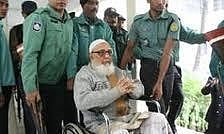
Ghulam Azam's defence lists 4 witnesses
It backtracks from its position not to disclose the names of witnesses, faced with a 'stiff alternative'.
bdnews24.com News Service
bdnews24.com
Published :
15 Oct 2012, 02:58 PM
Updated :
09 Aug 2022, 04:22 PM
Dhaka, Oct 15 (bdnews24.com)—Jamaat-e-Islami guru Ghulam Azam's defence on Monday submitted a handwritten list of four defence witnesses backtracking from its position not to disclose the names of witnesses.
The first war crimes tribunal of Bangladesh had ordered the defence lawyers to submit names of 12 witnesses that they intended to put on the stand against the prosecution's 16, including the war crimes investigator.
The defence had earlier submitted a list of almost 3,000 witnesses — 2,939 to be exact — for the former Jamaat chief.
Azam is alleged to have played a pivotal role in organising the infamous Peace Committee, a social front for notorious vigilante militia groups like Al Badr, Al Shams and Razakar, which were in turn dominated by Jamaat members and their student cadres from the Islami Chhatra Sangha.
The three-judge International Crimes Tribunal -1, set up to try crimes against humanity during the 1971 Liberation War, indicted the Jamaat man on May 13 for complicity, incitement, conspiracy and abetment to war crimes.
Azam's senior defence counsel Mizanul Islam, who has been leading the trials of most Jamaat leaders, filed an application moving the court to recall its order directing the defence to submit part of the witness list on Tuesday and the rest on Wednesday.
The counsel argued that the prosecution had not disclosed the names of their 16 witnesses out of the 88 that it had initially given with the records and documents just as the trial began. "We will give the witness names two days before they are scheduled to take the stand."
Tribunal Chairman Justice Mohammad Nizamul Huq said, "But you don't mention that in the petition."
"It says in 'due course' but not two days specifically," replied the counsel.
The Chairman stiffly said, "Fine then, you also provide particulars of your witnesses particulars by tomorrow. That is the order. The application is disposed of."
The prosecution, as part of its obligation, provides full details of the witnesses along with their statements to the court and the defence.
The defence counsel was taken aback at the tribunal chief's tone and said, "But you are only saying that out of anger, my lord."
"The prosecution has given witness particulars. You also do the same then," said Justice Huq.
"But you are angry," said Mizanul Islam.
"No I am not angry," said the tribunal chief and continued, "Let me tell you something Mr Mizanul Islam. You should not consider the court your adversary."
"I certainly don't," replied Mizanul Islam looking to placate the tribunal in any way he could.
"We believe so too," Justice Huq said. "And let us keep that view."
The defence counsel, finally seeing some light, said he had two names and would be able to give a few more by the end of the day.
Justice Huq had obviously backtracked from earlier position. "Do cooperate with the tribunal. Submit as many names as you can. Show us that you are cooperating."
The judge told the counsel his efforts should at least show that the defence has at least begun to comply with the order. "Give us as many names as you can and say that you could not decide upon the rest."
The conducting prosecutor of Azam's case, Zead-Al-Malum stood up to suggest that the court reject the application and then decide on the next course of action.
He cited a relevant provision to point out that the court had ample powers to do what it pleased in this regard. Thus, according to Malum, the court could accept the names as it pleased but had to reject the petition.
However, it was clear that the tribunal would still give the defence until the end of the day for giving some witnesses' names.
Malum was not content with the handwritten list and brought it to the attention of the tribunal saying that it was the first such a list, indicating the lack of propriety, was being submitted to the court.
In reply, the defence counsel said he would come with an appropriate petition on Tuesday.
Ring ring again
Prosecutor Zead-Al-Malum's mobile phone rang out while Jamaat leader Delwar Hossain Sayedee's son, Masood, was submitting exhibits at the court on Monday.
With more than half the court room empty, the 'surround sound' chime rang through the length and breadth of the court room.
The prosecutor was seen silencing it and putting it back into his pocket.
Barely two weeks back on Oct 2, one of Malum's witnesses had carried a mobile phone to the stand and it rang out several times.
Tuesday was Malum's second time with a ringing mobile in his pocket. The other time was the only time that the tribunal Chairman acknowledged a ringing mobile and mildly admonished the prosecutor on Jul 10, during cross-examination of a witness.
Justice Huq had said, "If you have to answer that, go out. The door is always open."
Embarrassed, the prosecutor stood up and said, "I have silenced it, my lord."
There was no further discussion and proceedings continued on Jul 10. On Tuesday, the tribunal chose to ignore the infraction of its order of Dec 15, 2011 when Justice Huq had forbidden everyone, including the police officials and the prosecutors, from carrying cell phones into the court room.
Jamaat Guru in ICT-1
On Dec 12, 2011, the prosecution brought a 52-point charter of charges against Azam and appealed for his arrest. Later, following the tribunal order, charges were re-arranged and presented to the tribunal on Jan 5.
He was produced before the tribunal on Jan 11 and sent to jail the same day. Since that evening, the 89-year old former Carmichael College professor has been kept at the prison cell of the Bangabandhu Sheikh Mujib Medical University for better treatment considering his delicate health.
A former chief of Jamaat-e-Islami, arguably the largest Islamist organisation in the subcontinent, Azam is allegedly among the key people who pioneered anti-liberation efforts in 1971 colluding with the Pakistani military junta of that time.
He is widely perceived to have been among core group of right-wing supporters of the Pakistani Army, who came out strongly in support of a united Pakistan.
Ghulam Azam, then chief of Jamaat, was instrumental in setting up the infamous Peace Committee at the national level. The Razakars, an auxiliary force set up mainly to actively thwart the liberation forces, are said to have been mobilised through the Peace Committees across Bangladesh.
Among the most notorious vigilante militia are the Al Badr, whose membership is said to have been mainly dominated by the Jamaat's student wing called the Islami Chhatra Sangha at that time.
The Al Badr is alleged to have spearheaded execution of the intellectual elites of Bangladesh just days before the victory on Dec 16, 1971.
Azam also spoke in favour of Pakistan to the Middle Eastern countries during the war, according to the prosecution.
He stayed in London for seven years after 1971 and returned to Bangladesh in 1978 during BNP founder Ziaur Rahman's rule. Having led Jamaat for long, Azam retired from active politics in 1999.
His party remains a key ally of the main opposition BNP. Two Jamaat leaders, also behind bars for war crimes charges, have even served as ministers during the BNP's last tenure in government between 2001 and 2006, when Azam's party was part of the ruling coalition.
Azam was indicted on five charges including incitement, conspiracy and abetment.
bdnews24.com/ta/bd/2033h